INSIGHTS
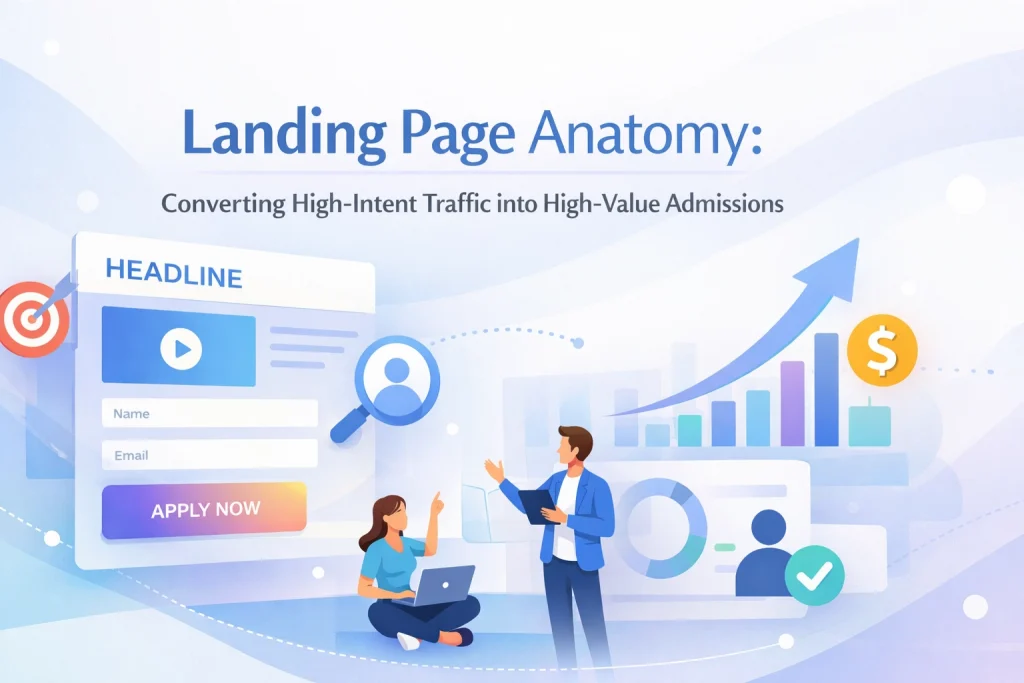
Landing Page Anatomy: Converting High-Intent Traffic into High-Value Admissions
You’ve seen the numbers. You’re spending thousands: perhaps tens of thousands: on Google Ads and high-intent SEO strategies. The traffic is hitting your site. You see the clicks in your dashboard, and you see the budget depleting in real-time. But then, the phone doesn't ring. Or worse, it rings, but the quality of the lead is so low that your intake team spends all day chasing ghosts.
In the behavioral health industry, we often talk about the "leaky bucket." You can pour as much water (traffic) as you want into the top, but if the bottom is full of holes, you’re just wasting resources. In 2026, the cost per admission (CPA) has reached heights that would have seemed impossible five years ago. According to recent industry benchmarks, the average CPA in addiction treatment can fluctuate wildly based on your digital infrastructure.
If your landing page isn't scientifically designed to convert a person in crisis, you aren't just losing a click; you’re losing a life and a high-value admission. Let's break down the anatomy of a landing page that actually converts.
The 3-Second Rule: Clarity Over Creativity
When someone lands on your page, especially in the addiction or mental health space, they are often in a state of high stress. They might be a parent looking for help for a child at 3 AM, or an individual who has finally hit a breaking point.
They don't want to see a generic, slow-loading video of a sunset. They need to know three things within three seconds:
- Are you the right place for my specific problem?
- Do you take my insurance?
- How do I talk to a human being right now?
Your Headline and Value Proposition must be front and center. Instead of "A Path to Healing," try something more direct: "Dual-Diagnosis Inpatient Treatment in South Florida – Most Private Insurance Accepted."

Visual Hierarchy and the "F" Pattern
Human beings scan web pages in an "F" pattern. They look across the top, then down the left side, then across again. If your most important information: your phone number, your VOB (Verification of Benefits) form, and your accreditation badges: isn't in those eye-path zones, you’re invisible.
The Hero Section Essentials:
- A Clear CTA: Your "Call Now" button should be a contrasting color. Don't make it blend in with your branding; make it pop.
- The Phone Number: It must be click-to-call. In 2026, over 80% of your high-intent traffic is coming from mobile devices. If they have to copy and paste your number, they’ve already moved on to the next facility in the search results.
- Trust Signals: LegitScript monitoring, Joint Commission gold seals, and NAATP memberships should be visible "above the fold."
Trust as a Currency: Why Credibility Wins Admissions
In healthcare marketing, trust isn't just a "nice to have": it’s the only thing that matters. You are asking someone to trust you with their life or the life of a loved one. This is why the psychology of first impressions is so critical.
I’ve seen facilities use stock photos of "happy people in a field." Stop doing that. It feels clinical, fake, and untrustworthy. Instead, show your facility. Show your medical director. Research consistently shows that showing your medical team reduces pre-admission anxiety. It puts a human face to the clinical expertise.
Compliance and Transparency
The regulatory landscape has shifted significantly. Navigating LegitScript and rehab advertising complexities requires a landing page that is not only persuasive but also perfectly compliant. Transparency acts as your shield; clear disclosures about your level of care and your location actually improve your ad approval rates.
The VOB Bottleneck: The Silent Killer of Conversions
One of the biggest mistakes we see at Ads Up Marketing is a landing page that leads to a dead end. If your "Verify Insurance" form has 20 fields, you are going to lose 90% of your prospects.
You need to streamline this. Ask for the essentials: Name, Phone, Insurance Provider, and Member ID. Every extra field you add decreases your conversion rate by an estimated 5-10%. We often tell our clients that their VOB process is their biggest marketing bottleneck. If the landing page does its job but the form is too daunting, the "High-Value Admission" disappears before it even reaches your CRM.
Performance Impact: Optimized vs. Non-Optimized Landing Pages
To understand the ROI of professional landing page design, look at the data below. This represents a typical mid-sized facility spending $20,000 per month on Google Ads.
| Metric | Standard Website Page | Optimized Landing Page | Improvement |
|---|---|---|---|
| Conversion Rate (Lead) | 2.5% | 8.2% | +228% |
| Cost Per Lead (CPL) | $200 | $61 | -69.5% |
| VOB Submission Rate | 1.2% | 4.5% | +275% |
| Projected Admissions/Mo | 2-3 | 7-9 | ~3x Increase |
| Cost Per Admission (CPA) | $8,000 | $2,500 | -68.7% |
Note: Data based on average performance benchmarks for behavioral health centers in 2025-2026. For a deeper dive into these numbers, see our guide on Cost Per Admission vs. Cost Per Lead.
Mobile Speed: The Technical Bedrock
I know you’ve heard it before, but let me be direct: If your page takes longer than 2.5 seconds to load on a 4G connection, you are effectively throwing your ad budget into a paper shredder. High-intent traffic is impatient. A person in a 3 AM crisis call scenario isn't going to wait for your high-res hero video to buffer.
Use Google’s PageSpeed Insights. Optimize your images. Minimize your Javascript. If you aren't sure how to do this, that’s exactly where we come in. At Ads Up Marketing, we build landing pages that are lightning-fast because we know that speed equals admissions.

Addressing Objections Before They Are Asked
Your landing page copy should act as a silent intake specialist. What are the common reasons people hesitate?
- "Can I afford this?"
- "Will I lose my job?"
- "Is the facility clean?"
- "Do they treat my specific addiction?"
By using a "Frequently Asked Questions" section near the bottom of your landing page, you can handle these objections. This keeps the user on the page and moves them closer to the "Call" button. Furthermore, highlighting your adherence to HIPAA and patient privacy in your digital strategy provides an additional layer of security for the prospect.
Tracking the Full Patient Journey
A landing page is only as good as the data it produces. You need to know which keywords led to the call and which calls led to an admission. In 2026, we use advanced tracking to see the full patient journey. If you aren't connecting your landing page hits to your CRM data, you're flying blind.
Are you looking at your marketing KPIs through a lens of guesswork or data? If you don't know your exact conversion rate from click-to-call and call-to-VOB, you can't scale your facility effectively.
Why You Need Professional Intervention
You’re an expert at clinical care. You know how to save lives and manage a facility. But the digital landscape for treatment centers is more competitive and regulated than ever. Between navigating AI in rehab marketing and keeping up with evolving harm reduction legal frameworks, it’s a full-time job just to keep your ads running.
Building a landing page that converts isn't about "making it look pretty." It’s about behavioral psychology, technical SEO, and conversion rate optimization (CRO).
If your current marketing isn't delivering the high-value admissions you need to hit your 50-bed milestone, it’s time to look at your landing page anatomy.
Stop letting high-intent traffic slip through the cracks. Let’s fix your leaky bucket and start turning those clicks into the lives you’re meant to save.
Ready to transform your digital presence? Call us today at 305-539-7114 to audit your current landing pages and see where you’re leaving admissions on the table.