
INSIGHTS
Cost-Per-Admission vs. Cost-Per-Lead: Which Number Truly Matters?
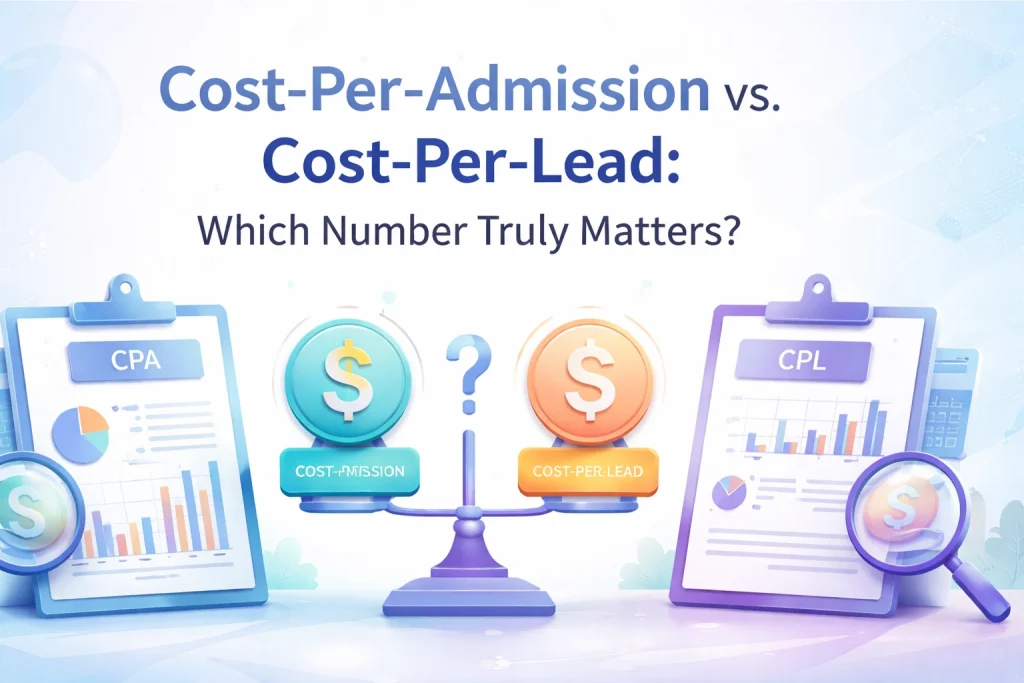
You're staring at your marketing dashboard, and honestly? The numbers are starting to blur together. Your team's celebrating because leads are pouring in at $150 a pop. But here's the thing, your census hasn't budged in weeks. Sound familiar?
If you're running a treatment center, you've probably heard both terms thrown around: Cost-Per-Lead (CPL) and Cost-Per-Admission (CPA). Marketing agencies love to flex low CPL numbers. It sounds impressive in reports. But does a cheaper lead actually mean anything if those leads never convert to actual admissions?
Let's break this down so you know exactly which metric deserves your attention, and more importantly, your budget.
What Exactly Is Cost-Per-Lead?
Cost-Per-Lead is pretty straightforward. It's the amount you spend to generate a single inquiry or form submission. Someone fills out your contact form, calls your admissions line, or downloads your insurance verification, that's a lead.
Here's the math: Total Marketing Spend ÷ Number of Leads = CPL
For healthcare and treatment centers, CPL typically ranges from $25 to $300 depending on your channel mix and specialty, according to industry benchmarks. Google Ads tends to run higher than organic traffic. Social media sits somewhere in the middle.
CPL tells you how efficiently your marketing engine is running at the top of the funnel. It's useful for comparing channels, like, is your Facebook campaign generating cheaper leads than your PPC? That kind of thing.

And Cost-Per-Admission?
Now we're getting to the number that actually affects your bottom line. Cost-Per-Admission measures what it truly costs to get a patient through your doors and into treatment.
The formula: Total Marketing Spend ÷ Number of Admissions = CPA
This metric accounts for everything, the initial click, the lead generation, the admissions follow-up, the verification dance with insurance, and finally, the actual enrollment. According to SAMHSA's treatment facility data, operational costs vary significantly by region and service level, which directly impacts sustainable CPA targets.
For treatment centers specifically, CPA ranges from $1,650 to $12,000 depending on location, level of care, and marketing channels used. That's a massive spread, and it tells you something important: not all leads are created equal.
The Gap Between a Lead and an Admission
Here's where it gets real. Let's say you're generating leads at $500 each. Feels a bit steep, right? But wait, what if 20% of those leads convert to admissions? Your actual CPA is $2,500 per patient.
Now imagine another scenario. Your CPL drops to $200 (nice!), but your conversion rate tanks to 5%. Suddenly your CPA balloons to $4,000.
Lower CPL doesn't automatically mean lower CPA. The conversion rate in between is where everything happens, or falls apart.
| Metric | Scenario A | Scenario B |
|---|---|---|
| Cost-Per-Lead | $500 | $200 |
| Conversion Rate | 20% | 5% |
| Cost-Per-Admission | $2,500 | $4,000 |
| Leads Needed for 10 Admissions | 50 | 200 |
| Total Marketing Spend | $25,000 | $40,000 |
See what happened there? The campaign with the "worse" CPL actually delivered better ROI. This is exactly why chasing cheap leads can backfire spectacularly.
So Which Number Should You Actually Care About?
For strategic decision-making, meaning where you allocate budget, which channels you scale, and whether your marketing is sustainable, Cost-Per-Admission matters more.
Here's why: CPA directly reflects your return on marketing investment. It connects your spending to actual revenue. A treatment center with a patient lifetime value of $15,000 can sustain a $3,000 CPA all day long. But if your CPA creeps up to $10,000, you're leaving very little margin for operations, staffing, and growth.
The National Association of Addiction Treatment Providers (NAATP) emphasizes that sustainable growth in treatment requires understanding true acquisition costs, not just lead volume.

But Don't Ignore CPL Entirely
Now, I'm not saying CPL is useless. Far from it. CPL is your operational metric, it helps you diagnose where your marketing breaks down.
Think of it this way: if CPL spikes on one channel but stays steady everywhere else, you know something's off with that specific campaign. Maybe the targeting shifted, or a competitor started bidding aggressively. CPL gives you that visibility.
CPL also matters for budgeting and cash flow. High-intent leads might cost more upfront, but if your admissions team can close them consistently, that higher CPL pays for itself. We've written about this tension between high-intent leads vs. high-volume traffic if you want to dig deeper.
The Real Problem? Most Centers Track Neither Properly
Here's the honest truth: a lot of treatment centers don't have clean data on either metric. Leads come in through multiple channels. Admissions happen days or weeks later. Attribution gets messy. And suddenly you're making budget decisions based on vibes instead of numbers.
Sound harsh? Maybe. But I've seen it over and over again.
The fix isn't complicated, it just requires discipline:
- Implement proper call tracking so you know which campaigns drive phone inquiries
- Use CRM tagging to follow leads from first touch to admission
- Calculate both metrics monthly and compare trends over time
- Segment by channel so you're not averaging everything into meaningless numbers
If your admissions process isn't optimized, even perfect marketing won't save your census. The whole funnel needs to work together.

How to Actually Lower Your Cost-Per-Admission
Alright, let's get practical. Here are the levers you can pull:
1. Improve Lead Quality (Even If CPL Goes Up)
Targeting people actively searching for treatment beats targeting anyone who might sorta kinda be interested. Yes, high-intent keywords cost more. But they convert way better.
2. Speed Up Your Admissions Response
Data from NIDA and treatment outcome studies consistently show that faster intervention improves engagement. Leads that sit for 24+ hours go cold. Aim for contact within 15 minutes.
3. Fix Your Verification Process
Insurance verification bottlenecks kill conversions. If families have to wait days to know if they're covered, they'll call the next facility on their list. Streamline this or outsource it.
4. Train Your Admissions Team
Marketing can only do so much. If your team doesn't know how to handle objections, build rapport, and guide families through a scary decision, leads leak out the bottom of your funnel.
5. Audit Your Marketing Channels Quarterly
What worked last year might be bleeding money now. Review channel performance against CPA: not just CPL: and reallocate accordingly.
We've covered some of these common marketing mistakes in more detail if you're curious where your gaps might be.
Why This Matters for Your Bottom Line
Let's zoom out. When you understand the difference between CPL and CPA: and track both properly: you stop making reactive decisions. You stop panicking when leads dip. You stop celebrating when leads spike but admissions don't follow.
Instead, you make strategic moves based on what actually drives revenue.
Treatment centers that nail this typically see:
- 20-30% reduction in wasted ad spend
- Higher census stability month over month
- Better forecasting for hiring and capacity planning
- Improved relationships with marketing partners (because expectations are realistic)
Let's Figure This Out Together
Look, we get it. You didn't get into this business to stare at spreadsheets and debate attribution models. You got into it to help people. But the reality is, sustainable impact requires sustainable operations: and that means knowing your numbers.
At Ads Up Marketing, we specialize in helping treatment centers build marketing systems that focus on actual admissions, not vanity metrics. We'll help you track what matters, optimize what's broken, and scale what works.
If you're tired of wondering whether your marketing is really paying off, let's have a conversation. Call us at 305-539-7114 or visit our site to get started. No pressure, no jargon: just honest answers about what's working and what isn't.
Because at the end of the day, the only number that truly matters is how many people you're helping get into treatment. Everything else is just math to get you there.