INSIGHTS
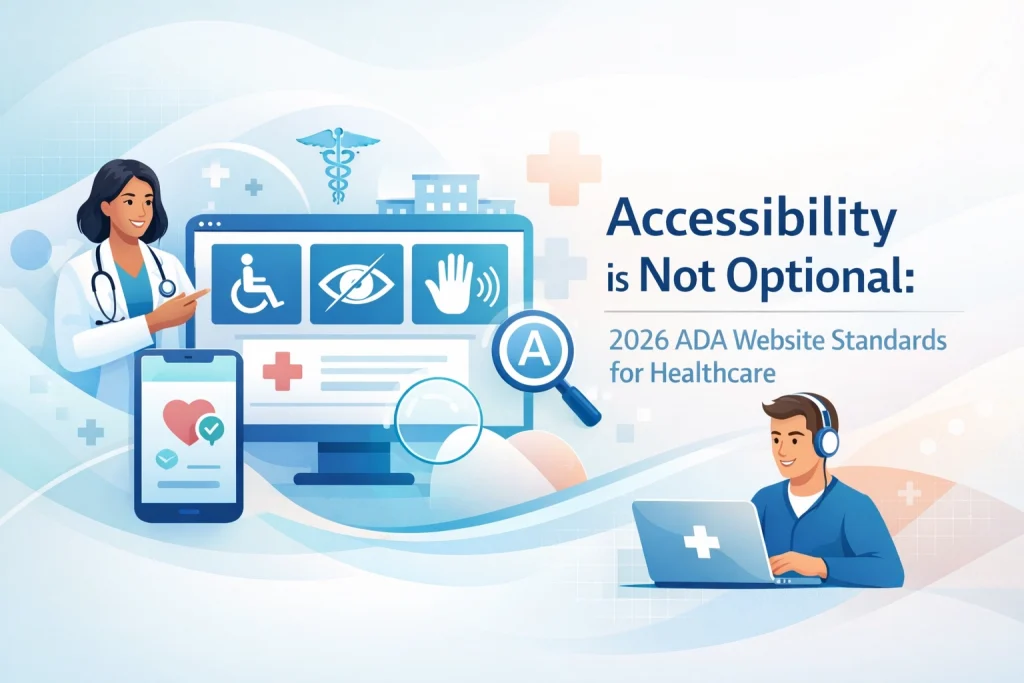
Accessibility is Not Optional: 2026 ADA Website Standards for Healthcare
If you’re running a healthcare facility, a specialized treatment center, or a medical practice, I have a question for you: When was the last time you tried to navigate your own website using only your keyboard? Or better yet, have you ever closed your eyes and tried to book an appointment using a screen reader?
If the answer is "never," you aren't alone: but you might be in trouble.
It is Monday, March 23, 2026. We are exactly seven weeks away from the May 11, 2026 deadline set by the U.S. Department of Health and Human Services (HHS). By that date, the Section 504 final rule mandates that healthcare providers receiving federal financial assistance: including Medicare and Medicaid: must ensure their digital platforms meet strict accessibility standards.
This isn't just a "best practice" anymore. This is a legal requirement with teeth. At Ads Up Marketing, we’ve seen how digital shifts can catch even the best-run facilities off guard. Let’s break down what you need to know to stay compliant and, more importantly, stay accessible to the patients who need you most.
Table of Contents
- The May 2026 Deadline: Why the Clock is Ticking
- What is WCAG 2.1 Level AA?
- The High Cost of Ignoring Accessibility
- Performance Impact: Compliance vs. Non-Compliance
- Key Areas for Healthcare Compliance
- How Ads Up Marketing Secures Your Digital Future
The May 2026 Deadline: Why the Clock is Ticking
For years, digital accessibility was a bit of a "grey area" for many private practices. While the Americans with Disabilities Act (ADA) Title III has always applied to "places of public accommodation," the specific technical standards for websites were often debated in court rather than codified in federal regulation.
That changed on May 9, 2024, when the HHS Office for Civil Rights published the final rule for Section 504 of the Rehabilitation Act.
The mandate is clear: If you have 15 or more employees and you accept federal funding (Medicare, Medicaid, or CHIP), your websites, mobile apps, and even your self-service kiosks must meet WCAG 2.1 Level AA standards by May 11, 2026. Smaller organizations have until 2027, but if you’re looking to grow, waiting is a dangerous game.
According to the HHS Office for Civil Rights, these rules were established because the digital divide in healthcare has become a matter of life and death. From inaccessible lab results to appointment portals that don't work with screen readers, the barriers for the 1 in 4 Americans living with a disability are staggering.

What is WCAG 2.1 Level AA?
The Web Content Accessibility Guidelines (WCAG) 2.1 Level AA is the "gold standard" for digital inclusion. It’s built on four core principles, often referred to by the acronym POUR:
- Perceivable: Users must be able to perceive the information being presented. This means providing alt text for images and captions for videos.
- Operable: Users must be able to operate the interface. Can someone navigate your drug rehab site using only a keyboard or voice commands? They should be able to.
- Understandable: Information and the operation of the user interface must be understandable. Your navigation shouldn't feel like a maze.
- Robust: Content must be robust enough that it can be interpreted reliably by a wide variety of user agents, including assistive technologies like JAWS or NVDA screen readers.
If you’re unsure if your site measures up, you can’t afford to guess. We recommend starting with a free AdWords audit or a full site review to see how your technical foundation stacks up against these 50 testable success criteria.
The High Cost of Ignoring Accessibility
I know what you’re thinking: "Lee, I have a million things on my plate. Is the government really going to come after my website?"
The short answer? Yes. But the government isn't the only one you should worry about.
- Loss of Funding: Non-compliance can lead to the direct loss of federal funding. For most healthcare facilities, losing Medicare/Medicaid eligibility is a death sentence for the business.
- Litigation Exposure: "Drive-by" lawsuits have moved online. Plaintiffs' attorneys now use automated scanning tools to find websites that fail WCAG standards and fire off demand letters by the dozen.
- Loss of Patient Trust: If a potential patient with a visual impairment can’t read your testimonials or book an intake call, they’ll go to a competitor who has made their site accessible.
In the addiction treatment space specifically, harm reduction and accessibility go hand in hand. If someone is in crisis and your website is the barrier between them and help, you’ve failed your mission before the first phone call.
Performance Impact: Compliance vs. Non-Compliance
To give you an idea of the ROI on making these changes, let’s look at how compliance affects your bottom line beyond just avoiding fines.
| Feature | Non-Compliant Site | WCAG 2.1 AA Compliant Site |
|---|---|---|
| Legal Risk | High (Target for ADA lawsuits) | Low (Safe harbor/Good faith effort) |
| Search Engine Optimization | Lower (Google rewards accessibility) | Higher (Clean code = Better crawling) |
| User Experience (UX) | High Bounce Rate (Frustrated users) | Low Bounce Rate (Inclusive Design) |
| Market Reach | Excludes ~25% of the population | Reaches 100% of the population |
| Federal Funding | At Risk of Revocation | Fully Protected |

Key Areas for Healthcare Compliance
When we work on drug rehab marketing and website development, we prioritize three main areas that the HHS has highlighted as critical:
1. Patient Portals
This is where the most sensitive interactions happen. Your login process must work with screen readers. Two-factor authentication (2FA) shouldn't just rely on a visual code; there must be an accessible alternative. Your lab results and medical records need to be in accessible table formats, not just flat PDFs that a screen reader can't "see."
2. Appointment Scheduling and Bill Pay
Can a user with a motor disability schedule an appointment without a mouse? If your scheduling calendar requires "drag and drop" functionality, you are likely out of compliance. Every form field must be properly labeled so that a user knows exactly what they are typing and where.
3. Mobile Applications
The 2026 standards aren't limited to desktop. If your facility has a mobile app for patient tracking or telehealth, it must also meet these accessibility requirements.
For more on how these regulations tie into your overall strategy, check out our guide on transparency as a shield. Clear disclosures aren't just for ads; they are for your entire digital presence.
How Ads Up Marketing Secures Your Digital Future
I know this feels like a lot. Between LegitScript certification, CARF accreditation, and now the 2026 ADA standards, it feels like the goalposts are always moving.
But here’s the thing: you don’t have to do this alone.
At Ads Up Marketing, we don't just build websites; we build compliant, high-converting digital ecosystems. Whether you need a ground-up custom solution or a focused SEO audit to identify accessibility gaps, we have the expertise to ensure you don't wake up on May 12, 2026, with a legal headache.
What we provide:
- Comprehensive Accessibility Audits: We test your site against the 50 WCAG 2.1 Level AA criteria.
- Remediation Services: Our developers fix the code, add the alt text, and ensure your navigation is keyboard-friendly.
- Inclusive Content Strategy: We make sure your social media marketing and videos are captioned and accessible.
Don't wait until the deadline is a week away. The process of auditing and remediating a complex healthcare site can take months, and with the deadline approaching, the demand for compliance experts is skyrocketing.
Let’s Get Your Site Up to Standard
If you’re worried about your facility’s compliance or just want to make sure you’re reaching every potential patient possible, give us a call. We understand the healthcare landscape, the legal requirements, and the technical hurdles.
Call Ads Up Marketing today at 305-539-7114 to discuss your digital strategy, or contact us through our website for a consultation. Let’s make sure your "open for business" sign is readable by everyone.
For more information on the latest in healthcare marketing and regulations, visit the National Association of Addiction Treatment Providers (NAATP) or SAMHSA.