
INSIGHTS
The First 60 Seconds: Why Your Intake Team is Losing Leads Before the Hello
Here's a stat that should make every facility owner's blood pressure spike: 78% of customers buy from whoever responds first, not whoever has the best program, the nicest facility, or even the lowest price. That means your intake team is literally racing against the clock from the moment a lead comes in, and most of them don't even know they're in a race.
The brutal truth? Your intake team response time is costing you admissions before your staff even picks up the phone. We're not talking about the conversation itself going poorly. We're talking about losing the lead in the dead space between when someone reaches out and when your team acknowledges they exist.
The Psychology of Digital Desperation
When someone calls your facility, they're not casually shopping around. They're in crisis mode. Maybe it's a parent who just found pills in their teenager's backpack at 2 AM. Maybe it's someone whose spouse gave them an ultimatum. These aren't people browsing treatment options like they're picking a restaurant for dinner.
Guidance from SAMHSA’s National Guidelines for Behavioral Health Crisis Care emphasizes rapid, compassionate first contact as a core intake standard for crisis and access lines (SAMHSA). Healthcare access research shows that faster telephone access and shorter speed of answer improve patient-perceived access and satisfaction (AHRQ; AJMC). In healthcare specifically, McKinsey finds that timely, seamless engagement builds trust and improves business performance.
Think about what that means for your bottom line. If you're averaging 100 leads per month and your intake team takes 30 minutes to respond, you could literally double your admission rate just by cutting response time to under 5 minutes.
What Really Happens in Those Critical 60 Seconds
Your potential patients aren't sitting by the phone waiting for you to call back. Here's the reality of what happens in that first critical minute:
0-30 seconds: They've already moved on to the next Google result or started filling out another contact form. SAMHSA crisis care standards emphasize immediate engagement on crisis and intake lines; even brief delays increase drop-off risk. Healthcare call center data also show that longer speed of answer lowers patients’ perception of timely access (AJMC).
30-60 seconds: They're questioning whether your facility actually cares about helping them. Every second of silence reinforces the narrative that maybe they're not worth saving, maybe treatment doesn't really work, maybe they should just handle this on their own.
After 60 seconds: The psychological window starts closing. They're either already talking to your competitor or they've moved into that dangerous headspace where the crisis feeling fades and they convince themselves they don't really need help right now.
The Intake Team Mistakes That Kill Conversions
Most facility owners think their intake teams are doing fine because they eventually call leads back. But "eventually" is the enemy of admissions. Here are the silent conversion killers happening in your intake department right now:
The Perfect Information Trap: Your team waits to gather all the details about the caller before responding. They want to have bed availability confirmed, insurance pre-verification started, and the perfect talking points ready. Meanwhile, the lead is calling your competitor who answers with "Hi, I'm here to help. What's going on?"
The Handoff Delay: The lead comes in to one person who then needs to "get the right person" to call back. Each handoff adds 15-30 minutes and increases the chance of the lead going cold by 400%.
The Information Gathering Marathon: Instead of acknowledging the lead immediately and then gathering information, teams try to complete intake paperwork before even confirming the person is still interested. Healthcare access guidance from AHRQ recommends minimizing hold time and simplifying phone systems to prevent abandonment and frustration, and VHA data link longer speed of answer to worse perceptions of timely access (AJMC).
The Real Cost of Slow Response Times
Let's put some numbers behind this problem. Here's what delayed intake team response time actually costs facility owners:
| Response Time | Conversion Rate | Leads Lost (per 100) | Revenue Impact (Average) |
|---|---|---|---|
| Under 1 minute | 30% | 0 (baseline) | $0 |
| 5 minutes | 21% | 30 leads | -$180,000/month |
| 30 minutes | 1.4% | 94 leads | -$564,000/month |
| 1 hour | 0.7% | 96 leads | -$576,000/month |
Based on average treatment revenue of $6,000 per admission
These aren't theoretical numbers. This is happening in your facility right now if you're not measuring and optimizing response times.
The Immediate Acknowledgment Strategy
The solution isn't complicated, but it requires a complete mindset shift. Your intake team needs to stop thinking about "complete responses" and start thinking about "immediate acknowledgment."
Step 1: The 60-Second Rule
Every lead gets acknowledged within 60 seconds. Not a complete intake call, not a full assessment: just human contact that says "I see you, I hear you, and I'm here to help."
Step 2: The Bridge Response
Train your team to say something like: "I just got your message and I want to help you figure this out. I'm pulling up our availability right now. Can you give me 30 seconds to grab your file, and then let's talk about what's happening?"
This isn't stalling: it's buying time while maintaining connection. The lead knows you're working on their problem, not ignoring it. There's a clinical upside too: peer-reviewed evidence links stronger patient engagement with better outcomes and experience, beginning with fast, supportive first contact (NCBI).
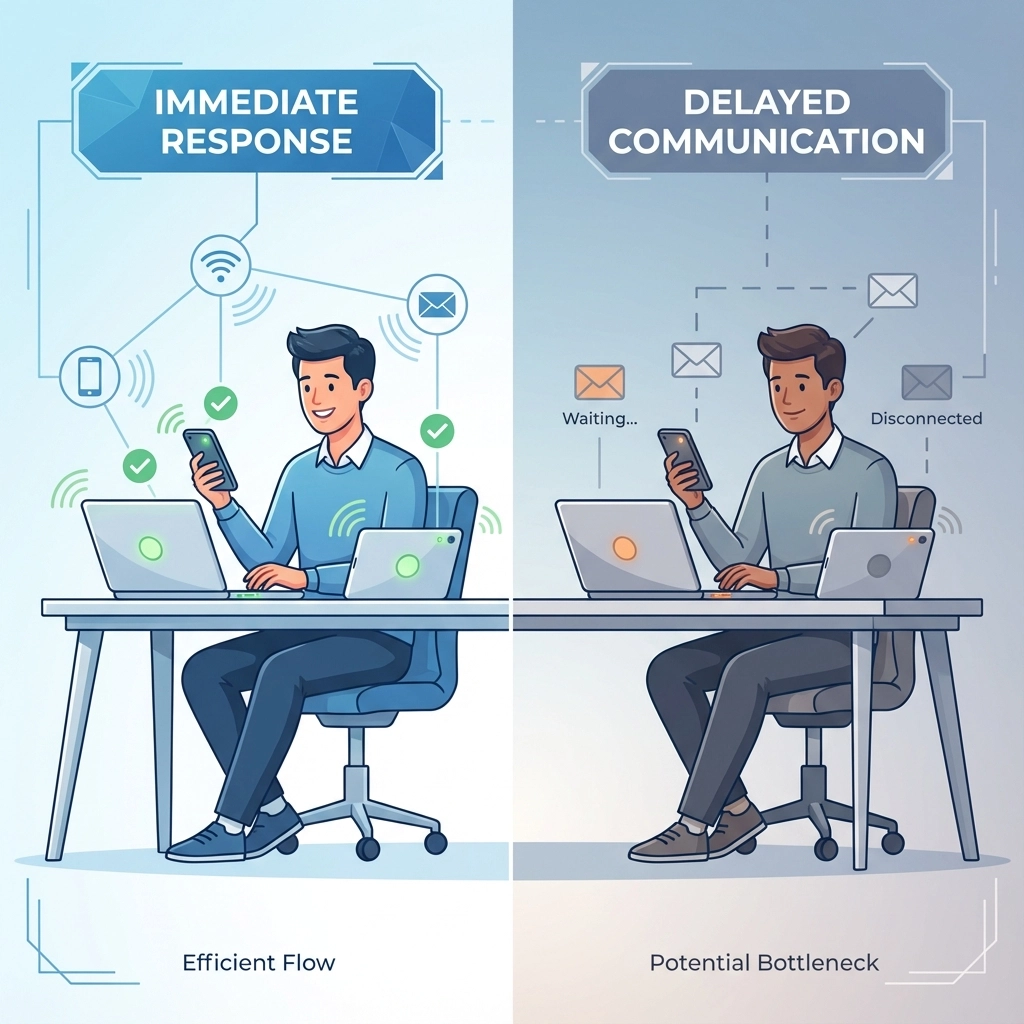
Step 3: The Immediate Next Step
Every first contact ends with a concrete next action happening within 24 hours. Not "someone will call you back," not "we'll send you information": something specific like "I'm going to have our insurance specialist call you at 2 PM today to sort out your coverage, and then we'll have a bed ready for you by tomorrow morning if that works."
Technology That Actually Helps (Instead of Hurts)
Most facilities have phone systems and CRM tools that actually slow down response times instead of speeding them up. Here's what works:
Lead Distribution Technology: Tools like RingCentral or CallRail can automatically route leads to available intake staff within seconds, not minutes.
Text Response Integration: Studies from Zipwhip show that 95% of texts are read within 3 minutes compared to only 22% of emails. Your intake team should be able to send immediate text acknowledgments.
Mobile-First Systems: If your intake team can't respond to leads from their phones, you're automatically adding 15-30 minutes to every response time.
The Training That Actually Moves the Needle
Traditional intake training focuses on gathering information and following scripts. High-converting intake teams are trained on psychological first aid and crisis de-escalation. They understand that their primary job in the first 60 seconds isn't information gathering: it's emotional connection.
Key training elements:
- Voice tone recognition: Teaching staff to match the emotional state of the caller
- Immediate value delivery: Providing something helpful (even if small) in the first interaction
- Commitment escalation: Moving from "we'll help" to "here's exactly how we'll help" within minutes
Measuring What Matters
You can't improve your intake team response time if you're not measuring it. Most facilities track lead volume and conversion rates, but they miss the critical metrics:
- First response time: How long from lead generation to first human contact
- Response consistency: Variation in response times across different staff members
- Weekend/after-hours performance: When most crisis calls actually happen
- Response method effectiveness: Phone vs. text vs. email first-touch success rates
The ROI of Getting This Right
Let's be clear about what's at stake here. If your facility averages 100 leads per month and you're currently converting 10% (industry standard), improving your intake team response time to under 60 seconds could realistically get you to 25-30% conversion rates.
That's not just 15-20 more admissions per month. At $6,000 average revenue per patient, that's an additional $90,000-$120,000 in monthly revenue from the same marketing spend. Over a year, we're talking about $1.2-1.4 million in additional revenue just from responding faster.

The facilities that dominate their markets aren't necessarily the ones with the best clinical programs or the fanciest facilities. They're the ones who make people feel heard and helped immediately. They understand that in the addiction treatment space, speed is empathy.
Your 30-Day Response Time Challenge
Here's what we recommend to every facility owner who's serious about converting more leads:
Week 1: Measure your current average response time across all lead sources
Week 2: Implement immediate acknowledgment protocols for all intake staff
Week 3: Add text response capabilities and mobile access to your intake systems
Week 4: Train staff on crisis-first communication and track improvement metrics
Most facility owners who implement this see 20-40% improvement in lead conversion within 30 days. The ones who don't? They keep wondering why their competitors are always full while they're struggling to maintain census.
The bottom line is this: your intake team response time isn't just an operational detail: it's probably the biggest factor determining whether your facility thrives or barely survives. Every minute you wait to optimize this process is costing you admissions, revenue, and ultimately, the chance to help more people get their lives back.
If you want to audit your current intake process and identify exactly where you're losing leads, call us at 305-539-7114. We'll do a complete intake performance analysis and show you exactly how much money you're leaving on the table with slow response times. Because in this business, every second counts: and every lead you lose was someone who needed your help.