You’ve spent years: maybe decades: poured into the trenches of the behavioral health industry. You’ve navigated the regulatory hurdles, managed the high-stress clinical environment, and most importantly, helped countless individuals find the path to recovery. But now, you’re looking at the exit. Or perhaps, you’re looking for a partner to help you scale.
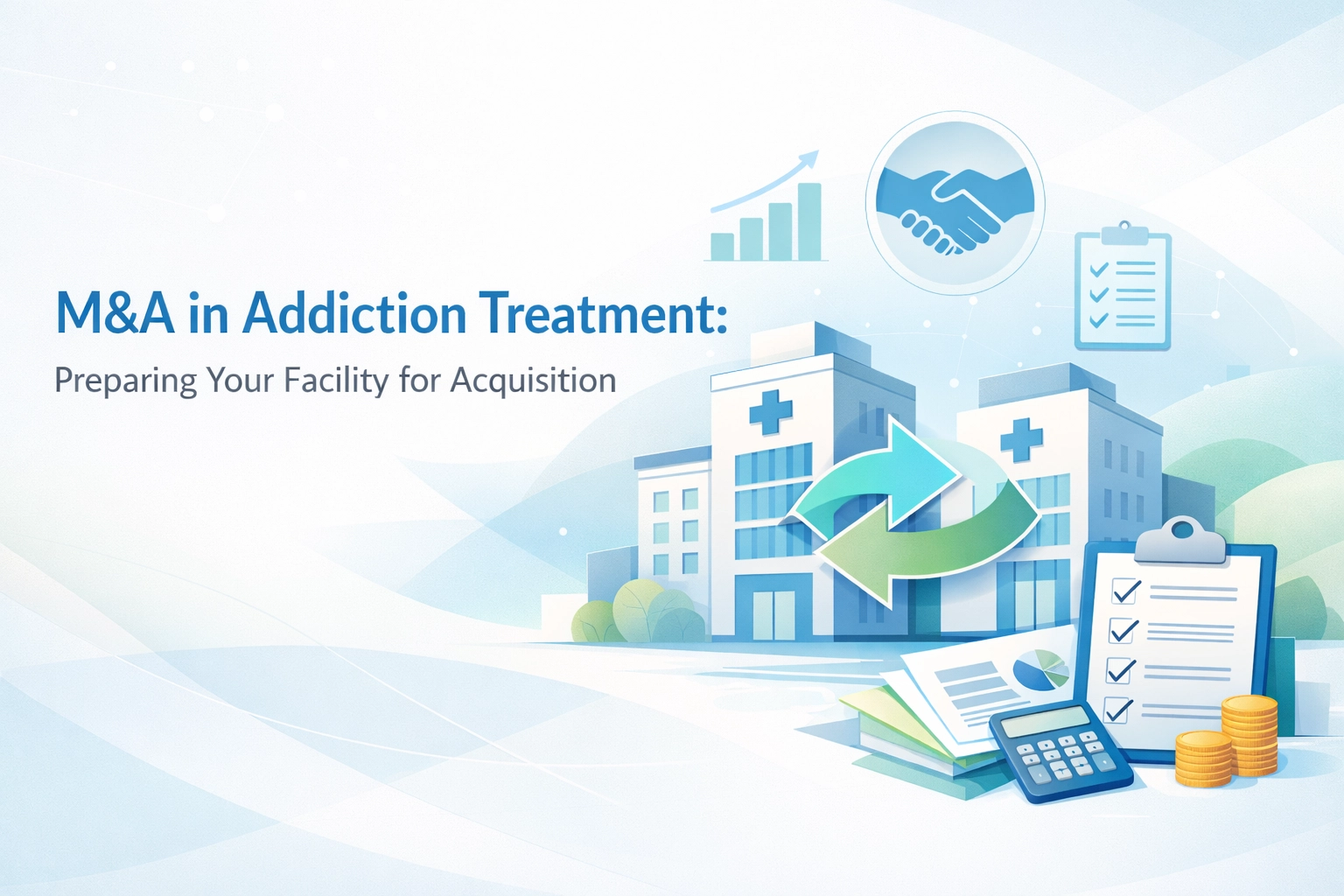
The market for Mergers and Acquisitions (M&A) in the addiction treatment space is more active than ever in 2026. However, there’s a massive difference between "having a facility for sale" and "being ready for acquisition." I’ve seen owners leave millions on the table simply because they didn't have their house in order before the "For Sale" sign went up.
If you’re a CFO or a facility owner, you know that valuation isn't just about how many beds you have filled today; it's about how much risk a buyer is taking on tomorrow. So, how do you bridge that gap?
Table of Contents
- The State of Addiction Treatment M&A in 2026
- What Drives Valuation: The Buyer’s Perspective
- Financial Transparency and Documentation
- Operational Strength: The 'Scalability' Factor
- Marketing Assets: Your Secret Valuation Multiplier
- The Due Diligence Checklist
- Performance Impact: Prepared vs. Unprepared
The State of Addiction Treatment M&A in 2026
The substance abuse treatment sector remains highly fragmented. While large national players exist, a huge portion of the market is still comprised of regional operators. This fragmentation is exactly what attracts private equity (PE) firms and for-profit consolidators. They aren't just buying your revenue; they are buying a platform they can optimize and expand.
According to industry data from SAMHSA, the demand for high-quality, ethical care continues to outpace supply. Buyers in 2026 are looking for facilities that don't just provide "a service," but those that have documented outcomes and a clean LegitScript certification.
But here is the kicker: the "wild west" days of rehab marketing and M&A are long gone. Regulatory scrutiny is at an all-time high. If your records are a mess or your marketing tactics are "grey hat," your valuation will plummet faster than a lead balloon.

What Drives Valuation: The Buyer’s Perspective
When a potential buyer looks at your facility, they aren't just looking at your passion for recovery. They are looking at EBITDA (Earnings Before Interest, Taxes, Depreciation, and Amortization) and risk.
Key factors that influence your multiple include:
- Payer Mix: Are you 100% reliant on out-of-network (OON) reimbursements? In 2026, a healthy balance of In-Network (INN) contracts is often viewed as more stable and less risky by conservative buyers.
- Staff Retention: Is your clinical team constantly churning? A facility is only as good as its people. High turnover is a red flag for operational instability.
- Compliance History: Any history of audits or regulatory "slaps on the wrist" will be poked and prodded during due diligence.
Financial Transparency and Documentation
"I think we're doing about $5M a year" doesn't cut it. To get the best price for your facility, your financial documentation needs to be "audit-ready" at a moment's notice. This means having clean, accrual-based accounting records for the last three years.
Buyers want to see:
- Revenue per Patient: How much are you actually netting after denials and adjustments?
- Cost of Acquisition (CAC): How much does it cost you to get a single patient through the door? If you don't have conversion tracking dialed in, you won't be able to answer this.
- Owner Add-backs: Are you running your personal Tesla or family vacations through the business? These need to be clearly identified as "one-time expenses" to normalize your EBITDA.
Operational Strength: The 'Scalability' Factor
Private equity loves a "plug-and-play" model. They want to know that if they buy your facility and add 20 more beds, your systems won't break.
Do you have a Standard Operating Procedure (SOP) for everything? From the moment a lead hits your CRM to the day a patient is discharged, the process should be documented and repeatable. If the business relies entirely on you being there 60 hours a week, it’s not a business; it’s a high-stress job. And buyers don't pay high multiples for jobs.

Marketing Assets: Your Secret Valuation Multiplier
So what's the connection between your Google ranking and your sale price? Everything.
A facility that relies solely on high-cost rehab leads from third parties is risky. What happens if that lead source dries up? On the flip side, a facility with a dominant local SEO presence and a strong organic brand is a goldmine.
Why Digital Assets Matter in M&A:
- Predictability: A well-oiled SEO strategy provides a steady stream of "free" leads.
- Brand Equity: A high-quality website and positive reviews act as a digital moat.
- Diversification: Using a mix of social media marketing and PPC reduces the risk of being beholden to one platform.
If your marketing is currently a black box, we can help. A free website audit from our team can show you exactly where your digital value stands today.
The Due Diligence Survival Guide
Due diligence is where most deals go to die. It’s an invasive, grueling process where a team of lawyers and accountants look under every rug in your facility. To survive it, you need to be proactive.
The "Must-Have" List:
- Licensing & Accreditations: Ensure all state licenses and Joint Commission/CARF accreditations are current and transferable.
- Property Leases: Are your leases transferable? Do they have "change of control" clauses?
- Clinical Outcomes: Do you have data showing your treatment actually works? Evidence-based outcomes are becoming a massive valuation driver.
Performance Impact: Prepared vs. Unprepared
To illustrate the financial impact of preparation, let's look at two hypothetical 50-bed facilities in the same region.
| Factor | Facility A (Unprepared) | Facility B (Optimized for Sale) |
|---|---|---|
| Financial Records | Cash-based, messy | Accrual-based, audited |
| Marketing | 90% Paid Leads / No SEO | 60% Organic / 40% Paid |
| Payer Mix | 100% OON | 70% INN / 30% OON |
| EBITDA | $1.5 Million | $1.5 Million |
| EBITDA Multiple | 4.5x | 7.0x |
| Final Sale Price | $6.75 Million | $10.5 Million |
Note: Multiples are illustrative and vary based on market conditions.
The difference is a staggering $3.75 million. Both facilities make the same profit, but Facility B is worth significantly more because it represents lower risk and higher scalability.

How Ads Up Marketing Boosts Your Valuation
I know the process of getting your facility ready for an acquisition feels overwhelming. You're already busy running a treatment center; when are you supposed to find the time to overhaul your digital footprint and clean up your data tracking?
That’s where we come in. At Ads Up Marketing, we specialize in the "business side" of healthcare. We don't just "do marketing"; we build assets that increase your company's value.
Whether it's tightening up your PPC performance to lower your CAC or building an SEO powerhouse that makes you the dominant local name, our goal is to make your facility the most attractive target on the market.
Don't wait until you're exhausted and ready to quit before you start thinking about your exit. The best time to prepare for a sale was two years ago. The second best time is today.
Ready to see how your facility’s digital presence stacks up?
Let’s chat about how we can maximize your valuation and get you the exit you deserve. Call us today at 305-539-7114 or contact us through our website. Let's make sure you get every penny your hard work is worth.
For more information on the evolving landscape of addiction treatment, visit NAATP or check out our latest guides on Digital Marketing Services.