INSIGHTS
The Anatomy of a High-Converting Treatment Center Website
You are likely spending thousands of dollars every month on Google Ads, SEO, and social media to drive traffic to your facility’s website. But here is the cold, hard truth: if your website doesn't immediately establish trust, that traffic is just a line item on your expense report. In the addiction treatment industry, the "bounce rate" isn't just a metric; it represents a person in crisis who didn't feel safe enough to pick up the phone.
When a family member or a person struggling with substance use disorder lands on your page, they aren't looking for a "sales pitch." They are looking for a lifeline. If your site looks like it was built in 2012, or if it’s so cluttered they can’t find the insurance verification form, they will leave. In less than three seconds, they’ve already decided whether or not they trust you.
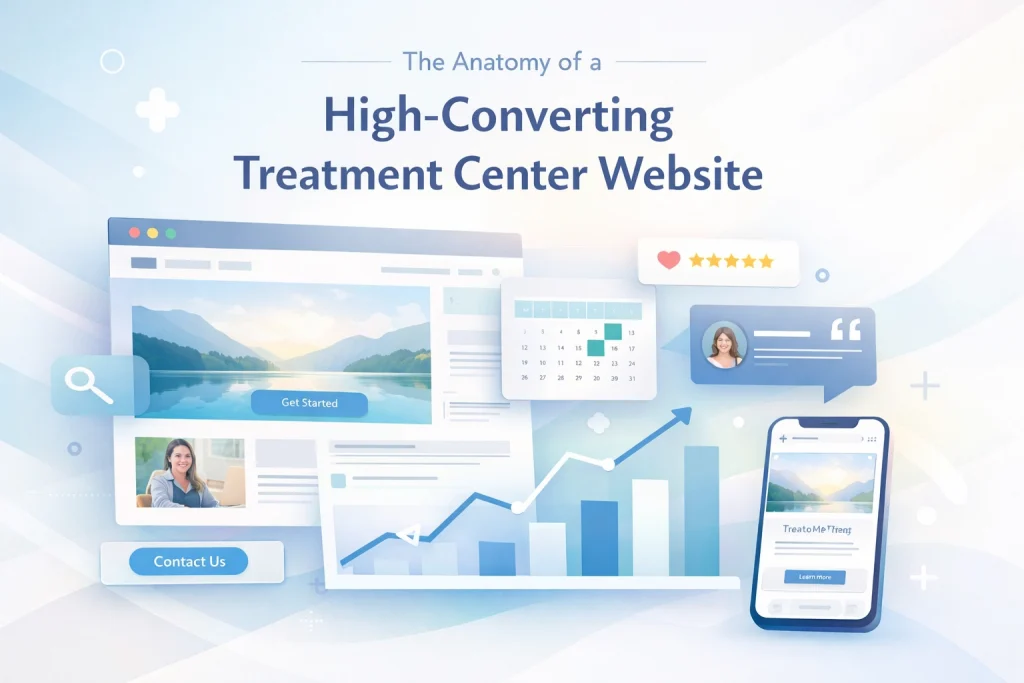
So, how do you move from "just a website" to a high-converting digital asset that actually fills beds? Let’s break down the anatomy of a high-converting treatment center website through the lens of visual trust and user experience (UX).
The Psychology of Visual Trust
In healthcare marketing, trust is the primary currency. Before we talk about buttons and forms, we have to talk about how your site feels. A "clinical" look might seem professional to you, but to a person in withdrawal or a mother in a panic, it can feel cold and intimidating.
Visual trust is built through a balance of professional design and human empathy. This means using high-resolution, original photography of your actual facility and staff: not generic stock photos of people smiling while holding coffee mugs. People want to see where they will be sleeping, who will be treating them, and the environment they will be healing in.

According to SAMHSA, providing clear, accessible information is a cornerstone of effective behavioral health communication. When your UI (User Interface) is clean, with plenty of white space and calming colors (blues, greens, soft neutrals), you reduce the cognitive load on the visitor. You are essentially saying, "We have it under control. You can breathe here."
Navigation: The Path of Least Resistance
If a visitor has to click three times to find your "Admissions" page, you’ve already lost them. High-converting treatment center websites utilize what we call "flat navigation." This means the most important information: levels of care, insurance accepted, and contact info: is never more than one click away.
Think about the user’s state of mind. They are likely stressed, perhaps even impaired. Your navigation should be intuitive, not a scavenger hunt.
Key UX elements for navigation include:
- Sticky Headers: Keep your phone number and "Verify Insurance" button visible even as the user scrolls.
- Logical Hierarchy: Group your services logically (e.g., Detox, Residential, PHP, IOP).
- Clear CTAs: Don't use "Submit." Use "Get Help Now" or "Check My Coverage."
Does your current site pass the "stress test"? If you aren't sure, you might benefit from a free website audit to see where people are dropping off.
Mobile Optimization Is No Longer Optional
In 2026, over 70% of searches for addiction treatment happen on mobile devices. If your mobile site is just a "shrunken down" version of your desktop site, your conversion rates are suffering.
Mobile UX requires a different strategy. Buttons need to be "thumb-friendly." Forms should be short and easy to type into. Most importantly, your click-to-call button needs to be front and center. A high-converting treatment center website prioritizes the mobile experience because that is where the "crisis search" happens.
The Performance Impact: UI/UX vs. ROI
As a facility owner or CFO, you want to know how this affects the bottom line. Better design isn't just about aesthetics; it’s about lowering your Cost Per Acquisition (CPA). When your site converts at 5% instead of 2%, your marketing dollars go twice as far.
| Metric | Low-Optimization Site | High-Converting Site |
|---|---|---|
| Average Load Time | 5.2 Seconds | 1.8 Seconds |
| Mobile Bounce Rate | 65% | 32% |
| Inquiry-to-Call Rate | 1.5% | 4.8% |
| Average CPA | $1,200 | $650 |
| Trust Factor | Low (Stock Photos/Clutter) | High (Original Media/Clean UI) |
As you can see, the ROI of a well-designed site is astronomical. If you want to dive deeper into how we scale these results, check out our drug rehab marketing services.
Trust Signals and Credibility Markers
Beyond the layout, specific "trust signals" must be strategically placed to validate your authority. These include:
- LegitScript Certification: This is mandatory for running ads, but it also serves as a massive badge of trust for organic visitors. (Learn more about LegitScript for treatment centers).
- Accreditations: Joint Commission (JCAHO) or CARF logos should be in the footer and on the "About Us" page.
- Staff Bios: Highlighting the clinical expertise of your team (LCSWs, MDs, PsyDs) shows that you are a legitimate medical facility, not just a marketing front.
- Verified Reviews: Integrating third-party reviews from Google or LegitScript directly onto the site provides "social proof" that your program actually works.

Content That Converts: Education Over Egos
Many rehab owners make the mistake of making the website all about them. While your "story" matters, the visitor cares more about their problem. Your content should follow an "Issue-Solution-Action" framework.
- Issue: Do you feel like you’re losing control?
- Solution: Our evidence-based PHP program helps you rebuild while living at home.
- Action: Call us at 305-539-7114 for a confidential assessment.
Educational resources, such as blogs on "What to pack for rehab" or "How to talk to a spouse about their drinking," build top-of-funnel trust. These pieces establish you as a thought leader in the space, which is critical for long-term SEO for drug rehabs.
The Technical Backbone: Speed and Security
You could have the most beautiful site in the world, but if it takes 8 seconds to load, no one will ever see it. Google’s Core Web Vitals are a major ranking factor. Furthermore, security is paramount. Your site must be HTTPS secure, and any forms that collect patient data must be HIPAA-compliant.
We often see facilities lose potential admissions because their insurance verification form was "broken" or looked "sketchy." Ensuring that your conversion tracking is set up correctly allows you to see exactly where these technical glitches might be happening.

Stop Losing Leads to Poor Design
Building a high-converting treatment center website is a science. It requires an understanding of behavioral psychology, healthcare regulations, and cutting-edge web technology. If your website feels like a digital brochure rather than a conversion engine, you are leaving lives: and revenue: on the table.
At Ads Up Marketing, we specialize in bridge-building. We bridge the gap between someone in need and the life-saving treatment you provide. We don't just "build websites"; we build high-performance assets designed to increase admissions and maximize your ROI.
Ready to transform your digital presence?
Don't let another high-intent lead bounce to a competitor because of a clunky website. Let's look at your data and build a site that reflects the quality of care you provide.
Contact us today at 305-539-7114 or visit our contact page to schedule a consultation. Your mission is to save lives; our mission is to make sure those lives find you.
For more industry insights, you can also explore the latest guidelines from the National Association of Addiction Treatment Providers (NAATP), which outlines the ethical standards for treatment center marketing and web presence.