INSIGHTS
Expansion Strategy: Should Your Rehab Open a PHP or IOP Program Next?
You’re staring at your occupancy reports, and while the beds are full, the stress is higher than the profit margins. Running a residential treatment center (RTC) in 2026 is a heavy lift: high overhead, intense staffing requirements, and the constant pressure of keeping those beds occupied. You know you need to expand to stabilize your revenue, but the "what's next" is paralyzing.
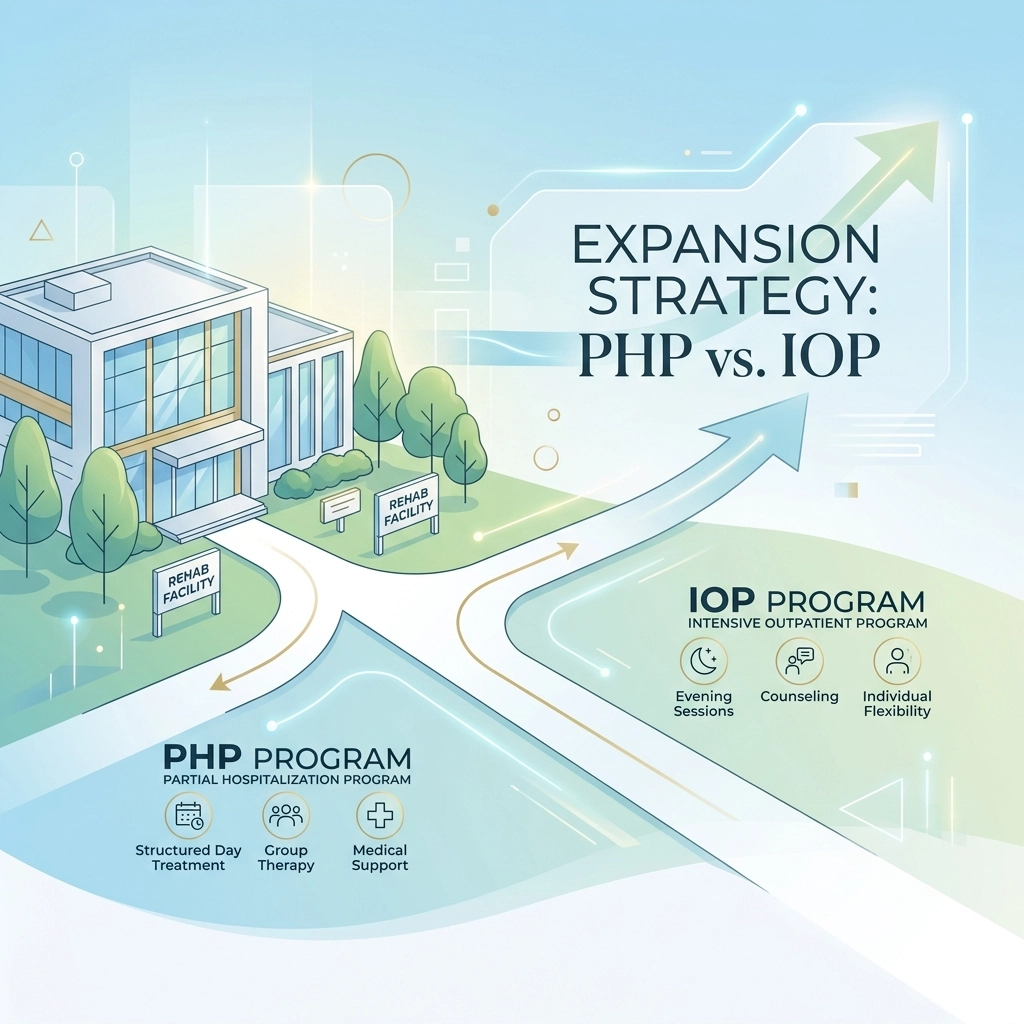
Do you double down on clinical intensity with a Partial Hospitalization Program (PHP), or do you cast a wider net with an Intensive Outpatient Program (IOP)?
Choosing the wrong expansion path isn't just a minor setback; it’s a drain on your capital and your team’s morale. If you build a PHP in a market that’s already saturated with high-acuity care, you’re fighting for scraps. If you launch an IOP but don’t have the digital infrastructure to fill it, you’re just paying rent on an empty office.
In this guide, we’re going to look at the rehab owner profitability 2026 landscape and help you decide which service line will actually move the needle for your business.
Table of Contents
- The Scaling Dilemma: Why Expansion is Non-Negotiable
- PHP vs. IOP: Breaking Down the Levels of Care
- The Financial Reality: Performance Impact Comparison
- Market Demand & SEO: Letting Data Drive the Build
- Operational Hurdles: Staffing and Licensing
- Strategic Roadmap: Which One Wins?
The Scaling Dilemma: Why Expansion is Non-Negotiable
If you only offer residential care, you are leaving money: and lives: on the table. According to data from the Substance Abuse and Mental Health Services Administration (SAMHSA), the continuum of care model is no longer just a clinical recommendation; it’s a business necessity.
Why? Because insurance payers are increasingly favoring "step-down" models. They want to see patients moving from high-cost environments to lower-cost, sustainable outpatient settings. If you don’t have a place for your residents to go after their 30-day stay, you lose that patient to a competitor who does. You’ve already paid the cost of patient acquisition; it’s much more profitable to retain that patient for another 60 to 90 days in an outpatient setting than to hunt for a brand-new admission.

PHP vs. IOP: Breaking Down the Levels of Care
Before we look at the spreadsheets, let’s make sure we’re aligned on the clinical definitions. While both are "outpatient," they serve very different purposes in your expansion strategy.
Partial Hospitalization Program (PHP)
Think of PHP as "residential without the bed." It’s high-intensity, usually requiring 5–6 hours of clinical work per day, 5 days a week.
- Who it’s for: Patients who need a high level of structure but have a safe place to sleep at night.
- The Advantage: Higher reimbursement rates than IOP. It’s a perfect "bridge" for patients leaving residential care who aren't ready for the "real world."
Intensive Outpatient Program (IOP)
IOP is the workhorse of the recovery industry. It typically involves 9–15 hours of therapy per week, often in the evenings to accommodate work or school.
- Who it’s for: Patients transitioning from PHP or those with moderate symptoms who need to maintain their professional lives.
- The Advantage: Lower overhead. You don’t need to provide meals or 24/7 supervision, and the virtual IOP model is exploding in 2026.
The Financial Reality: Performance Impact Comparison
Let's talk numbers. As a CFO or owner, you care about the bottom line. Below is a breakdown of how these programs typically perform in a mid-sized market.
Performance Impact: PHP vs. IOP (Estimated 2026 Averages)
| Feature | Partial Hospitalization (PHP) | Intensive Outpatient (IOP) |
|---|---|---|
| Avg. Daily Reimbursement | $600 – $900 | $250 – $450 |
| Weekly Clinical Hours | 25 – 30 Hours | 9 – 15 Hours |
| Staffing Intensity | High (Nursing/Psychiatry) | Moderate (Therapists/LCSWs) |
| Profit Margin | 20% – 30% | 35% – 50% |
| Patient Retention | 3 – 4 Weeks | 8 – 12 Weeks |
| Facilities Overhead | High (Daily Meals/Large Space) | Low (Flexible Space/Virtual) |
Data sourced from industry benchmarks and NAATP financial reports.
While PHP offers higher daily revenue, the average rehab center revenue 2026 trends show that IOP often has better margins due to lower staffing costs and the ability to scale via telehealth. If your capital is tight, IOP is usually the safer bet for quick ROI.
Market Demand & SEO: Letting Data Drive the Build
One of the biggest mistakes I see owners make is opening a program because "the building next door became available." That’s a recipe for disaster. You need to know if there is actual search intent in your geographic area.
Before you sign a lease, you should be looking at local SEO data. Are people in your city searching for "intensive outpatient near me" or "day treatment for addiction"?
At Ads Up Marketing, we use advanced tools to see the exact search volume for these terms. If "IOP" has 5x the search volume of "PHP" in your zip code, the market is telling you exactly what it needs. Furthermore, you need to ensure your conversion tracking is set up to distinguish which campaigns are actually driving admissions for these specific levels of care.
Pro Tip: Don't forget about LegitScript certification. You can't run Google Ads for these new programs without it.

Operational Hurdles: Staffing and Licensing
Expanding isn't just about marketing; it’s about compliance. If you're moving from RTC to outpatient, you need to check your state's specific requirements.
- CARF/Joint Commission: Does your current accreditation cover the new level of care? If not, you’ll need a CARF accreditation consultant to guide you through the survey process.
- Staffing: PHP requires more medical oversight (think MDs and RNs), whereas IOP is heavily driven by licensed counselors. In 2026, the labor market for clinicians is tight: make sure you can actually hire for the program you choose.
- Revenue Codes: Ensure your billing team is ready for the shift. Outpatient billing is a different beast than residential per diem rates.
Strategic Roadmap: Which One Wins?
So, back to the big question: Should you open a PHP or IOP program next?
Go with PHP if:
- You currently run a residential program and are losing patients because you don't have a high-acuity step-down.
- You have the clinical staff (nurses/psychiatrists) already on payroll who can split their time.
- Your local market has a shortage of intensive day-treatment options.
Go with IOP if:
- You want to maximize your profit margins with lower overhead.
- You want to reach a broader audience, including those who are still working.
- You are interested in the social media marketing potential of reaching people in early-stage addiction who aren't ready for "rehab" but know they need help.
The Hybrid Approach
The most successful facilities we work with at Ads Up Marketing don't choose just one: they build a pipeline. They start with an IOP to capture the largest market share, then use the profits to fund a PHP expansion, creating a seamless behavioral health marketing ecosystem.
But this still doesn't drill down into your specific market. Every city is different. What works in South Florida might not work in suburban Ohio.
Let’s Get Practical
Expanding your facility is a massive investment. Don't leave it to guesswork. You need a partner who understands the intersection of clinical care and digital growth. Whether you need a free AdWords audit to see what your competitors are spending or a full-scale SEO strategy to dominate your local area, we can help.
Ready to grow your facility? Let’s look at the data together.
Call us today at 305-539-7114 or contact us today to schedule a consultation. We’ll help you analyze the market demand in your area so you can expand with confidence.