
INSIGHTS
Maximize Treatment Center ROI: Attribution Frameworks That Prove Every Ad Dollar
You open your monthly PPC report and see plenty of clicks, calls, and form submissions. The numbers look busy. Maybe even encouraging.
Then leadership asks the question that matters most: Which ads actually produced admissions: and how much revenue did they generate?
That is where the report often gets quiet.
For addiction treatment centers, measuring treatment center ROI attribution is more complicated than counting clicks or assigning every conversion to the last ad someone saw. Families may research for days. A parent may click a Google Ad, return through organic search, call from a different phone, and speak with admissions several times before a placement occurs.
If your reporting stops at the lead, you may be optimizing for activity instead of outcomes.
Table of Contents
- Why standard PPC reporting falls short
- The four stages of a treatment center ROI framework
- Choosing the right attribution model
- The metrics that should guide your budget
- Build attribution without creating compliance risk
- A practical implementation roadmap
- How Ads Up Marketing helps
Why Standard PPC Reporting Falls Short
Most ad platforms are designed to report on their own activity. Google Ads can tell you about clicks and conversions. Call tracking can show connected conversations. Your CRM may show opportunities. Your admissions system knows who arrived.
But these systems do not automatically agree.
So what’s the connection between a $75 click and a collected patient payment? Unless you deliberately preserve source information across the funnel, that connection can disappear during a handoff.
Common reporting problems include:
- Counting every form submission as a qualified lead
- Treating a short, irrelevant call the same as a meaningful admissions conversation
- Giving all credit to the final branded search click
- Ignoring the first channel that introduced the family to your facility
- Reporting gross revenue without considering payer mix, refunds, or operational costs
- Optimizing campaigns toward inexpensive leads that rarely become admissions
The issue is not that you lack data. The issue is that your data is disconnected.
SAMHSA’s 2024 National Survey on Drug Use and Health releases show the continued scale of behavioral health needs across the United States. That makes responsible, efficient outreach important: but it also means your marketing should help people find appropriate care, not simply generate more inquiries.
The Four Stages of a Treatment Center ROI Framework
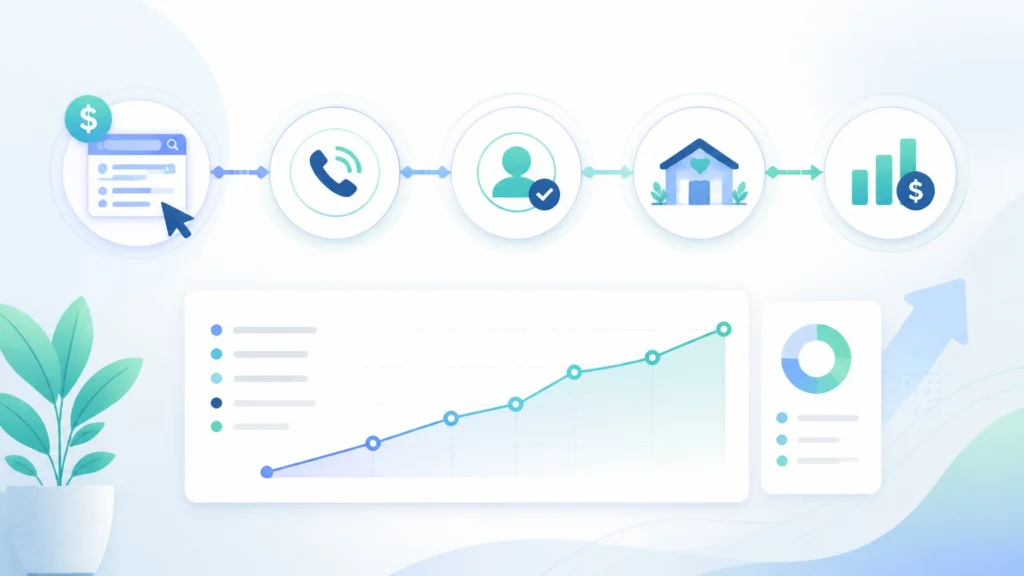
A useful attribution framework follows the patient or family journey from first interaction to financial outcome.

1. Marketing interaction
This is where a prospective patient or family member first encounters your facility.
Track:
- Search engine and social media source
- Campaign, ad group, keyword, and creative
- Geographic location
- Landing page
- First visit date
- First-touch and last-touch source
Use consistent UTM parameters on paid campaigns. Capture those parameters in your forms and CRM before the information is overwritten by a later visit.
2. Meaningful inquiry
Not every conversion has the same value. A two-minute call from someone seeking the level of care you provide is more valuable than a missed call, a vendor inquiry, or a form with no usable contact details.
Define meaningful inquiry stages such as:
- Connected call
- Qualified call
- Insurance verification started
- Assessment scheduled
- Referral or transfer accepted
- Follow-up required
Your call center and admissions support process should use the same definitions as your marketing reports. Otherwise, marketing sees “leads” while admissions sees “people we could actually help.”
3. Admission outcome
This is the point where attribution becomes operationally useful.
Track whether the opportunity:
- Scheduled an assessment
- Completed the assessment
- Was clinically appropriate
- Verified insurance or payment ability
- Arrived for treatment
- Began the appropriate level of care
The exact stages will vary by facility. A detox program may have a shorter admission cycle than a residential or outpatient provider. That is fine. The framework should reflect how your operation actually works.
4. Financial outcome
Revenue should be connected to the source campaign where your systems and privacy policies allow it.
Use collected revenue when possible: not just a projected episode value. You should also account for:
- Payer type
- Expected length of stay
- Net collections
- Refunds or write-offs
- Referral fees, where applicable
- Delivery costs
- Staff and admissions overhead
A simple ROAS calculation is:
ROAS = Collected revenue ÷ ad spend
A more complete ROI calculation is:
ROI = (Collected revenue − total marketing cost) ÷ total marketing cost
The distinction matters. A campaign can produce strong ROAS while generating weak profit if the downstream cost of serving that patient is high.
Choosing the Right Attribution Model
There is no single perfect attribution model for every treatment center. Each model answers a different business question.
| Attribution model | What it tells you | Where it can mislead you |
|---|---|---|
| First-touch | Which channel introduced the family to your facility | It ignores later conversion activity |
| Last-touch | Which channel appeared closest to the inquiry or admission | It often overcredits branded search |
| Linear multi-touch | How credit is distributed across the journey | It assumes every touchpoint matters equally |
| Time-decay | Which interactions gained importance closer to conversion | It may undervalue early education |
| Data-driven | Which touchpoints appear to contribute most based on account data | It requires reliable conversion volume and clean data |
Google explains that GA4 cross-channel data-driven attribution uses machine learning and historical account data to allocate credit across conversion paths.
That can be helpful for mature accounts. But this still doesn’t drill down into whether the conversion was a qualified call, an admission, or collected revenue. Your CRM and admissions data still need to supply those downstream signals.
For many treatment centers, the best approach is to use multiple views:
- First-touch for understanding demand creation
- Last-touch for evaluating immediate response
- Multi-touch for budget planning
- Admission-based reporting for executive decisions
- Collected-revenue reporting for profitability
The Metrics That Should Guide Your Budget
Clicks and impressions are useful diagnostic metrics. They should not be your final definition of success.
A more complete treatment center ROI dashboard should include:
- Cost per click
- Landing page conversion rate
- Call connection rate
- Qualified call rate
- Cost per qualified inquiry
- Lead-to-admission rate
- Cost per admission
- Average collected revenue
- Revenue per ad dollar
- Net contribution after delivery costs
- Time from first touch to admission
Here is a simplified example:
| Campaign | Ad spend | Qualified inquiries | Admissions | Collected revenue | Cost per admission | ROAS |
|---|---|---|---|---|---|---|
| Detox – Local | $12,000 | 48 | 8 | $72,000 | $1,500 | 6.0x |
| Residential – Nonbrand | $18,000 | 60 | 5 | $95,000 | $3,600 | 5.3x |
| Branded search | $4,000 | 35 | 6 | $48,000 | $667 | 12.0x |
At first glance, branded search wins. But should you move most of your budget there?
Probably not. Branded campaigns often capture people who already know your facility. They may be valuable closers, but they do not necessarily create new demand. The residential nonbrand campaign may be introducing families who would not otherwise have found you.
Performance Impact: What Better Attribution Changes
| Decision area | Weak attribution | Connected attribution |
|---|---|---|
| Budget allocation | Follows cheapest lead | Follows qualified admissions and margin |
| PPC optimization | Optimizes platform conversions | Optimizes downstream outcomes |
| Admissions feedback | Separate from marketing | Returned to campaign reporting |
| Leadership reporting | Clicks, forms, and spend | Cost per admission and collected revenue |
| Growth decisions | Based on assumptions | Based on repeatable evidence |
This is why conversion tracking for behavioral health is not just a technical task. It is a management system for deciding where your next dollar should go.
Build Attribution Without Creating Compliance Risk
Behavioral health marketing requires special care because website activity can reveal that someone is seeking treatment.
The HHS Office for Civil Rights guidance on online tracking technologies explains that identifiers combined with health-related website behavior may constitute protected health information in certain circumstances.
Your attribution plan should be reviewed with your compliance and legal advisors. Practical safeguards may include:
- Inventorying pixels, cookies, analytics tags, and session-recording tools
- Limiting third-party tracking on sensitive pages
- Avoiding PHI in URLs, form fields, ad platform events, and analytics parameters
- Using minimum-necessary data
- Confirming business associate agreements where required
- Separating marketing reporting from clinical records
- Using aggregate or de-identified reporting for executive dashboards
- Documenting who can access source and admissions data
Do not place a diagnosis, treatment detail, insurance information, or identifiable intake note inside a UTM parameter. “Qualified inquiry” is very different from “opioid treatment request for [person’s name].”
NIDA describes substance use disorders as treatable medical conditions and outlines evidence-based treatment settings and approaches in its treatment resource. Your marketing measurement should support access to appropriate care while respecting the sensitivity of the people reaching out.
A Practical Implementation Roadmap
You do not have to rebuild every system at once. Start with the gaps that create the most financial uncertainty.
Step 1: Define your funnel
Agree on the meaning of:
- Lead
- Connected call
- Qualified opportunity
- Assessment
- Admission
- Collected revenue
Step 2: Preserve source information
Use UTMs, call tracking, form-source fields, and CRM fields consistently. Make sure source data survives transfers between marketing, admissions, and billing.
Step 3: Connect calls to outcomes
Call tracking should show more than call volume. Review connection, duration, disposition, qualification, follow-up, and admission progression.
Step 4: Return offline outcomes
Where appropriate and permitted, connect qualified opportunities and admissions back to campaigns. This gives PPC platforms and your team a better signal than raw form volume.
Step 5: Review performance by decision window
Do not judge a campaign only seven days after launch if your average time to admission is several weeks. Compare results by a realistic measurement window.
Step 6: Optimize the full experience
A high-performing ad cannot rescue a confusing landing page or an unanswered call. Review your website design and conversion experience alongside the media account.
How Ads Up Marketing Helps
At Ads Up Marketing, we work exclusively with addiction treatment centers and behavioral health facilities. That focus matters because attribution in this industry is not just about connecting clicks to form fills.
We help connect:
- Paid search and social campaigns
- Landing pages and website interactions
- Call tracking and conversation quality
- CRM stages and admissions dispositions
- Qualified opportunities and admissions
- Campaign cost and collected revenue
Our PPC management service is built around search intent, geography, payer priorities, clinical fit, and what happens after the phone rings. We also offer month-to-month agreements, clear KPIs, and experience informed by more than $100 million in paid-media data.
Want to know whether your campaigns are producing admissions: or just activity? Request a confidential attribution analysis or call 305-539-7114.
You may not need more leads. You may need a clearer view of the leads you already generate, where they stall, and which campaigns create the strongest financial outcome.
That is the difference between reporting ad spend and managing treatment center ROI.
Frequently Asked Questions
What is treatment center ROI attribution?
Treatment center ROI attribution is the process of connecting marketing activity: such as paid search clicks, calls, and forms: to qualified opportunities, admissions, and collected revenue. It helps you evaluate campaign performance using business outcomes instead of surface-level platform metrics.
What is the most important PPC metric for a rehab center?
Cost per admission is usually more useful than cost per lead because it accounts for lead quality and admissions performance. You should also review qualified call rate, lead-to-admission rate, payer mix, and collected revenue.
Should addiction treatment centers use last-click attribution?
Last-click attribution can help identify which channel generated the final inquiry, but it should not be your only model. It may overvalue branded search and undervalue earlier touchpoints such as nonbrand search, SEO content, or remarketing.
Can rehab marketing attribution be HIPAA compliant?
It can be designed with privacy and compliance requirements in mind, but the specific setup should be reviewed by qualified legal and compliance professionals. Avoid sending PHI to advertising platforms and use only the data necessary for reporting and optimization.
How can Ads Up Marketing improve PPC ROI?
Ads Up Marketing connects paid media with call quality, CRM stages, admissions progression, and available revenue data. That allows your team to reduce wasted spend, improve conversion paths, and invest more confidently in campaigns that produce viable admissions.
Ready to make every advertising decision easier to defend? Talk with Ads Up Marketing or call 305-539-7114.