
INSIGHTS
Attribution Modeling for Rehab: Which Channels are Actually Driving Admissions?
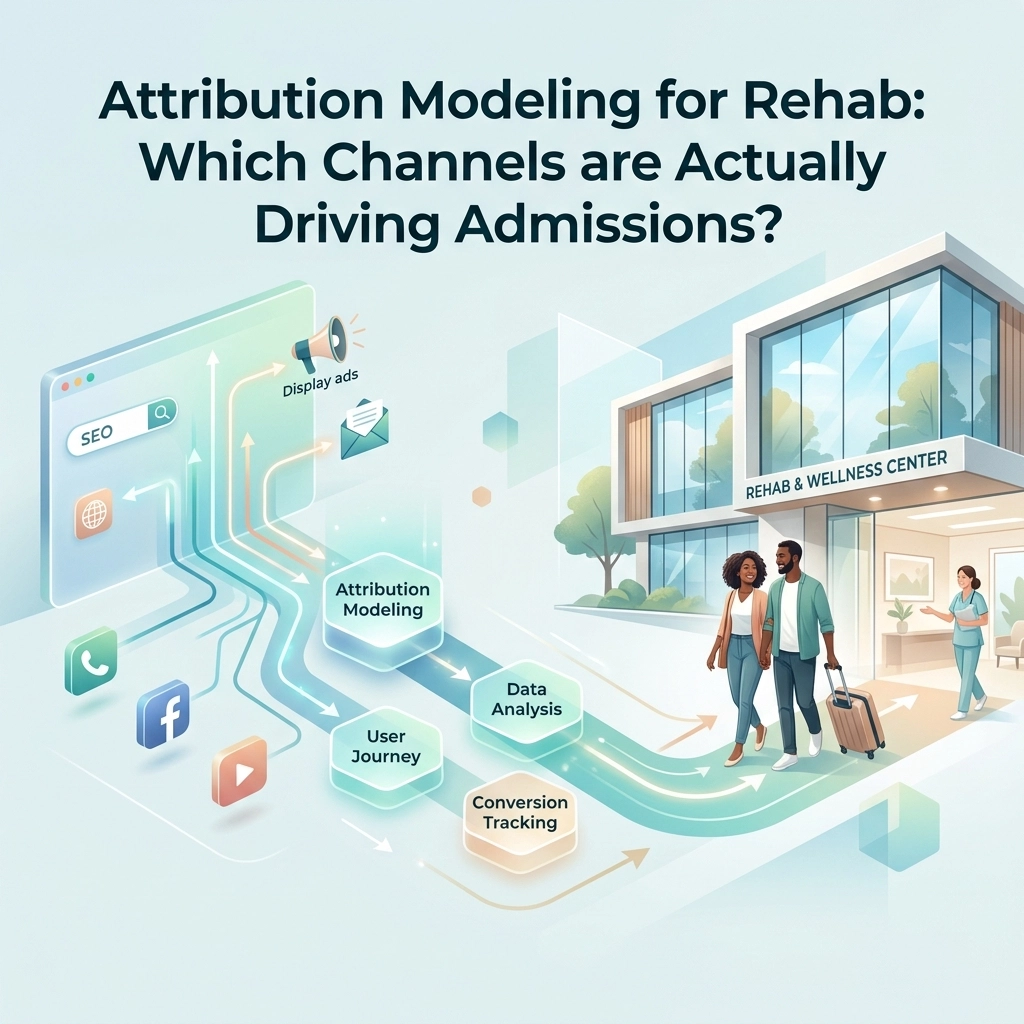
You’re looking at your monthly marketing report and the numbers just aren't adding up. Your Google Ads dashboard says you generated 50 leads. Your call center software says you had 200 inquiries. But at the end of the month, you only had 12 admissions.
Which of those 200 inquiries actually turned into a patient? Was it the person who clicked your "Drug Rehab" ad, or was it the person who found your blog post about withdrawal symptoms three weeks ago and finally decided to call today?
If you can’t answer that question, you’re essentially throwing money at a dartboard in a dark room. You might hit the bullseye occasionally, but you have no idea how to repeat the success. In the competitive landscape of 2026, where cost per admission is rising, guessing is a luxury your facility can’t afford.
The Messy Reality of the Patient Journey
In healthcare marketing, we love to talk about "funnels." We imagine a clean, straight line where a person realizes they need help, searches for a rehab, clicks an ad, and checks in.
But let’s be real: the journey to recovery is never a straight line. It’s a zig-zag.
A potential patient: or more likely, a worried family member: might start their journey by reading an educational article on a site like SAMHSA. A week later, they might see one of your retargeting ads on Facebook. Three days after that, they search for your facility name on Google to read reviews. Finally, they click a click-to-call extension on a mobile search ad.
If you are only looking at "last-click" attribution, Google Ads gets 100% of the credit. You might decide to cut your SEO and social media budget because they "aren't producing." But the second you cut those awareness channels, your Google Ads performance craters. Why? Because you stopped filling the top of the journey.
Why Traditional Tracking Fails Rehab Owners
Most rehab centers fall into the trap of oversimplification. They rely on "Last-Touch Attribution." This model gives all the credit for an admission to the very last channel the person interacted with before calling.
While this is easy to set up in a basic dashboard, it’s dangerously misleading for a high-stakes decision like addiction treatment. According to industry insights from organizations like the National Association of Addiction Treatment Providers (NAATP), the decision-making process for inpatient care can take anywhere from a few hours to several months.
If you don't understand how your SEO efforts are nurturing these leads over time, you’re only seeing 10% of the picture.

Decoding Attribution Models: Which One Fits Your Facility?
To truly understand your ROI, you need to choose an attribution model that reflects the complexity of the healthcare space. Here is a breakdown of how different models impact your perceived performance.
1. First-Touch Attribution
This gives 100% of the credit to the first time a user encountered your brand.
- The Pros: Great for seeing which top-of-funnel strategies (like social media marketing) are starting the conversation.
- The Cons: It ignores everything that actually "closed" the deal.
2. Last-Touch Attribution
The default for most platforms. 100% credit goes to the final click.
- The Pros: Shows you what finally pushed the lead over the edge.
- The Cons: It makes your brand-building and educational content look worthless on paper.
3. Linear Attribution
Every touchpoint in the journey gets equal credit.
- The Pros: It acknowledges that the journey is a team effort.
- The Cons: It doesn’t tell you which touchpoint was actually the most influential.
4. Position-Based (U-Shaped) Attribution
This is often the "sweet spot" for rehab marketing. It gives 40% credit to the first touch, 40% to the last touch, and spreads the remaining 20% among the middle interactions.
- The Pros: It values the "introduction" and the "admission" while acknowledging the research phase in between.
- The Cons: It can be technically difficult to set up without an expert partner.
5. Time Decay Attribution
Touchpoints closer to the time of admission get more credit than those earlier in the journey.
- The Pros: Reflects the increasing intent as a person gets closer to choosing a facility.
Performance Impact: Comparing Attribution Models
To see why this matters for your bottom line, look at how the same $50,000 budget looks under different lenses.
| Marketing Channel | Last-Touch ROI | U-Shaped (Multi-Touch) ROI | Real-World Strategic Value |
|---|---|---|---|
| Google Search Ads | 450% | 310% | The "Closer" – High intent. |
| SEO (Organic Blog) | 80% | 240% | The "Educator" – Builds trust. |
| Facebook Retargeting | 120% | 290% | The "Reminder" – Keeps you top of mind. |
| Local SEO/GMB | 300% | 210% | The "Validator" – Confirms proximity/trust. |
The Takeaway: If you only used Last-Touch metrics, you might think your SEO strategy is failing. But under a U-Shaped model, you see that SEO is actually the heavy lifter that introduces your brand to 40% of your future admissions.
Connecting the Dots: HIPAA, CRM, and Call Tracking
The biggest hurdle in rehab attribution isn't just the math: it's the technology. You are dealing with Sensitive Health Information (PHI). You can't just send a patient's name back into Google Analytics to see which ad they clicked. That’s a massive HIPAA violation.
So, how do we bridge the gap between an anonymous click and a verified admission?
- Dynamic Number Insertion (DNI): We use conversion tracking tools that show a unique phone number to every visitor. When they call, the software knows exactly which keyword or ad they were looking at.
- CRM Integration: Your call center needs to log every inquiry into a CRM (like Salesforce or Kipu).
- Hashed Data Uploads: To close the loop, we take your admission data, anonymize it (hashing), and upload it back into the ad platforms. This tells the AI, "This person admitted," without ever revealing who they are.
This allows us to optimize your Google Ads for actual admissions rather than just "clicks" or "leads."

The "Gut-Punch" Question: Are You Funding Your Competitors?
Here’s a scenario I see all the time: A facility spends $20,000 a month on high-intent keywords like "best rehab near me." They get a lot of calls, but their admission rate is low.
When we dig into the attribution, we find out people are clicking their ads, but then leaving the site to check reviews or look for a LegitScript certification. Because the facility's website looks outdated or lacks "trust signals," the lead ends up calling a competitor they found during that research phase.
In this case, your marketing is literally paying to educate leads for the facility down the street. Proper attribution modeling identifies these "leaky buckets" in your funnel.
How Ads Up Marketing Solves the Attribution Puzzle
I know this sounds complex. You’re running a treatment center; you shouldn't have to be a data scientist too. That’s where we come in. At Ads Up Marketing, we specialize in custom solutions that take the guesswork out of your ROI.
We don't just send you a report with big numbers and "vanity metrics." We sit down with you and show you exactly how many dollars you spent on Google Ads and how many patients actually sat in your chairs because of it.
Whether you are looking to scale your virtual IOP or fill a residential detox, we help you understand the patient journey from the first "I need help" search to the final intake form.
Stop Guessing. Start Scaling.
Are you tired of looking at marketing reports that don't reflect the reality of your admissions office? Let's fix that. We can perform a free AdWords audit to see where your tracking is failing and where your budget is being wasted.
Don't let another month go by without knowing which of your channels is actually driving your business. You focus on saving lives; we’ll focus on the data that gets them through your front door.
Call us today at 305-539-7114 or visit our contact page to schedule a consultation.