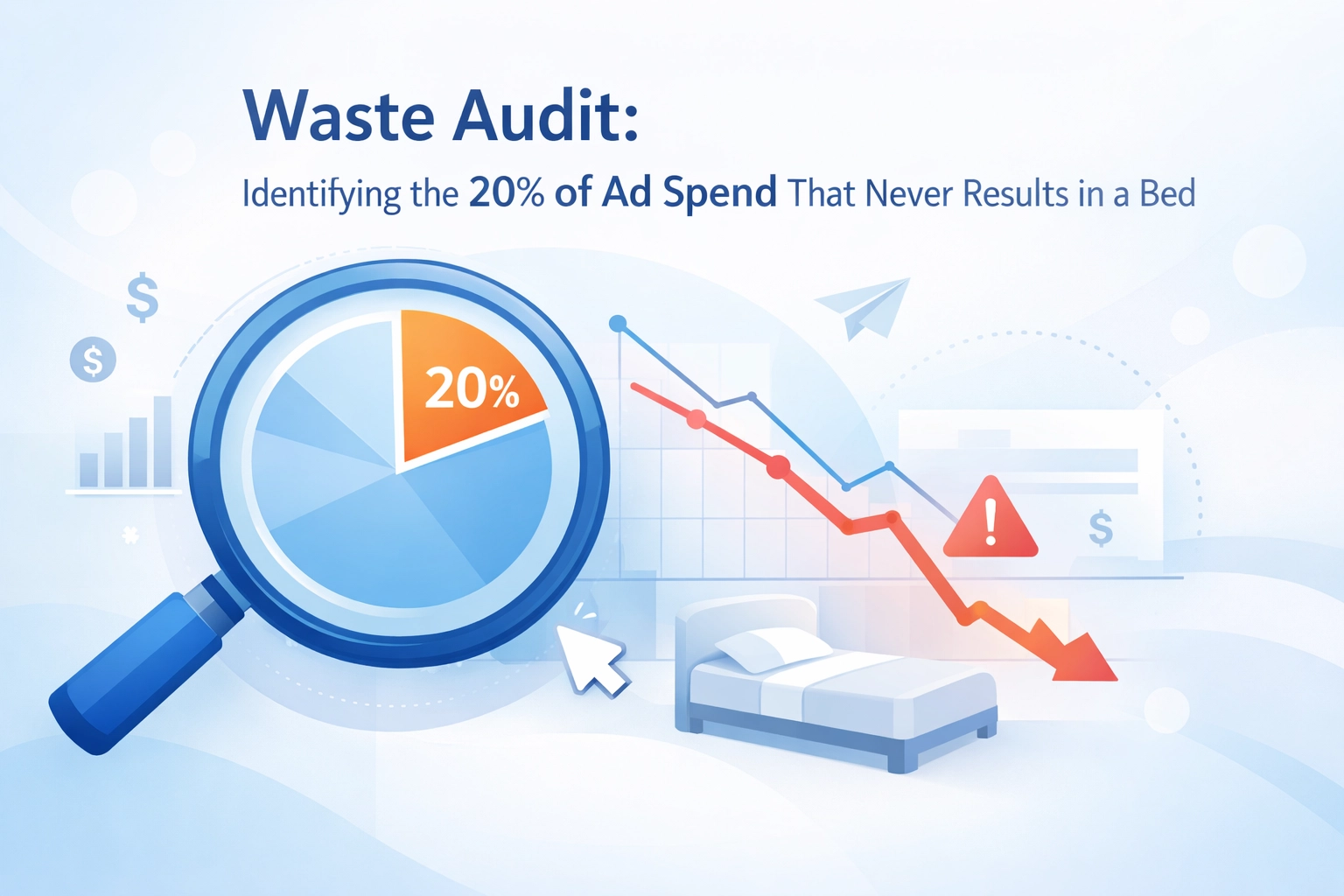
You've probably heard of the Pareto Principle, the idea that 80% of your results come from 20% of your efforts. But here's the uncomfortable truth that keeps facility owners up at night: there's also a flip side where 20% of your ad spend generates absolutely nothing.
No calls. No admissions. No beds filled.
Just money disappearing into the digital void while your competitors are banking actual patients.
If you're spending $30,000, $50,000, or even $100,000+ monthly on paid advertising for your treatment center, there's a solid chance that somewhere between $6,000 and $20,000 of that budget is funding clicks that will never, ever convert into revenue. And honestly? Most facility owners have no clue where that waste is hiding.
Let's fix that.
What a Waste Audit Actually Reveals
A waste audit isn't just glancing at your Google Ads dashboard and hoping for the best. It's a systematic dissection of every dollar you're spending to identify the exact keywords, placements, audiences, and campaigns that are bleeding your budget dry without delivering admissions.
Think of it like this: You wouldn't keep paying a business development rep who brings in zero clients month after month, right? So why are you continuing to fund keywords and ad placements that do the exact same thing?
According to SAMHSA's National Survey data, over 46 million Americans struggle with substance use disorders, yet the average treatment center operates at just 75-80% capacity. The problem isn't a lack of people who need help, it's that your marketing dollars are reaching the wrong people at the wrong time.
The High-Intent vs. Low-Intent Keyword Disaster
Here's where most rehab marketing goes sideways. You're probably bidding on keywords like "signs of addiction" or "what is rehab like" because they have decent search volume and seem relevant. And yes, someone searching those terms might eventually need treatment.
But they're not ready now. They're researching. They're curious. They're not filling out your admissions form today.
Meanwhile, you're paying $15-$45 per click for traffic that has a conversion rate hovering around 0.2%. Do the math on that, and you'll see why your cost-per-admission numbers make your CFO want to scream.
High-intent keywords look different:
- "drug rehab near me accepting admissions today"
- "intensive outpatient program [city name]"
- "detox center that takes [insurance name]"
- "luxury rehab Florida immediate placement"
These searchers aren't browsing. They're ready to make a decision, often within 24-48 hours. The conversion rates on these terms can be 10-15x higher than general informational queries, but you need to know which specific long-tail phrases are actually driving your admits versus which ones just look good on paper.
Key Metrics That Expose the Waste
You can't manage what you don't measure. Here's the data you need to be tracking weekly (not monthly: weekly):
| Metric | What It Reveals | Red Flag Threshold |
|---|---|---|
| Cost Per Admission (CPA) by Keyword | Which specific search terms actually convert | CPA >3x your target average |
| Click-Through Rate (CTR) by Ad Group | Whether your ads are relevant to searchers | CTR <2% for rehab-related searches |
| Conversion Rate by Campaign | Which campaign types drive actual inquiries | CR <1.5% for high-intent campaigns |
| Wasted Spend % | Dollar amount going to non-converters | >15% of total monthly budget |
| Search Query Mismatch Rate | How often broad match shows for irrelevant terms | >30% irrelevant impressions |
That last one: search query mismatch: is where enormous waste hides. Your broad match keyword "alcohol treatment" might be triggering ads for searches like "alcohol treatment for wood furniture" or "how to treat alcohol poisoning at home." Seriously. It happens more than you'd think.
If you're not running weekly search query reports and adding negative keywords aggressively, you're probably wasting 10-20% of your budget right there.
The Geographic Black Hole
Here's another place money evaporates: You're paying for clicks from people who will never, ever travel to your facility.
If you're a California-based residential program that doesn't accept out-of-state Medicaid, why are you showing ads to searchers in Florida, Texas, and New York? Yet I see this constantly when auditing accounts. Default geographic settings that cast way too wide a net, generating expensive clicks from people who: even if they're interested: can't logistically use your services.

The fix requires surgical precision:
- Geo-targeting based on your actual admission data (where do your patients come from?)
- Bid adjustments that reduce spend in low-converting zip codes
- Separate campaigns for local vs. national searches with different messaging and budgets
- Exclusion of areas where you're legally prohibited from marketing or accepting patients
Device and Time-of-Day Waste
Most facility owners don't realize that conversion rates can vary by 300-400% depending on when someone sees your ad and what device they're using.
For example, mobile searchers late at night (10 PM – 2 AM) often have astronomically high conversion rates for detox and crisis intervention services. Meanwhile, desktop searches during business hours might perform better for executive programs and luxury treatment.
But if you're running the same bids 24/7 across all devices, you're overpaying during low-intent hours and underspending during your golden windows. That's waste on both ends.
According to research from the National Institute on Drug Abuse (NIDA), timing interventions when motivation is highest significantly impacts treatment uptake. Your ad scheduling should reflect this reality.
The Retargeting Money Pit
Retargeting can be incredibly effective: or an absolute budget killer. The difference comes down to audience segmentation and frequency capping.
If you're retargeting everyone who visited any page on your website with the same generic ad for 90 days, you're lighting money on fire. Someone who bounced after 8 seconds because they clicked the wrong link should not see your ads 50 times over the next three months.
Smart retargeting separates audiences:
- Website visitors who spent 3+ minutes on clinical pages
- People who started but didn't complete a contact form
- Those who called but didn't admit (requires call tracking integration)
- Previous patients for alumni programming or PHP/IOP step-down
Each group needs different messaging, different frequency caps, and different budget allocations. Treating retargeting as one-size-fits-all is one of the fastest ways to waste 15-25% of your monthly display budget.
Running Your Own Waste Audit (The Checklist)
Look, I'm not going to pretend this is simple. A thorough waste audit of a treatment center's paid media takes our team 12-15 hours minimum, and we do this every day. But if you want to start identifying the obvious waste yourself, here's where to begin:
Week 1: Search Query Analysis
- Download all search queries from the last 90 days
- Identify any query that got >10 clicks with zero conversions
- Add irrelevant queries to your negative keyword list
- Flag high-cost, low-intent terms for bid reduction or pause
Week 2: Geographic Performance Review
- Pull conversion data by state, city, and zip code
- Calculate cost-per-admission by geography
- Exclude or reduce bids in areas with CPA >2x your target
- Increase bids in high-performing local markets
Week 3: Device & Schedule Optimization
- Analyze conversion rates by device (mobile, desktop, tablet)
- Review performance by hour and day of week
- Implement bid adjustments based on actual conversion data
- Test aggressive bid increases during your highest-converting hours
Week 4: Campaign & Ad Group Pruning
- Identify campaigns with spend >$500/month and zero admissions
- Review ad groups with <1% CTR: they need new creative or pausing
- Consolidate fragmented campaigns that compete with each other
- Reallocate budget from low-performers to your proven winners

Why Most Facilities Don't Do This
I know what you're thinking: "This sounds like a full-time job."
You're right. It basically is.
Most facility owners and even marketing directors don't have the time, tools, or frankly the specialized knowledge to execute waste audits properly. You're busy running a treatment center, managing clinical operations, dealing with insurance nightmares, and actually helping people recover.
That's exactly why partnering with a team that specializes in healthcare marketing: specifically addiction treatment marketing: makes financial sense. We run these audits constantly for our clients, and the average waste we identify and eliminate in the first 60 days is between 18-24% of monthly ad spend.
Do the math on your current budget. If you're spending $40,000/month and we eliminate just 20% waste, that's $8,000/month back in your pocket: or reallocated to campaigns that actually fill beds. That's $96,000 annually.
The AI-Powered Detection Advantage
Here's something most agencies won't tell you: Manual audits miss things. Humans can't process millions of data points simultaneously or spot patterns that only emerge when you're analyzing thousands of variables at once.
According to Google's own research, AI-powered bid strategies and anomaly detection can identify spending inefficiencies up to 47% faster than manual analysis. But: and this is critical: the AI is only as good as the strategy and structure you feed it.
We use AI-powered analytics to flag unusual patterns immediately: campaigns suddenly consuming budget at 3x normal rates, keyword groups with declining conversion quality, audience segments showing fatigue, and dozens of other micro-indicators that signal waste.
But we pair that technology with actual human expertise in addiction treatment marketing. The AI tells us where to look; our team tells you what to do about it.
What Happens When You Actually Fix the Waste
Last quarter, we worked with a residential facility in South Florida spending $52,000/month with a cost-per-admission around $4,100. Their executive team was ready to cut the ad budget entirely because the ROI just wasn't there.
After a comprehensive waste audit, we identified:
- $8,400/month going to broad match keywords triggering irrelevant searches
- $6,200/month wasted on geographic areas with zero historical admissions
- $4,800/month on retargeting audiences with <0.1% conversion rates
- $2,900/month during time windows that had never generated a single admit
We eliminated the waste, reallocated those dollars to proven high-intent campaigns, and restructured their entire account architecture. Within 90 days, their cost-per-admission dropped to $2,650 while actually increasing monthly admissions by 23%.
Same budget. Better targeting. More patients.
Your Next Step
You can keep guessing where your ad dollars are going, or you can get surgical about eliminating waste and maximizing ROI.
If you're serious about understanding exactly where your marketing budget is leaking and how to plug those holes, we should talk. Our team at Ads Up Marketing specializes exclusively in addiction treatment marketing, and we've audited hundreds of facility ad accounts over the last several years.
Call us at 305-539-7114 and let's run a preliminary waste audit on your current campaigns. We'll identify the obvious leaks within the first week and give you a clear roadmap for what's salvageable and what needs to be cut immediately.
Because here's the thing: Every dollar you waste on clicks that don't convert is a dollar you can't spend reaching someone who actually needs your help today. And in this industry, that matters more than just about anything else.
Stop funding the 20% that's giving you nothing. Let's put that money where it actually fills beds and changes lives.
Focus Keyword: rehab ad spend waste audit 2026