You've built a solid referral network. Admissions are up, census looks good, and everything seems to be humming along. Then one day, you get a letter from your attorney, or worse: a notice from the Office of Inspector General. Suddenly, those handshake agreements and informal arrangements you've relied on for years are under federal scrutiny.
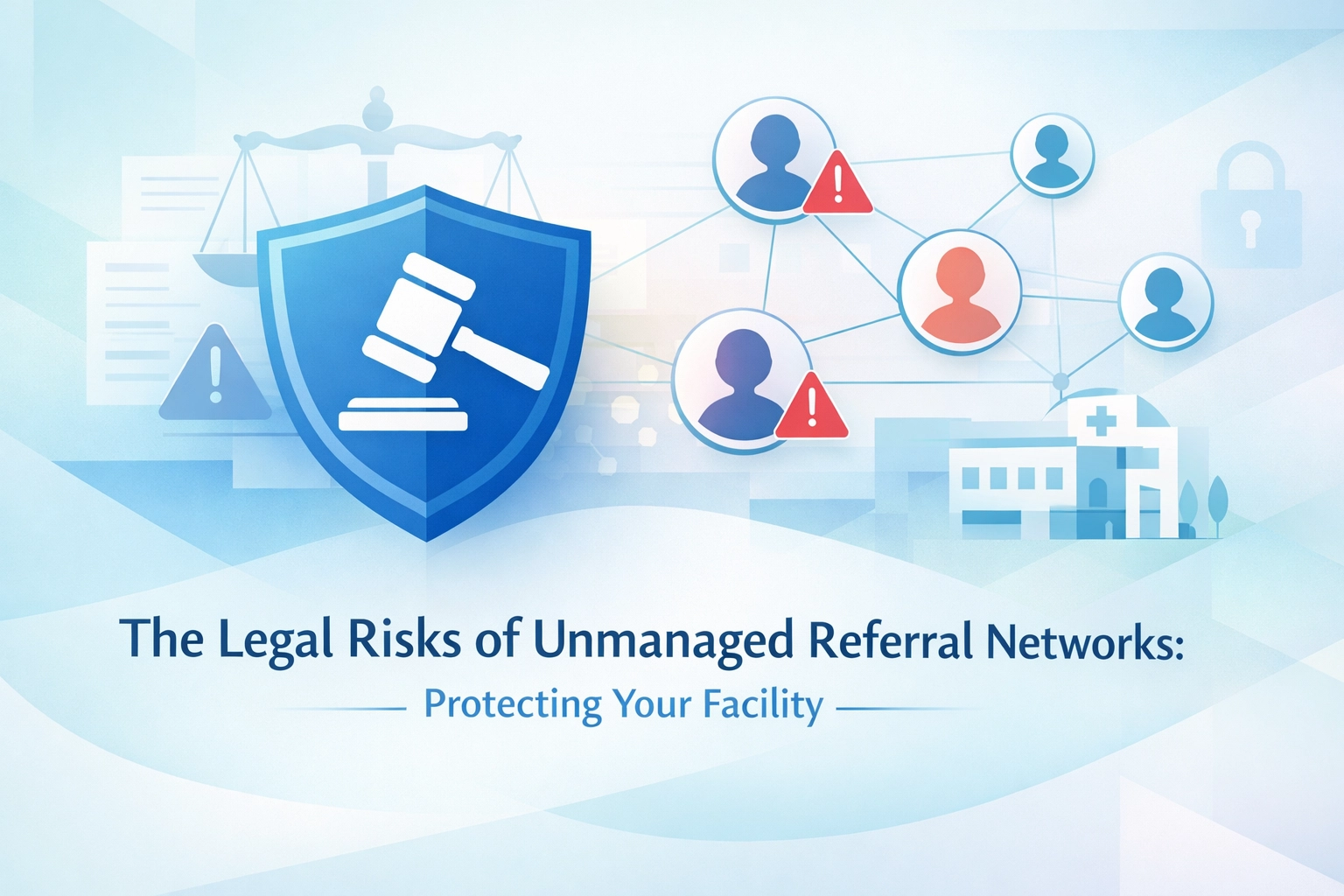
Sound like a nightmare? For many treatment center owners, it's a reality that hits harder than they ever imagined. Unmanaged referral networks aren't just operationally risky: they're legal landmines that can trigger six-figure fines, exclusion from federal healthcare programs, and even criminal prosecution.
The harsh truth is this: good intentions don't protect you from bad compliance. If your referral relationships aren't properly documented, transparently structured, and regularly audited, you're playing with fire. And in the addiction treatment space, where federal scrutiny is at an all-time high, that fire burns fast.
What Are Unmanaged Referral Networks?
Let's start with the basics. A referral network is any collection of individuals or organizations that send clients to your facility: think interventionists, sober living operators, alumni networks, medical directors, therapists, or case managers.
An unmanaged referral network is one where these relationships operate without proper oversight, documentation, or compliance controls. That means:
- No written agreements outlining roles and compensation
- Payments that vary based on referral volume rather than services rendered
- Vague or nonexistent job descriptions for medical directors or consultants
- Below-market pricing on leases or services to incentivize referrals
- No disclosure to clients about referral relationships
If any of this sounds familiar, you're not alone. But you are exposed.

The Legal Minefield: What's at Stake
Federal regulators don't mess around when it comes to healthcare referral arrangements. The two big laws you need to understand are the Anti-Kickback Statute (AKS) and the Stark Law, both of which were designed to prevent improper financial incentives from influencing patient care decisions.
According to the Substance Abuse and Mental Health Services Administration (SAMHSA), compliance with federal healthcare regulations is non-negotiable for facilities accepting insurance or participating in federal programs. Violations can result in exclusion from Medicare and Medicaid, civil penalties up to $100,000 per violation, and potential criminal charges.
Here's a quick breakdown of how unmanaged referral networks can blow up your compliance posture:
| Risk Area | Violation Type | Potential Penalty | Common Trigger |
|---|---|---|---|
| Medical Director Flat Fees | AKS / Stark Law | $100K+ per violation | Vague job duties, minimal documentation |
| Referral-Based Bonuses | AKS | Civil fines + exclusion | Compensation tied to admissions volume |
| Below-Market Leases | AKS / Stark Law | Civil fines + criminal charges | Office space rented to referral sources at discounted rates |
| Undisclosed Arrangements | State Consumer Protection Laws | Civil penalties + lawsuits | No written disclosure to clients |
| Joint Ventures with Unequal Risk | AKS | Exclusion from federal programs | Passive investors generating referrals without sharing real risk |
The National Association of Addiction Treatment Providers (NAATP) emphasizes that ethical marketing and referral practices aren't just about avoiding fines: they're about maintaining trust and protecting patient welfare in a vulnerable population.
The Anti-Kickback Statute: Why It Matters for Treatment Centers
The Anti-Kickback Statute makes it illegal to knowingly offer, pay, solicit, or receive anything of value in exchange for referrals of patients covered by federal healthcare programs. That includes Medicare, Medicaid, TRICARE, and other federally funded insurance.
Here's where treatment centers trip up most often:
Medical Director Agreements That Don't Pass the Smell Test
You hire a well-connected physician as your medical director, pay them $5,000 a month, and their role is… loosely defined. They attend a few meetings, sign off on some paperwork, and: surprise: they also refer a steady stream of patients your way.
If you can't document exactly what services they're providing, how many hours they're working, and that their compensation reflects fair market value (FMV) for those specific services, you've got a problem. Even worse? If their compensation increases as referral volume goes up, you're staring down an AKS violation.
Compensation Tied to Referral Volume
Any arrangement where payments fluctuate based on how many clients someone sends you is a red flag. This includes:
- Bonuses for hitting admission targets
- Tiered commission structures
- "Performance incentives" that track referral growth instead of legitimate quality metrics
The law doesn't care if you call it a "quality bonus" or a "performance incentive." If the math shows the payment rises when referrals rise, it looks like a kickback.

Below-Market Leases and Favorable Pricing
Let's say you rent office space to a therapist who refers clients to your facility: but you charge them half the going market rate. Or you provide free lab services, discounted urine testing, or equipment to a referral source.
Even if you're not directly paying them cash, discounted pricing functions as an inducement. Under both the AKS and Stark Law, these arrangements create illegal financial incentives tied to referral volume.
Stark Law and Self-Referral Prohibitions
While the Anti-Kickback Statute focuses on intent to induce referrals, Stark Law is a strict liability statute: meaning you can violate it even without bad intent. Stark Law prohibits physicians from referring patients to entities with which they (or their immediate family members) have a financial relationship, unless a specific exception applies.
For addiction treatment centers, Stark Law most commonly comes into play with:
- Lab services and toxicology testing
- Designated health services (DHS) like outpatient prescription drugs
- Medical director arrangements that don't meet safe harbor requirements
If your medical director refers patients to your facility and you're billing for any DHS, you need to ensure the arrangement fits within a Stark Law exception: typically the personal services exception, which requires written contracts, FMV compensation, and clearly defined services.
Documentation Failures: The Silent Killer
Here's the thing most facility owners don't realize: even if your referral arrangements are legitimate, poor documentation can sink you. Federal investigators don't take your word for it. They want to see:
- Written agreements with clearly defined roles
- Time logs or activity reports showing services rendered
- FMV analyses supporting compensation amounts
- Board meeting minutes approving agreements
- Disclosure forms signed by clients
Without a paper trail, your compliance defense evaporates. And in whistleblower cases: which account for the majority of enforcement actions: missing documentation is exactly what investigators latch onto.

Data Privacy and Consumer Protection Compliance
Beyond AKS and Stark, unmanaged referral networks expose you to HIPAA violations and state consumer protection laws. If referral sources are collecting and sharing patient information without proper Business Associate Agreements (BAAs) in place, you're violating federal privacy rules.
And if clients aren't informed about referral relationships upfront: especially when those relationships involve financial compensation: you may be violating state consumer protection statutes that require transparency in healthcare transactions.
The National Institute on Drug Abuse (NIDA) has highlighted the importance of ethical patient recruitment practices, noting that vulnerable populations like those seeking addiction treatment are entitled to full transparency about financial relationships that might influence their care.
Referral Fraud: The Risk You Can't Ignore
Unmanaged networks are also vulnerable to referral fraud: where bad actors manipulate your system to generate fake or illegitimate referrals. This could mean:
- Body brokers creating phantom clients
- Sober living operators billing for services never rendered
- Alumni coordinators receiving kickbacks for steering people to specific labs or pharmacies
Referral fraud doesn't just cost you money: it damages your reputation, invites regulatory scrutiny, and can lead to criminal investigations if you're deemed complicit.
How to Protect Your Facility (and Your License)
So what's the solution? It starts with establishing referral program governance that treats compliance as seriously as clinical outcomes. Here's what that looks like in practice:
1. Document Everything
Every referral relationship needs a written agreement that outlines:
- Specific services being provided
- Time commitments and deliverables
- Compensation structure with FMV support
- Termination clauses
- Compliance representations
2. Conduct Regular Audits
You can't manage what you don't measure. Schedule quarterly reviews of all referral arrangements to identify:
- Patterns suggesting fraud (e.g., the same sober living sending only high-reimbursement cases)
- Compensation creep tied to referral volume
- Missing documentation or unsigned agreements
3. Implement Staff Training
Your admissions team, business development staff, and clinical leadership need to understand AKS, Stark Law, and your facility's compliance policies. Make training mandatory and document attendance.
4. Disclose Relationships to Clients
Transparency isn't optional. Clients deserve to know if the person who referred them has a financial relationship with your facility. Create disclosure forms and have them signed during intake.
5. Get Legal Review Before New Arrangements
Before you enter into a joint venture, hire a new medical director, or create a new referral incentive structure, have healthcare compliance counsel review it. The cost of a legal review is pennies compared to the cost of an enforcement action.
How Ads Up Marketing Protects Your Compliance Posture
At Ads Up Marketing, we understand that growing your census and staying compliant aren't mutually exclusive: but they do require careful strategy. Our digital marketing services are built specifically for addiction treatment facilities, with compliance baked into every campaign.
We help you:
- Build transparent, compliant lead generation systems that don't rely on questionable referral arrangements
- Create SEO strategies that drive organic traffic from high-intent searches, reducing dependence on referral networks
- Implement conversion tracking to identify which marketing channels deliver real ROI: without legal risk
- Develop social media marketing campaigns that connect you directly with clients, bypassing intermediaries
When you work with us, you're not just getting better marketing: you're getting a partner who understands the regulatory landscape and builds campaigns that protect your facility while driving admissions.
Curious how compliant, high-performing marketing could transform your facility's growth trajectory? Give us a call at 305-539-7114 or visit our contact page. We'll show you exactly how to grow your census without the legal exposure.
The Bottom Line
Unmanaged referral networks are ticking time bombs. The short-term gains they offer: higher census, easier admissions: are dwarfed by the long-term risks: federal investigations, exclusion from insurance networks, financial ruin, and damaged reputations.
The good news? With the right systems, documentation, and marketing strategy, you can protect your facility while still growing your admissions. It just takes intentionality, transparency, and a commitment to doing things the right way.
Don't wait for a whistleblower complaint or an OIG letter to force your hand. Take control of your referral compliance today. Whether you tackle this in-house or bring in experts who specialize in addiction treatment marketing and compliance, the important thing is to act now.
Ready to build a compliant, sustainable growth strategy? Call 305-539-7114 today. We'll help you plug the gaps: and build a marketing engine that works without the legal headaches.