
INSIGHTS
The ‘Amazon Effect’ on Behavioral Health: Meeting Modern Expectations
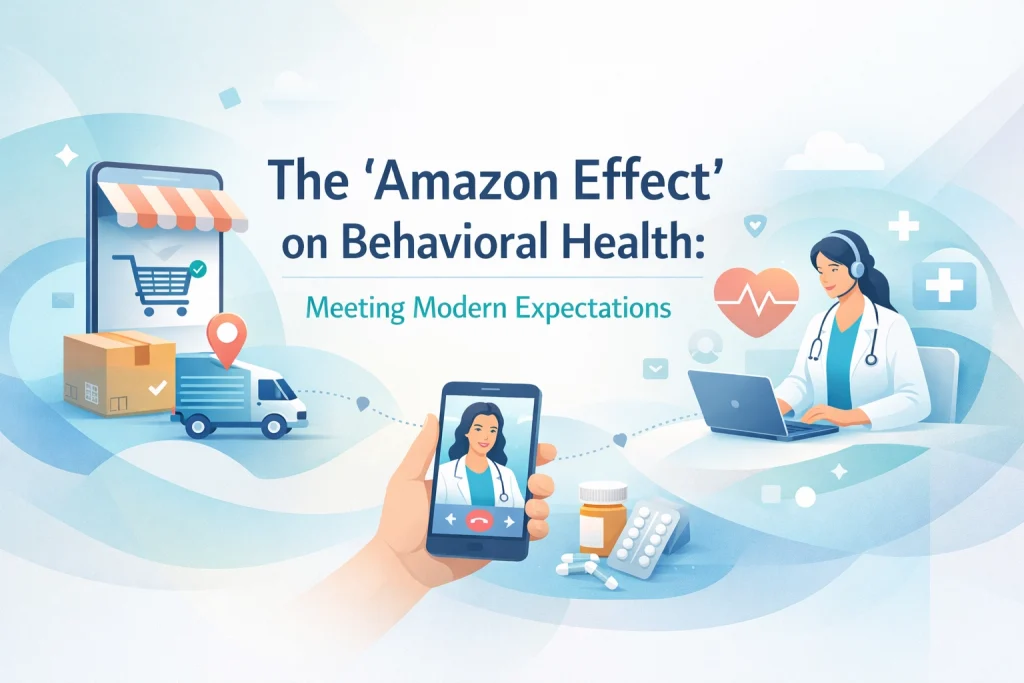
It’s 3:00 AM. A mother is sitting in her kitchen, the glow of her smartphone illuminating a face lined with exhaustion and fear. Her son has hit a breaking point, and she needs help: now. She isn’t just looking for a "good" facility; she’s looking for the one that responds first, provides the clearest information, and makes the admission process feel as seamless as ordering a pair of shoes on Amazon.
This is the reality of the "Amazon Effect" in the behavioral health industry.
As we navigate 2026, the gap between how people shop for retail goods and how they seek healthcare has virtually vanished. Your prospective patients (and their families) are conditioned by years of instant gratification, one-click checkouts, and total price transparency. If your facility still relies on "leave a message" contact forms or 24-hour VOB turnaround times, you aren't just behind the curve: you’re losing admissions to the center down the street that understands the modern consumer.
At Ads Up Marketing, we see this struggle every day. You provide world-class clinical care, but your digital "front door" feels like it’s stuck in 2015. Let’s talk about how to fix that.
Table of Contents
- The Law of Least Mental Effort
- Transparency: The New Currency of Trust
- The 3:00 AM Crisis: Instant Communication or Bust
- Performance Impact: Traditional vs. Amazon-Era Marketing
- Overcoming the VOB Bottleneck
- Why Your Digital Presence is Your New Admissions Coordinator
The Law of Least Mental Effort
In psychology, the Law of Least Mental Effort suggests that if there are several ways of achieving the same goal, people will eventually gravitate to the least demanding course of action. When someone is in the middle of a mental health or substance abuse crisis, their cognitive load is already at maximum capacity. They are suffering from decision fatigue and high cortisol levels.
Amazon mastered this by removing "friction." They introduced "Buy Now with 1-Click" because they knew that every extra second a customer spent in a checkout line was a second they could change their mind.
In the behavioral health space, friction looks like:
- Websites that don't load on mobile.
- Hidden "Contact Us" buttons.
- Lengthy intake forms that ask for a life history before a name.
- Lack of clear information regarding insurance and costs.
If you make a family work to find out if you can help them, they will find someone who makes it easy.

Caption: A seamless, mobile-responsive intake portal is the 2026 standard for reducing patient friction.
Transparency: The New Currency of Trust
Think about the last time you bought something on Amazon. Did you buy the product with zero reviews and one blurry photo? Probably not. You looked for high-resolution images, detailed descriptions, and hundreds of verified reviews.
According to the National Association of Addiction Treatment Providers (NAATP), transparency and ethics are now the primary drivers of long-term brand equity in our industry. Modern consumers expect to see:
- Who is treating them? (Real photos of the medical team, not stock photos).
- Where will they stay? (Video tours and honest facility imagery).
- What does it cost? (Clear insurance verification and financial transparency).
I know what you’re thinking: "Healthcare is more complex than a retail transaction." You’re right. But the expectation for transparency doesn't change just because the service is clinical. If you are hiding your medical team, you are inadvertently signaling that you have something to hide. In 2026, professionalism is a sales tool, and high-quality visuals are the bedrock of that trust.
The 3:00 AM Crisis: Instant Communication or Bust
The "Amazon Effect" means that "business hours" no longer exist. If a lead hits your website at 3:00 AM, they expect a response: if not a human one, then at least an intelligent automated one that can start the intake process.
According to SAMHSA, the window of willingness for someone seeking treatment is often incredibly small. If you miss that window because your call center didn't pick up or your chat bot was offline, that lead is gone forever. This is why advanced intake techniques are no longer optional for facilities trying to hit their 50-bed milestone.
Performance Impact: Traditional vs. Amazon-Era Marketing
To give you a better idea of the ROI involved in updating your strategy, look at the data below. This compares a "Traditional" facility (slow response, low transparency) with an "Optimized" facility (instant response, high transparency) based on 2026 industry benchmarks.
| Metric | Traditional Facility (2025 Model) | Amazon-Era Optimized (2026 Model) | Improvement |
|---|---|---|---|
| Lead-to-Call Conversion | 3.2% | 8.7% | +171% |
| Average VOB Speed | 4-6 Hours | < 15 Minutes | 95% Faster |
| Cost Per Admission (CPA) | $8,500 – $12,000 | $4,500 – $6,500 | ~45% Reduction |
| Web Exit Rate (Mobile) | 65% | 22% | -66% Bounce |
| Trust Score (User Rating) | 3.1 Stars | 4.8 Stars | +54% |
Data based on Ads Up Marketing internal benchmarks and 2026 CPA projections.
Overcoming the VOB Bottleneck
If there is one area where the Amazon Effect hits the hardest, it’s Insurance Verification (VOB). In the retail world, you know instantly if your card was declined. In the rehab world, patients are often told "we'll call you back in a few hours" after providing their insurance info.
That delay is a lead-killer.
By the time you call them back to say they’re covered, they’ve already spoken to two other centers. One of those centers likely had an automated VOB system or a highly trained call center blitz team that gave them an answer in minutes.
To compete in 2026, you must treat your VOB process as a marketing function, not just a billing function. It is the "Add to Cart" moment of your facility. If you need help streamlining this, call us at 305-539-7114. We specialize in integrating these systems so your marketing dollars don't go to waste.

Caption: Real-time data dashboards help facility owners track CPA vs. CPL in a fast-paced market.
Why Your Digital Presence is Your New Admissions Coordinator
In the past, marketing was just about getting the phone to ring. Today, your digital presence: your website, your reviews, your social media, and your SEO: does 70% of the heavy lifting before the person even dials your number.
Modern consumers are doing their homework. They are looking for LegitScript certification to ensure you’re legitimate. They are checking to see if you understand patient privacy and HIPAA in your digital interactions. They are looking for a reason to trust you.
How Ads Up Marketing Can Help
The "Amazon Effect" can feel overwhelming, especially when you’re trying to focus on clinical outcomes. You shouldn't have to be a tech genius to run a successful treatment center, but you do need a partner who understands the intersection of healthcare compliance and modern consumer psychology.
We help you:
- Reduce Friction: We audit your user journey to ensure it's as easy as a "One-Click" purchase.
- Boost Transparency: We help you showcase your team and facility in a way that builds immediate trust.
- Track Everything: We move beyond "cost per lead" and focus on tracking the full patient journey to ROI.
Are you ready to modernize your admissions funnel?
The expectations of 2026 aren't going away. You can either adapt to the Amazon Effect or watch your census drop as more agile competitors take the lead. I know you're working hard to save lives: let us handle the work of finding the people who need you most.
Don't let another 3:00 AM crisis call go to your competitors. Let’s build a system that meets the moment.
Contact Ads Up Marketing today at 305-539-7114 or visit our Custom Solutions page to start your transformation.