Focus Keyword: rehab call center scripts vs conversation
Imagine this: A person struggling with substance abuse finally hits their breaking point. They’ve spent all night researching, crying, and fighting the internal battle of whether or not to seek help. They pick up the phone, heart racing, and dial your facility.
On the other end, an admissions rep picks up and immediately starts reading: "Hello, thank you for calling [Facility Name]. My name is John. To better assist you, may I start by getting your full legal name and your primary insurance provider?"
The caller pauses. They didn't want a data entry clerk; they wanted a lifeline. Within thirty seconds, they feel like just another "lead" in a CRM. The wall goes back up, the answers become one-worded, and the call ends without an admission.
If your call center relies on rigid, word-for-word scripts, you aren't just losing calls: you’re killing your conversions and your ROI. In the world of healthcare marketing, especially addiction treatment, the "human element" isn't a luxury; it’s the entire product.
The Core Problem: Why Robots Don't Close Admissions
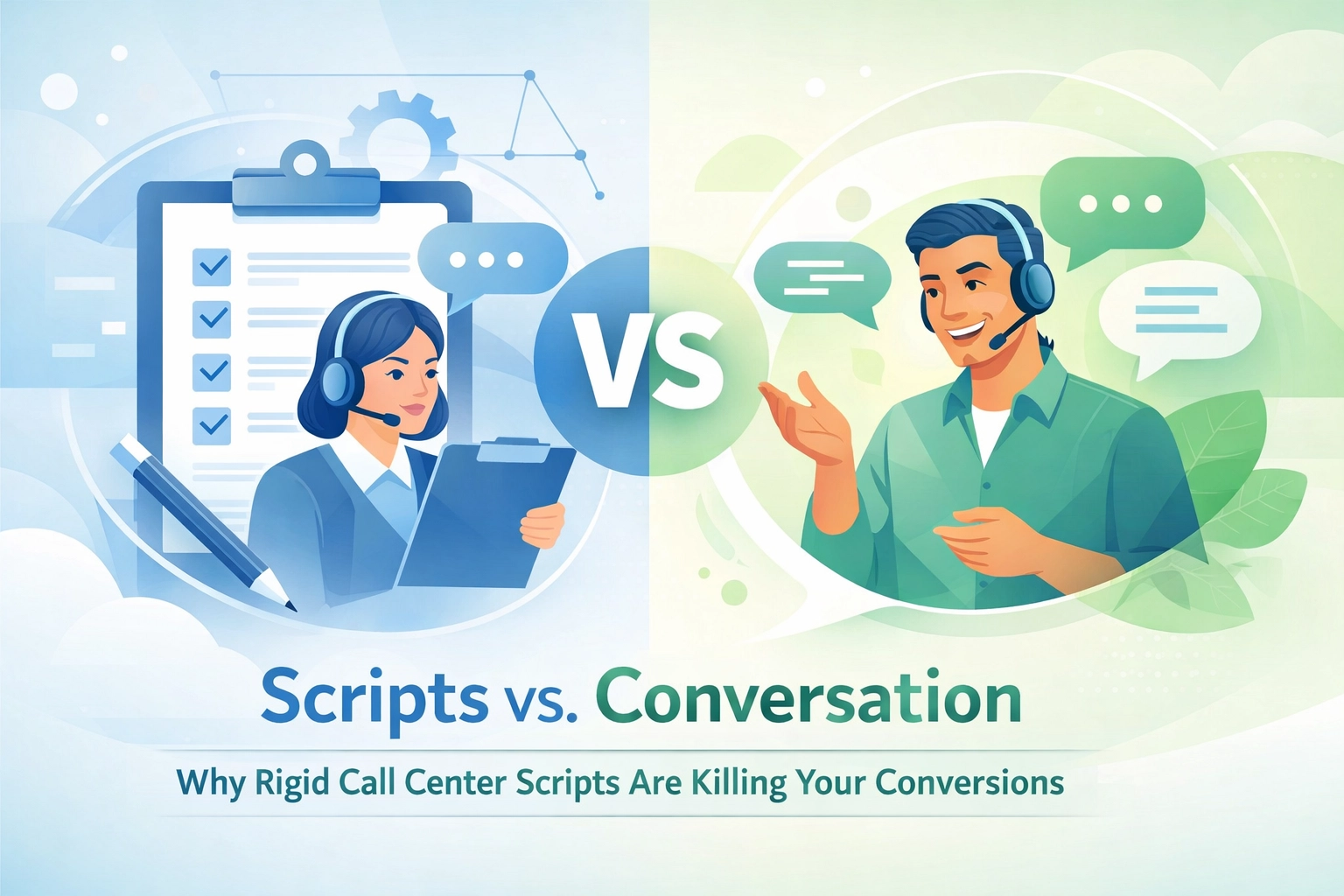
When we talk about rehab call center scripts vs conversation, the debate usually centers on "consistency." Owners want to ensure every agent says the right things to stay compliant and professional. But there’s a massive difference between consistency and rigidity.
According to recent consumer studies, over three-quarters of people agree that how an agent delivers a message significantly impacts their experience. If your team sounds like they are reading from a teleprompter, the caller feels undervalued. In a high-stakes environment like a drug rehab center, feeling "undervalued" leads to immediate distrust.
1. Missing the Emotional Cues
Rigid scripts force agents to focus on the next line of the script rather than the last sentence the caller said. If a mother is crying on the phone about her son’s overdose, and your agent's script says they must ask for the zip code next, you’ve lost the connection. Scripts often cause agents to ignore emotional cues that are vital for building rapport.
2. The "Canned Response" Disconnect
When an agent is tied to a script, they often give answers that don't quite match the question. You’ve been there: you ask a specific question about a service, and the representative gives you a 3-paragraph pre-written response that only half-answers you. It’s frustrating. It makes the agent appear incompetent, even if they are highly trained.

Performance Impact: Scripted vs. Conversational Frameworks
As a facility owner or CFO, you need to see the numbers. How does this actually affect your bottom line? Let’s look at the data breakdown of how a conversational approach compares to a rigid scripted one in a typical high-intent call environment.
Performance Impact Comparison
| Metric | Rigid Scripting | Conversational Framework |
|---|---|---|
| Initial Connection Rate | High (Process driven) | High (Empathy driven) |
| Average Call Duration | Short (Checklist focused) | Medium (Relationship focused) |
| Lead-to-Admission Rate | 8% – 12% | 18% – 25% |
| VOB Request Success | Moderate | High |
| Caller Trust Score | Low | High |
| Cost Per Admission (CPA) | Higher due to lost leads | 30% – 40% Lower |
Data based on internal performance audits for drug rehab leads and industry benchmarks.
The Competitive Advantage: Building Authentic Connections
So, what’s the alternative? Do you just let your agents say whatever they want? Absolutely not. That’s a recipe for compliance nightmares and LegitScript violations.
The solution is a Conversational Framework.
Instead of a script that says: "Read this exact sentence," a framework says: "Ensure you cover these three points, but use the caller’s name and reference their specific struggle."
Effective Frameworks Should:
- Prioritize Reflective Listening: Instead of waiting for their turn to speak, agents should paraphrase what the caller just said. "I hear how much weight you've been carrying for your family, and I want you to know you're in the right place."
- Allow for Personalization: Agents need the freedom to inject their personality. This builds a real-world connection that makes the caller feel like a person, not a case number.
- Focus on the "Why": A script asks "What drugs are you using?" A conversation asks "What’s been happening lately that made you decide today was the day to call?"
How Rigid Scripts Hurt Your SEO and Marketing ROI
You might be wondering: "I'm the Digital Marketing Manager, why do I care about the call center?"
Because your SEO strategy and PPC campaigns are only as good as the people answering the phone. If Ads Up Marketing works tirelessly to get you the highest quality drug rehab marketing leads, but your call center treats them like a grocery list, your ROI will tank.
When your conversion rates are low at the call center level, your "Cost Per Admission" skyrockets. You might blame the leads, but the reality is often the handling of those leads. By implementing conversion tracking, we can see exactly where the disconnect happens.
Are people hanging up during the "insurance intake" portion of the script? That’s a sign your script is too rigid and invasive too early.

Balancing Structure with Empathy
I know what you're thinking: "If I don't give them a script, they’ll miss the VOB info or forget to mention our clinical modalities."
It’s a valid concern. We advocate for a "Guideline" approach. Think of it like a GPS. The GPS gives you the destination (the admission) and the key turns (the VOB, the clinical fit, the travel arrangements), but it doesn’t tell you exactly how to move your hands on the steering wheel.
The 3-Step Transition to Conversational Excellence
- The "Listen First" Rule: Train your agents to let the caller speak for at least 60-90 seconds before asking a single data-collection question.
- The "Bridge" Technique: Teach agents how to bridge from an emotional moment into a logistical one. "I can tell how much you want to get your life back. To see how we can best support that journey, let's look at your insurance options so we can take the financial stress off your plate."
- Regular Call Audits: Don't just look at the "did they admit" stat. Listen to the tone. Was there a laugh? Was there a moment of shared empathy? If the call sounds like a robot, it’s a fail, even if they got the insurance info.
Why This Matters in 2026
The addiction treatment landscape is more competitive than ever. Patients and their families are more educated. They can smell a "sales pitch" from a mile away. Organizations like SAMHSA and the NAATP emphasize the importance of ethical, person-centered care. That care starts the second the phone rings.
If your facility is struggling to turn clicks into patients, the problem might not be your marketing. It might be the "scripted" wall you've built between your staff and the people who need them.
Let Us Help You Bridge the Gap
At Ads Up Marketing, we don't just "run ads." We look at your entire funnel. From the first search on Google to the moment the patient walks through your front door, we ensure every touchpoint is optimized for conversion.
Are your rigid scripts killing your business? Are you tired of seeing high-quality leads vanish because of a robotic intake process?
We can help you audit your current process, optimize your lead flow, and train your team to convert with empathy.
Don't let another life-saving opportunity slip through the cracks. Reach out to us today for a free website audit or a consultation on your digital strategy.
Call us now at 305-539-7114 or visit our contact page to get started.
FAQs About Call Center Conversions
Q: Can we still be HIPAA compliant without a rigid script?
A: Absolutely. HIPAA is about how you handle data, not the exact words you use to ask for it. You can be conversational while still following all privacy protocols.
Q: How long does it take to see results after switching to a framework?
A: Often, you’ll see an increase in "call length" and "secondary contact" rates (call-backs) within the first week. Actual admission increases usually follow within 30 days.
Q: Do you offer training for admissions teams?
A: We provide the data and the strategy to help your admissions directors implement these changes effectively, ensuring your PPC and SEO efforts aren't wasted.
Stop being a robot. Start being a resource.