
Let's talk money. Not the feel-good stuff about "brand awareness" or "engagement metrics", actual dollars spent and beds filled. Because in 2026, if you're still making marketing decisions based on vanity metrics or outdated benchmarks, you're probably bleeding cash without even knowing it.
This week's ROI deep-dive covers four critical areas every rehab owner needs to master: understanding the true cost of a lead, building SEO equity that pays off long-term, auditing PPC campaigns before they drain your budget, and finally, finally, knowing exactly which ad dollar put that patient in a bed.
The True Cost of a Lead: Why CPC is a Dangerous Vanity Metric
Your PPC agency sends you a report showing a $12 cost-per-click. You think, "Not bad." But here's the problem: CPC tells you absolutely nothing about whether you're making money.
Cost-per-click is like judging a restaurant by how cheap the parking is. Sure, it's part of the experience, but it has zero bearing on whether the food is any good or if you'll come back.
What actually matters? Let's break it down with real numbers:
| Metric | Campaign A | Campaign B |
|---|---|---|
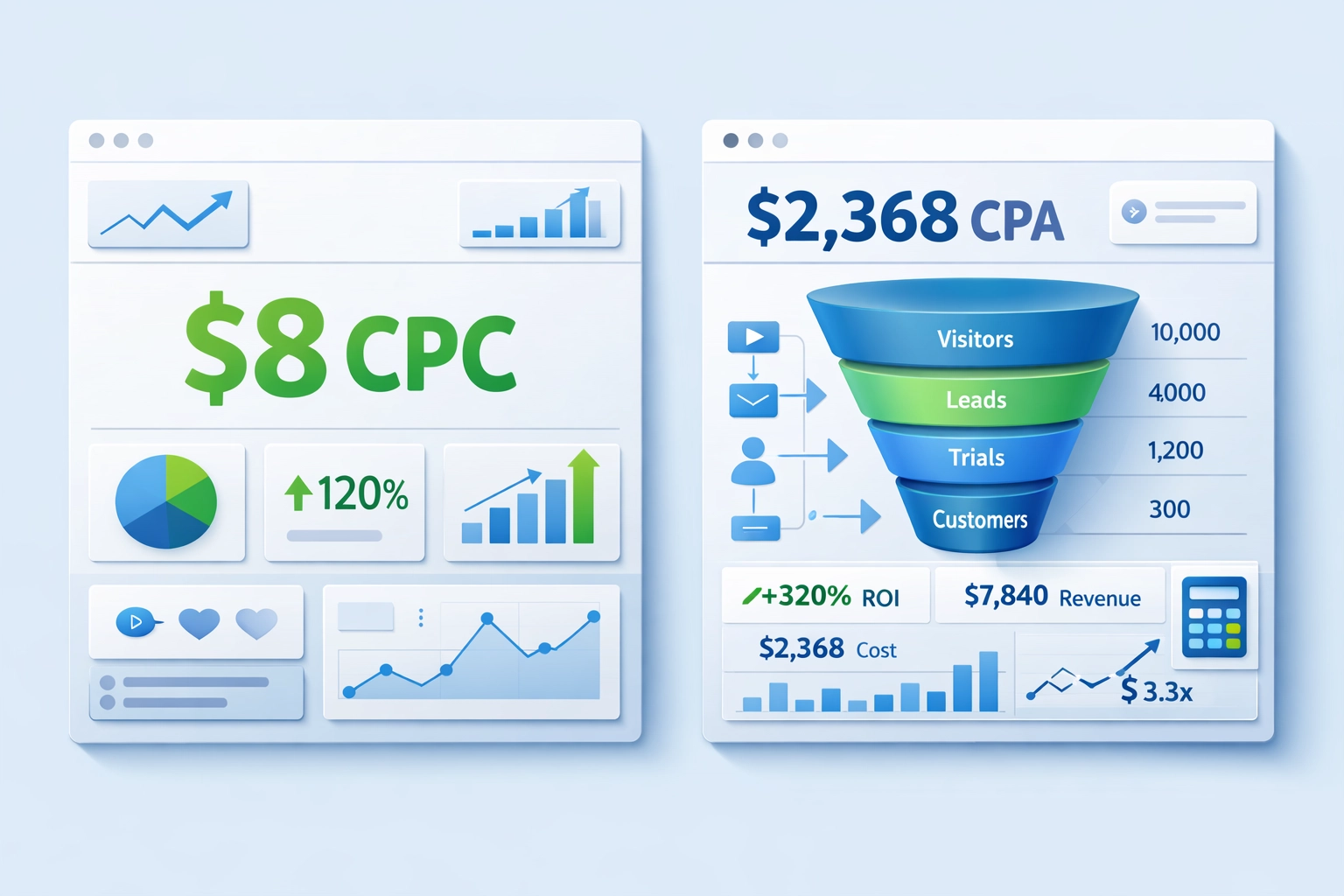
| Cost Per Click (CPC) | $8 | $25 |
| Click-Through Rate | 4.2% | 1.8% |
| Landing Page Conversion | 3% | 12% |
| Cost Per Lead (CPL) | $267 | $521 |
| Lead-to-Admission Rate | 8% | 22% |
| Cost Per Admission (CPA) | $3,338 | $2,368 |
Campaign A looks like a winner if you're only watching CPC. But when you follow the money all the way to an actual admission? Campaign B is $970 cheaper per bed filled.
And let's be clear about today's reality: if you're running out-of-network or high-acuity programs in 2026, you're looking at CPAs closer to $10,000 per admission. That's not a typo. The old $6k benchmark from 2019? Gone. Google's AI automation, increased competition, and tighter compliance have pushed that floor way up. Even blended across all payer types, you'd be lucky to see $2k-$3k these days.
So what should you track instead of CPC?
Start here:
- Cost per qualified lead (someone who actually picks up the phone and has insurance)
- Lead-to-VOB completion rate (how many leads make it through verification)
- VOB-to-admission conversion (the money shot)
- Total cost per admission by payer type (in-network vs. OON vs. self-pay)
According to SAMHSA's treatment facility locator data, there are over 14,500 addiction treatment facilities in the U.S.: all competing for the same search terms. That competition is exactly why CPC keeps climbing while conversion rates stay flat or decline.
If your agency is still sending you reports that lead with CPC and bury the admission data on page three, that's a red flag. At Ads Up Marketing, we reverse that: admissions come first, and everything else is context.
Want to see what your actual cost-per-admission looks like broken down by campaign, keyword, and payer type? Call us at 305-539-7114 and we'll walk you through a real audit: not a sales pitch.
SEO for the Long Haul: Why Your 2026 Strategy Starts with 2025 Content
Here's the uncomfortable truth about SEO: the content you publish today won't really pay off until next year.
I know. You want results now. But Google doesn't work on your timeline: it works on trust, authority, and time. The facilities dominating search results in February 2026? They started building that foundation in 2024 and 2025.
Think of SEO like planting a tree. You can't plant it today and expect shade tomorrow. But if you never plant it, you'll still be standing in the sun five years from now while your competitors are relaxing in the shade they built.
Here's the timeline most rehab owners don't understand:
- Months 1-3: Google indexes your content, but you're basically invisible
- Months 4-6: You start appearing on page 2 or 3 for long-tail phrases
- Months 7-9: With consistent publishing, you crack page 1 for niche terms
- Months 10-12: Domain authority builds, you compete for broader terms
- Year 2+: Compounding returns: older content ranks higher, new content ranks faster
The National Institute on Drug Abuse has been publishing evidence-based addiction content for decades. Guess who owns the top search results for nearly every treatment-related query? Exactly.
You're not NIDA, but the principle is the same: consistency over time beats sporadic intensity. Publishing 20 killer blog posts this month and then going dark for six months? That's worse than publishing 2-3 solid posts every single week for a year.
What should your 2026 SEO strategy actually look like?
Content Pillars to Own:
- Treatment modalities you specialize in (EMDR, DBT, trauma-informed care)
- Insurance and financial questions (What does Florida Blue cover? Does Medicare pay for detox?)
- Local market dominance (best rehab in Tampa, luxury treatment in South Florida)
- Clinical differentiation (dual diagnosis, co-occurring disorders, medication-assisted treatment)
The key is specificity. Don't write "What is Rehab?": write "What Happens During the First 72 Hours of Medical Detox at a Florida Facility?" That's the kind of long-tail content that converts searchers who are ready to make a decision.
Need help building an SEO strategy that actually pays off? We've got the systems and expertise to make it happen. Give us a call at 305-539-7114.
PPC Audit Checklist: How to Spot a Failing Campaign in 15 Minutes
You don't need a PhD in digital marketing to know if your PPC campaigns are working. You just need to know where to look: and what numbers actually matter.
Grab your Google Ads dashboard and let's run through this in real time.
1. Check your Search Terms Report (2 minutes)
Open it. Scroll. If you see terms like "free rehab," "rehab cost," or "jobs at rehab": your negative keyword list is broken. You're paying for clicks from people who will never become patients.
Our guide on negative keywords breaks this down in detail, but here's the fast version: if more than 15% of your search terms are irrelevant, you're wasting money.
2. Look at Device Performance (3 minutes)
Filter by device. If mobile is eating 60%+ of your budget but has a conversion rate under 2%, you've got a landing page problem. Most rehab websites aren't mobile-optimized for speed, and every extra second of load time kills conversions.
3. Check Geographic Performance (3 minutes)
Are you paying for clicks from states you don't accept patients from? It happens more often than you'd think. If your facility is in Florida but 30% of your clicks are coming from California, someone messed up the geo-targeting.
4. Review Ad Copy vs. Landing Page Alignment (4 minutes)
Click on your top ads. Do they land on a page that matches the promise? If your ad says "Luxury Detox in Miami" but the landing page is a generic homepage, your conversion rate is DOA.
5. Analyze Your Quality Score (3 minutes)
If most of your keywords have a Quality Score below 5, Google is penalizing you with higher CPCs. That's a signal that your ads, landing pages, or both need serious work.
| Quality Score | What It Means | Action Required |
|---|---|---|
| 8-10 | Excellent – Low CPC | Keep optimizing |
| 6-7 | Average – Room to improve | Refine ad copy, improve landing page |
| 4-5 | Below Average – Higher CPC | Major overhaul needed |
| 1-3 | Poor – Wasting money | Pause and rebuild |
If you just ran through this checklist and found three or more red flags, it's time for a professional audit. We've helped facilities cut PPC waste by 40% while increasing admissions. Call 305-539-7114 and let's fix it.
Attribution Mastery: Knowing Exactly Which Ad Dollar Put a Patient in a Bed
This is the holy grail: and the part most agencies completely botch.
You spend $50k on marketing last month. You got 8 admissions. But which specific campaigns, ads, or keywords generated those admissions? Most owners have no idea.
That's not acceptable anymore. In 2026, attribution isn't optional: it's survival.
The Attribution Problem in Behavioral Health:
Someone searches "Florida rehab" on their phone. Clicks your ad. Doesn't call. Two days later, they Google your facility name on their laptop. Click again. Still don't call. A week later, their family member searches "how to stage an intervention," finds your blog post, and calls your admissions line. That call converts.
So which campaign gets credit? The original PPC ad? The branded search? The blog post?
Most systems give all the credit to the last touchpoint: which is insane because it ignores the entire journey.
What You Need: Multi-Touch Attribution
This tracks every interaction someone has with your brand before they become a patient:
- First-click attribution (what started the journey)
- Middle-touch attribution (what kept them engaged)
- Last-click attribution (what closed the deal)
We use conversion tracking systems that connect your CRM, call tracking, and analytics to paint the full picture. It's not perfect: nothing is: but it's exponentially better than guessing.
Real-World Example:
One of our clients was about to cut their SEO budget because "it wasn't generating leads." But when we implemented proper attribution, we discovered that 60% of their PPC conversions had first discovered the facility through an SEO blog post weeks earlier. Cutting SEO would have tanked their PPC performance.
Bottom line? If you don't know which marketing channels are actually working: not just busy, but actually filling beds: you're flying blind. And in a market where CPAs are hitting $10k, you can't afford to waste a single dollar.
Ready to stop guessing and start knowing? We'll build you a custom attribution model that shows exactly where every admission came from: and which campaigns to scale vs. kill. Call 305-539-7114 or reach out here to get started.