You've just opened your doors. The certifications are framed on the wall, your clinical team is ready, and the facility looks incredible. But here's the problem: nobody knows you exist yet.
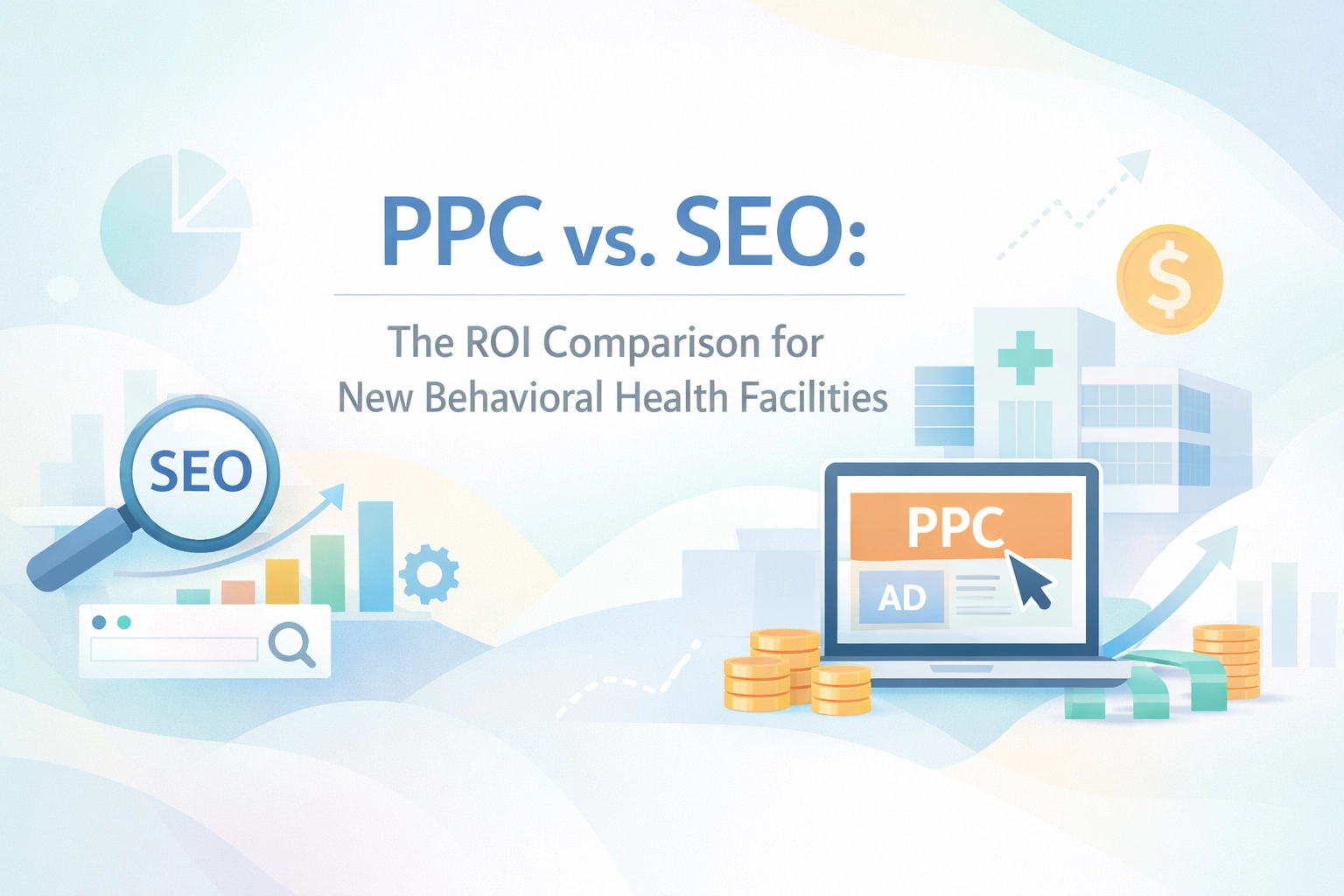
You need patients now, not six months from now. But you also can't afford to bleed money on paid ads forever. So which do you choose: the immediate results of PPC or the long-term sustainability of SEO?
Here's the truth most marketing agencies won't tell you straight: you probably need both, but the timing and budget split matter more than the channels themselves. Let's break down the actual ROI math so you can make a decision based on numbers, not guesswork.
The Immediate ROI Reality of PPC
When you launch a PPC campaign today, you can have calls coming in tomorrow. That's not an exaggeration: it's how paid search works. You bid on terms like "drug rehab near me" or "mental health treatment center," and your facility shows up at the top of Google instantly.
For a new behavioral health facility with zero brand recognition, this is oxygen. You need revenue now to cover payroll, facility costs, and operational overhead. PPC delivers that.
But here's where it gets expensive. In competitive markets, you're paying $50-$150+ per click for behavioral health keywords. Not per admission: per click. If your conversion rate from click to admission is 2-3% (which is solid), you're looking at $5,000-$7,500 per admission just in ad spend before you factor in staff costs, intake processes, or any other operational expenses.
And the moment you stop paying? The traffic stops. Your leads dry up. You're back to square one.
That's the PPC trap. It works brilliantly for immediate patient acquisition, but it's a treadmill. You have to keep running or you fall off.
The Long-Term ROI Math of SEO
SEO is the complete opposite timeline. You're not getting results next week. You might not see meaningful organic traffic for 3-6 months minimum. For some competitive terms, it could take a year or more to crack the first page.
But once you get there? The economics flip dramatically.
According to industry data, mature SEO campaigns deliver 4-6x higher long-term ROI compared to sustained PPC advertising. Some healthcare providers report SEO returns as high as 8x compared to PPC's 4x over multi-year periods. Why? Because organic clicks are essentially free once you've earned those rankings.
You invest upfront in content creation, technical optimization, backlink building, and ongoing maintenance. But once you rank on page one for "IOP program in [your city]" or "dual diagnosis treatment center," you're getting qualified traffic without paying per click.
Even better: 78% of patients researching behavioral health services prefer clicking organic results over ads. They trust earned rankings more than paid placements. For something as personal and high-stakes as addiction or mental health treatment, that trust factor converts.
According to SAMHSA's behavioral health treatment services data, patients conduct extensive research before selecting a provider. Organic visibility signals credibility in a way paid ads simply can't replicate.
Breaking Down the Investment Timeline
Let's look at the actual numbers over 12 months for a hypothetical new facility with a $10,000/month marketing budget:
| Month | PPC Investment | PPC Admissions (est.) | SEO Investment | SEO Admissions (est.) | Total Admissions |
|---|---|---|---|---|---|
| 1-3 | $7,000/mo | 2-3/mo | $3,000/mo | 0 | 2-3/mo |
| 4-6 | $6,000/mo | 2-3/mo | $4,000/mo | 0-1/mo | 2-4/mo |
| 7-9 | $5,000/mo | 2/mo | $5,000/mo | 1-2/mo | 3-4/mo |
| 10-12 | $4,000/mo | 1-2/mo | $6,000/mo | 2-3/mo | 3-5/mo |
Notice the shift? You start PPC-heavy because you need revenue immediately. But as SEO gains traction (months 7-12), you can reduce PPC spend while maintaining or even increasing total admission volume.
By month 12, you're spending less on PPC but generating more admissions overall because organic traffic is finally contributing. That's when ROI starts compounding.
The Trust Factor You Can't Buy
Here's something that doesn't show up in cost-per-click calculations but matters enormously: perceived authority.
When someone searches for "best alcohol rehab in Miami" and your facility appears organically at the top, they assume you're established, credible, and legitimate. When you appear as a paid ad, they know you paid to be there.
For behavioral health specifically: where stigma, fear, and vulnerability are already barriers: earned organic rankings build trust that paid placements simply can't match. Families researching treatment for a loved one aren't making snap decisions based on the top ad. They're reading reviews, comparing programs, and looking for signals of quality and safety.
As noted by the National Association of Addiction Treatment Providers (NAATP), patient confidence in provider legitimacy directly impacts admission conversion rates. Organic visibility communicates permanence and credibility.
The Strategic Timeline for New Behavioral Health Facilities
So what should you actually do when you're just starting out?
Start with a PPC-dominant strategy for immediate patient acquisition while simultaneously building SEO foundations. This isn't either/or: it's sequential.
Here's the phased approach that works:
Phase 1 (Months 0-3): PPC Survival Mode
- Allocate 70-80% of budget to PPC
- Target high-intent keywords for immediate admissions
- Use PPC revenue to fund operations while SEO builds
- Launch basic SEO foundation (technical optimization, core content)
Phase 2 (Months 4-6): The Transition
- Shift to 60% PPC / 40% SEO
- Organic rankings start appearing for less competitive terms
- Continue PPC for revenue stability
- Expand content marketing and backlink building
Phase 3 (Months 7-12): SEO Momentum
- Move to 40% PPC / 60% SEO
- Organic traffic contributes meaningfully to admissions
- Reduce PPC spend on keywords you now rank for organically
- Focus PPC on highly competitive terms only
Phase 4 (12+ Months): Sustainable Growth
- 30% PPC / 70% SEO becomes maintainable
- Organic traffic covers baseline admission needs
- PPC used strategically for seasonal pushes or new programs
- ROI dramatically improves as cost-per-admission drops

This isn't theoretical. We've guided dozens of behavioral health facilities through exactly this progression at Ads Up Marketing. The facilities that try to go all-in on SEO from day one often run out of cash before organic traffic materializes. The ones that rely exclusively on PPC get trapped in an expensive treadmill they can't escape.
Budget Allocation That Actually Works
Based on our work with behavioral health providers, here's the budget split that consistently delivers results:
| Timeline | PPC Allocation | SEO Allocation | Primary Goal |
|---|---|---|---|
| First Quarter | 70-80% | 20-30% | Immediate patient acquisition + foundation building |
| Months 4-6 | 60% | 40% | Sustain admissions while SEO gains traction |
| Months 7-12 | 40-50% | 50-60% | Transition to organic-dominant model |
| Year 2+ | 30-40% | 60-70% | Sustainable growth with reduced ad dependency |
The exact percentages depend on your market competitiveness, treatment specializations, and how quickly your SEO gains momentum. But the pattern holds: start heavy on PPC, gradually shift toward SEO as rankings improve.
Some facilities ask: "Can we just skip PPC and go all-in on SEO to save money upfront?"
Technically yes, but realistically no. Unless you have enough runway to operate at low census for 6-12 months while organic traffic builds, you'll burn through reserves before you see ROI. We've seen facilities try this approach, and most end up panic-launching PPC campaigns at month 4 anyway: after they've already blown through savings.
Why Integration Beats Either/Or
Here's the advantage most people miss: PPC and SEO actually amplify each other when done strategically.
PPC gives you immediate data on which keywords convert best. You can test messaging, landing pages, and calls-to-action in real-time with paid traffic, then apply those insights to your SEO content strategy. Why guess which blog topics will drive admissions when PPC can tell you exactly which search queries lead to conversions?
Meanwhile, strong SEO performance improves your Quality Score in Google Ads, which lowers your cost-per-click on PPC campaigns. Google rewards advertisers who have relevant, high-quality websites with better ad positions at lower costs.
And when you rank organically AND run ads for the same keywords? You dominate the search results page. Studies show that capturing both the top ad spot and the top organic result can increase total click-through rate by 30-50% compared to either alone.
As discussed in our article on why your 2026 CPA benchmarks are probably wrong, the facilities winning long-term are the ones treating PPC and SEO as complementary systems, not competing alternatives.
The Compliance Factor Changes Everything
One more critical consideration for behavioral health specifically: regulatory compliance affects both channels differently.
PPC platforms like Google Ads and Facebook require LegitScript certification for addiction treatment advertising. That's an additional hurdle and cost. SEO has no such gatekeeping: you can rank organically whether you're LegitScript certified or not (though certification still helps with credibility).
But SEO requires more careful attention to HIPAA compliance in your digital marketing. Every form, tracking pixel, and analytics tool needs to be properly configured. One misstep with patient data can torpedo your organic visibility if Google flags you for privacy violations.
We help facilities navigate both compliance landscapes because cutting corners on either one will torpedo your ROI regardless of which channel you prioritize.

What This Means for Your Facility Right Now
If you're a new behavioral health facility trying to decide between PPC and SEO, here's the bottom line:
You need both, but the timing and budget allocation are everything.
Start with PPC-dominant campaigns to generate immediate revenue and patient volume. Use that cash flow to fund simultaneous SEO development. As organic rankings improve (typically 6-12 months), gradually shift budget toward SEO while reducing PPC dependency.
By year two, you should be operating on a sustainable model where organic traffic covers baseline admission needs and PPC provides strategic boosts for new programs, seasonal variations, or competitive spikes.
The facilities that get this right achieve 30-50% lower cost-per-admission by year two compared to those running PPC-only strategies. They also build lasting brand equity that survives algorithm changes, platform policy updates, and market competition.
Let's Build Your Integrated Strategy
At Ads Up Marketing, we've guided dozens of behavioral health facilities through exactly this transition. We know which keywords are worth bidding on immediately, which ones to target with SEO content, and how to shift budget allocations as your organic visibility grows.
We handle the technical complexity: from LegitScript certification to HIPAA-compliant analytics to negative keyword optimization that cuts wasted PPC spend.
Most importantly, we understand behavioral health marketing isn't just about traffic and clicks. It's about connecting real people in crisis with the help they need while building sustainable growth for your facility.
Ready to stop guessing and start growing? Call us at 305-539-7114 or visit adsupmarketing.com to schedule a strategy session. We'll analyze your market, assess your competition, and build a customized PPC-to-SEO transition plan that maximizes ROI from day one.
Because the right answer to "PPC or SEO?" isn't either/or: it's both, in the right sequence, with the right expertise guiding the way.