
INSIGHTS
The Utilization Rate Trap: Why 100% Occupancy Might Actually Be Hurting Your Revenue
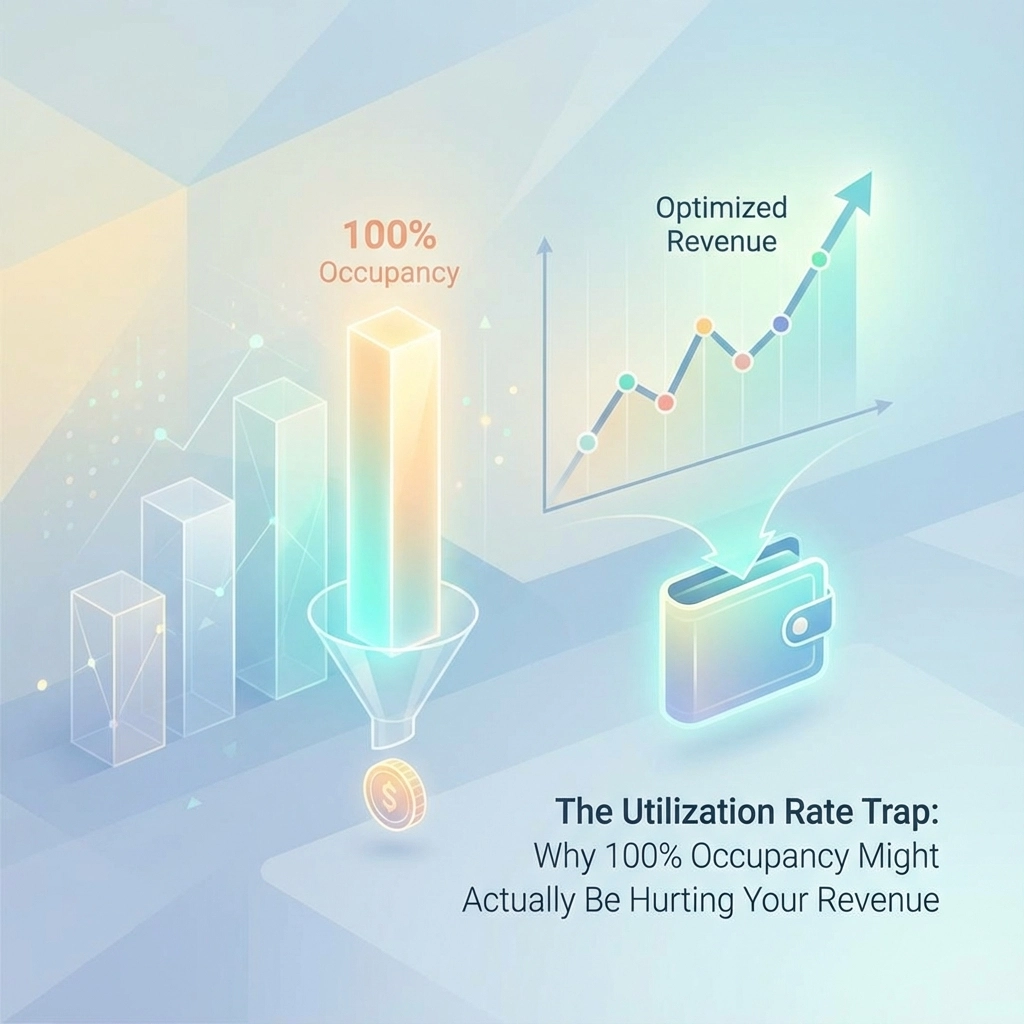
You've probably been taught that 100% occupancy is the holy grail of treatment center operations. Every bed filled, maximum revenue coming in the door, shareholders happy. But what if I told you that running at full capacity might actually be costing you money?
Most treatment center owners are shocked to discover this reality. They've been chasing the wrong metric entirely, focusing on beds filled rather than dollars earned. The truth is, there's a utilization rate sweet spot that maximizes both revenue and patient outcomes, and it's not 100%.
The Staff Burnout Crisis at Full Capacity
When your facility operates at 100% capacity week after week, your clinical and support staff hit a breaking point fast. According to the National Association of Addiction Treatment Providers (NAATP), healthcare worker burnout rates have increased by 38% over the past three years, with addiction treatment facilities showing some of the highest turnover rates.
Think about what happens when you're running every bed, every day:
- Clinical staff ratios stretch beyond safe limits – Your therapists start carrying caseloads of 25-30 clients instead of the recommended 15-20
- Administrative burden multiplies – More patients mean exponentially more paperwork, insurance authorizations, and compliance documentation
- Quality control breaks down – When your team is overwhelmed, mistakes happen with VOB verification, treatment planning, and discharge coordination
- Turnover accelerates – Burned-out staff leave, taking institutional knowledge and client relationships with them
Here's the kicker: replacing a clinical staff member costs you an average of $75,000-$90,000 when you factor in recruitment, training, and productivity loss during the transition period. At 100% capacity, you're practically guaranteeing this expensive cycle.

Quality of Care Deterioration (And Its Revenue Impact)
You might think that more patients automatically equals more revenue, but poor quality care at full capacity creates a revenue leak that's hard to plug. When your clinical team is stretched thin, several profit-damaging things start happening:
Shorter Length of Stay: Overwhelmed therapists rush through treatment protocols. Patients don't get the depth of care they need, leading to premature discharges. The Substance Abuse and Mental Health Services Administration reports that facilities operating above 95% capacity see average length of stay drop by 12-18 days compared to facilities running at 85-90%.
Increased Readmission Rates: Rushed treatment leads to higher relapse rates. While readmissions might seem like additional revenue, they actually signal poor outcomes that damage your reputation and referral relationships.
Insurance Complications: Payers are getting smarter about quality metrics. When your outcomes data shows shorter stays and higher readmission rates, insurance companies start questioning your medical necessity documentation and pushing back on authorizations.
Reputation Damage: In today's digital world, one family's bad experience at your overwhelmed facility can torpedo your Google reviews and referral relationships. And we all know that online reputation directly impacts admission rates.
The Hidden Margin Compression
Here's where the math gets really interesting. Operating at 100% capacity doesn't just hurt quality, it actively compresses your profit margins through several mechanisms:
Labor Cost Explosion: You're paying overtime rates constantly, bringing in temporary staff at premium rates, and dealing with the productivity loss that comes with exhausted employees.
Operational Inefficiency: When everyone's in crisis mode, nothing runs smoothly. Your supply costs go up, your administrative efficiency drops, and you start making expensive mistakes with insurance billing and compliance.
Premium Recruitment Costs: To maintain staffing at full capacity, you end up paying above-market rates for clinical staff, often bringing in traveling therapists at 40-60% higher cost than permanent employees.
Let me show you what this looks like in real numbers:
| Utilization Rate | Average Daily Rate | Monthly Revenue | Staff Costs | Net Margin |
|---|---|---|---|---|
| 100% (50 beds) | $650 | $975,000 | $485,000 | 22.3% |
| 88% (44 beds) | $750 | $990,000 | $380,000 | 31.7% |
| 85% (42.5 beds) | $775 | $987,750 | $365,000 | 33.1% |
Data based on industry averages from facilities with 50-bed capacity
Notice how the facility running at 85% capacity actually generates nearly the same revenue as the 100% facility, but with significantly higher profit margins due to premium pricing power and lower operational costs.
Finding Your Revenue Sweet Spot (85-90%)
The magic happens in that 85-90% utilization range. Here's why this becomes your profit maximization zone:
Pricing Power: When you're not desperately trying to fill every bed, you can be selective about payer mix and rates. You can turn down low-reimbursing insurance plans and focus on higher-value clients.
Staff Performance: Your clinical team has bandwidth to provide excellent care, leading to better outcomes, longer appropriate stays, and stronger referral relationships.
Operational Excellence: Systems run smoothly, billing is accurate, and you avoid the costly mistakes that happen when everyone's overwhelmed.
Strategic Flexibility: You have capacity to accept high-value emergency admissions or referrals from key partners without scrambling for bed space.

The Quality-Revenue Connection
What most owners don't realize is that running at optimal capacity (not maximum capacity) actually drives higher revenue per patient through several channels:
- Extended Appropriate Length of Stay: When patients receive quality care from non-overwhelmed staff, they stay for clinically appropriate durations
- Better Insurance Relationships: Payers notice facilities with strong outcomes and become more willing to approve extended stays
- Premium Referral Sources: High-quality outcomes attract referrals from physicians, courts, and employee assistance programs that pay better rates
- Reduced Readmission Costs: Better initial treatment reduces costly readmissions that eat into your profit margins
How to Optimize Without Sacrificing Profitability
So how do you find your facility's revenue sweet spot? Start by analyzing these key metrics monthly:
Revenue Per Available Bed (RevPAB): This is your total monthly revenue divided by total bed capacity. A facility with 50 beds generating $950,000 monthly has a RevPAB of $19,000.
Average Daily Rate by Payer Mix: Track your actual reimbursement rates by insurance type. You might discover that accepting fewer Medicaid patients and more commercial insurance dramatically improves profitability.
Clinical Quality Metrics: Monitor length of stay, readmission rates, and patient satisfaction scores. These leading indicators predict both outcome quality and long-term revenue sustainability.
Staff Productivity Ratios: Calculate your cost per patient day for clinical staff. When this number starts climbing rapidly, you've likely pushed past optimal capacity.
The goal isn't to fill beds, it's to maximize profit per bed while maintaining clinical excellence. Sometimes that means saying no to admissions that don't fit your target payer mix or clinical profile.
Making the Strategic Shift
Moving from a quantity-focused to a quality-focused admissions strategy requires some operational changes:
- Implement dynamic pricing based on demand and payer mix
- Develop preferred payer relationships that prioritize higher-reimbursing insurance plans
- Create clinical capacity buffers for emergency admissions and complex cases
- Invest in staff retention programs to reduce turnover costs
- Focus marketing efforts on referral sources that send higher-value patients
This isn't about turning away patients who need help: it's about building a sustainable business model that can provide excellent care for the long term.
The Bottom Line on Utilization Optimization
Running at 100% capacity might feel like success, but it's often a trap that leads to staff burnout, quality deterioration, and margin compression. The sweet spot for most treatment centers sits between 85-90% utilization, where you can maintain pricing power, deliver excellent care, and optimize profitability.
Making this strategic shift requires analyzing your current metrics, understanding your real costs per patient, and having the discipline to prioritize profit per bed over beds filled. It's counterintuitive, but reducing your occupancy rate might be the fastest way to increase your bottom line.
If you're ready to optimize your facility's revenue potential and break free from the utilization rate trap, our team at Ads Up Marketing specializes in helping treatment centers identify their profit sweet spot and implement the marketing strategies to maintain it. We've helped dozens of facilities increase their profit margins while improving patient outcomes.
Call us at 305-539-7114 to schedule a free revenue optimization assessment. Let's work together to build a more profitable and sustainable operation.