
INSIGHTS
Why Your Rehab Admissions CRM is Leaking Leads (and How to Plug the Holes)
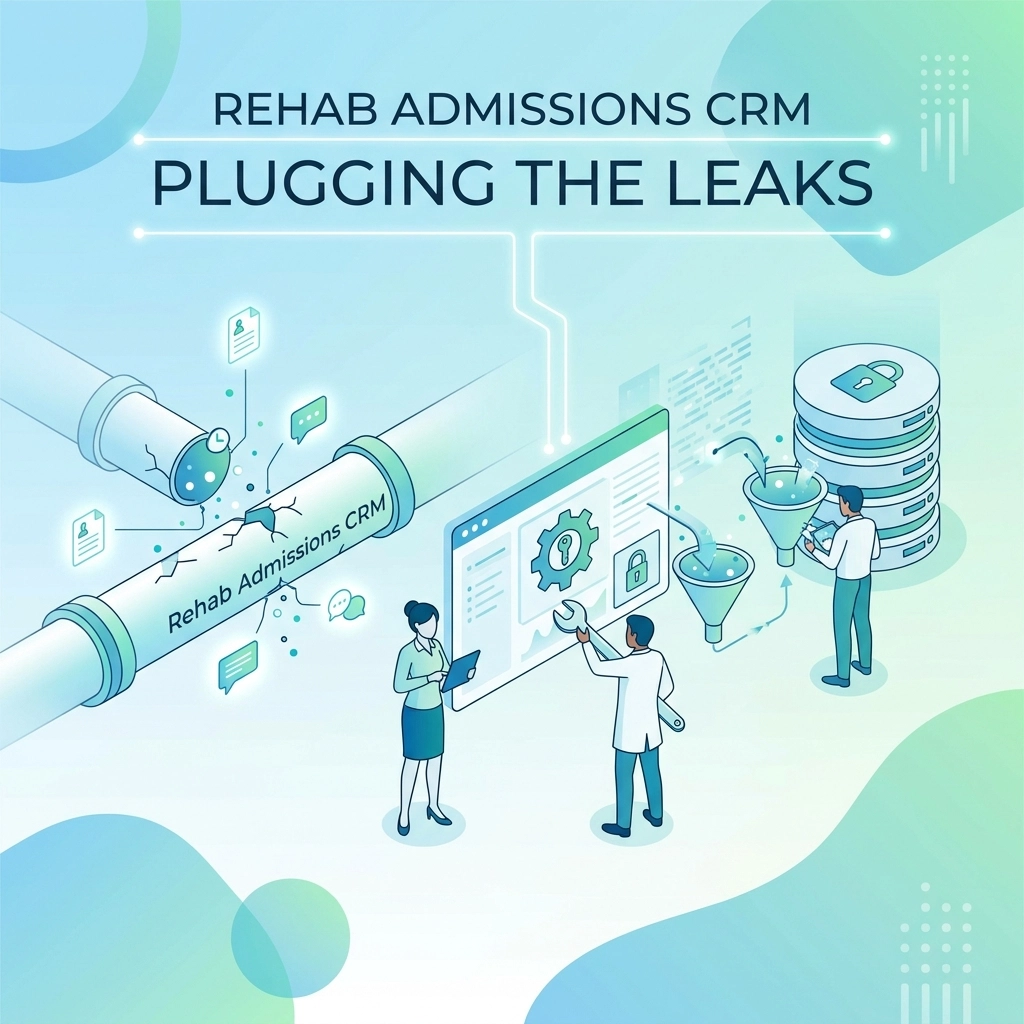
You just spent fifty thousand dollars on a fresh Google Ads campaign. The phone is ringing, the forms are coming in, and your marketing team is high-fiving in the hallway. But then, you look at the end-of-month admission numbers and your stomach drops. The math doesn’t add up. Where did all those people go?
If you feel like you’re pouring money into a bucket that has a giant hole in the bottom, you’re not alone. In the addiction treatment industry, "lead leakage" is the silent killer of ROI. It’s the gap between a person reaching out for help and actually walking through your front door. Often, the culprit isn't your marketing: it's your CRM (Customer Relationship Management) system and the workflows surrounding it.
When we talk about rehab admissions CRM optimization, we aren't just talking about shiny new software. We’re talking about a survival strategy for your facility. In this guide, we’re going to look at exactly why your leads are disappearing and how you can fix your pipeline to ensure every person who needs help gets a fair shot at recovery.
Table of Contents
- The High Cost of Silence: What is Lead Leakage?
- Why Human Effort Isn't Enough Anymore
- The Five Major "Holes" in Your Admissions CRM
- Data Breakdown: The ROI of Lead Recovery
- Technical Fixes: Plugging the Holes for Good
- Performance Impact: Optimized vs. Standard Systems
- Getting Help from the Experts
The High Cost of Silence: What is Lead Leakage?
Let’s be honest: the window of willingness for someone struggling with substance abuse is incredibly small. When someone finally picks up the phone or fills out a form, they are often in a moment of crisis. If you don't answer that call: or if you take two hours to call them back: that window slams shut.
Lead leakage occurs when a potential patient enters your system but falls out before a clinical decision is made. Research into lead management shows that nearly 28% to 41% of inbound leads in high-intent industries receive no second touch within seven days if the system isn't automated. In the rehab world, a "no second touch" scenario is essentially a lost life and lost revenue.
So what's the connection between your CRM and your bottom line? It’s simple: every lead that "leaks" represents a wasted marketing dollar. If you're paying $100 per lead and losing half of them to poor follow-up, your actual cost per lead is $200. That’s a fast track to rehab owner profitability issues.

Why Human Effort Isn't Enough Anymore
I know you have a dedicated admissions team. They care about the mission. But humans are forgetful, they get overwhelmed, and they have to sleep.
When your CRM relies entirely on a person remembering to "check the spreadsheet" or "call that guy back," you are gambling with your facility's future. Modern drug rehab marketing moves at the speed of light. If your CRM isn't doing the heavy lifting, your team is playing a permanent game of catch-up.
Ask yourself:
- Do we know exactly how many leads are currently in "Attempted" status?
- What is our average speed-to-lead for web forms?
- Do we have an automated cadence for following up with missed calls?
If the answer is "I'm not sure," you have a leakage problem.
The Five Major "Holes" in Your Admissions CRM
After auditing hundreds of accounts at Ads Up Marketing, we’ve identified five consistent areas where leads slip through the cracks.
1. The "Speed-to-Lead" Gap
If a lead sits in your inbox for more than 15 minutes, the chances of qualifying that lead drop by 10x. Most CRMs aren't configured to alert reps instantly across multiple devices.
2. The Single-Touch Failure
Most admissions reps will call a lead once. If they don't pick up, the rep moves on. However, data from the National Association of Addiction Treatment Providers (NAATP) suggests it often takes 6 to 8 touches to actually engage a prospect. If your CRM isn't forcing these follow-ups, they won't happen.
3. Mismanaged VOBs (Verification of Benefits)
This is a technical nightmare. A lead comes in, you send the insurance info to your billing team, and… it vanishes into a black hole. Without a CRM that tracks the "VOB Status" with automated reminders, the lead often gets tired of waiting and calls a competitor.
4. Poor Lead Attribution
If you don't know which leads came from Google Ads and which came from organic SEO, you can't optimize your spend. You might be doubling down on a "leaky" channel while starving your best-performing one.
5. Lack of "Zombie Lead" Nurturing
What happens to the leads from six months ago who weren't ready then? Usually, nothing. They sit in your CRM gathering digital dust. A "leak" also happens when you fail to re-engage people who have already shown interest in your facility.
Data Breakdown: The ROI of Lead Recovery
To understand why this matters to a CFO or owner, let's look at the numbers. Plugging even a small percentage of your lead leaks can result in massive revenue shifts without increasing your ad spend by a single penny.
| Metric | Unoptimized CRM | Optimized CRM (with Ads Up) |
|---|---|---|
| Lead Volume | 100 / Month | 100 / Month |
| Average Speed to Lead | 45 Minutes | < 2 Minutes |
| Follow-up Touches | 1.5 average | 6.0 (Automated) |
| VOB Turnaround | 24 Hours | 2 Hours |
| Admission Rate | 5% | 12% |
| Monthly Revenue (at $15k/adm) | $75,000 | $180,000 |
The Difference: An optimized CRM can potentially yield an extra $105,000 per month using the exact same lead volume. That is the power of plugging the holes.

Technical Fixes: Plugging the Holes for Good
So, how do we fix it? It’s not about yelling at your admissions team to "work harder." It’s about building a system that makes it impossible for them to fail.
Implement SLA Timers
Service Level Agreements (SLAs) aren't just for IT companies. Your CRM should have a "timer" for every new lead. If a rep hasn't changed the status of a lead from "New" to "Contacted" within 10 minutes, the CRM should automatically escalate that lead to a supervisor or route it to a different rep.
Automate the "After Hours" Experience
People don't just have crises between 9 AM and 5 PM. If a lead hits your CRM at 2 AM, what happens? An optimized system uses custom solutions like AI-driven SMS or automated scheduling to keep the lead engaged until a human can take over.
Centralize Communication
If your reps are texting leads from their personal cell phones, you are losing data. All communication: calls, texts, and emails: must happen inside the CRM. This allows you to review recordings for training and ensures that if a rep leaves your company, the lead history stays with you.
Use Advanced Conversion Tracking
You need to see the full journey. By integrating conversion tracking with your CRM, you can see which specific keywords are driving "high-quality" admissions versus which are just driving "phone shoppers."
Performance Impact: Optimized vs. Standard Systems
When we look at the 2026 landscape for healthcare marketing, the centers that survive are the ones that treat their data as their most valuable asset.
Performance Impact Comparison
- Standard Systems: Rely on manual entry, have high "lag time" between marketing and admissions, and offer zero visibility into why leads "died" in the pipeline. Result: High CPA (Cost Per Acquisition) and frustrated staff.
- Optimized Systems: Feature automated lead routing, instant SMS auto-responders, integrated LegitScript compliant tracking, and real-time VOB dashboards. Result: Lower CPA, higher staff morale, and consistent census growth.
But this still doesn't drill down to the most important part: the human element. Every lead you "plug" is a person who actually gets the treatment they desperately need.

Getting Help from the Experts
I know you’re struggling to keep the census up while managing rising lead costs. It feels like a treadmill that only goes faster. But here’s the thing: you don't have to build these complex systems alone.
At Ads Up Marketing, we specialize in the technical side of the house. We don't just send you drug rehab leads; we help you build the infrastructure to close them. From digital marketing services to deep-dive CRM audits, we ensure your bucket is watertight.
Stop letting your hard-earned revenue leak into the floorboards. Let's look at your system together and find out where the holes are.
Ready to maximize your admissions and fix your CRM for good? Call us today at 305-539-7114 or visit our contact page to schedule a free strategy session. Let’s get your facility the results it deserves.