INSIGHTS
Web Design for Behavioral Health: Why a ‘Corporate’ Look is Killing Your Leads
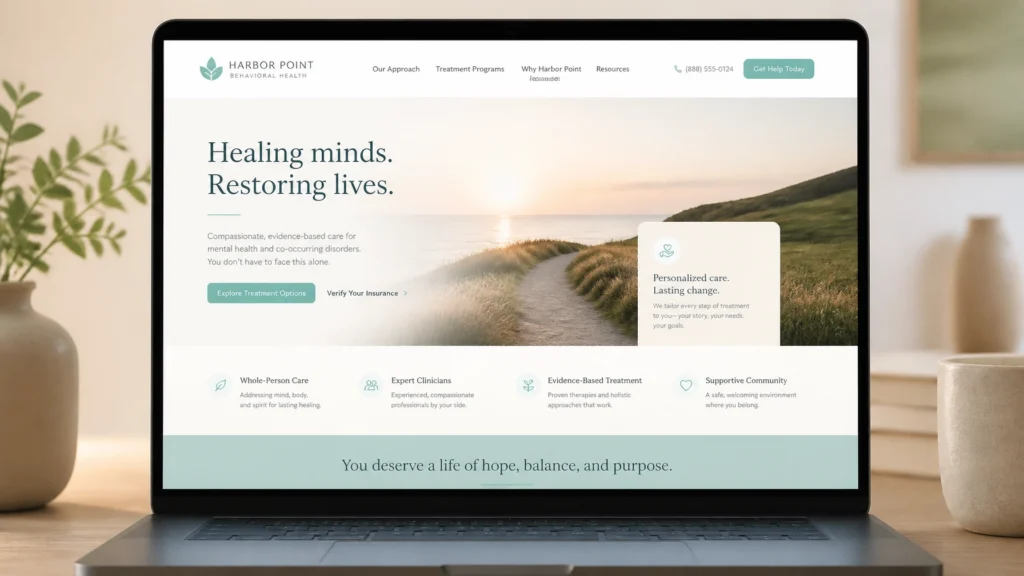
Picture this: It’s 2:00 AM. A desperate family member is sitting at their kitchen table, tears in their eyes, searching frantically online for a trusted addiction treatment center. They click on your facility's website, expecting a beacon of hope, safety, and understanding. Instead, they are greeted by a cold, sterile interface that looks identical to a generic enterprise software company: filled with stock corporate imagery, confusing jargon, and abstract abstract icons.
Within three seconds, they click the back button and head to your competitor.
If you’re running a rehab center or behavioral health facility, you might wonder why your traffic isn't translating into admissions. You’ve invested heavily in PPC and SEO, but your phone isn't ringing the way it should. The culprit isn’t your clinical care team; it’s your digital front door. In addiction treatment and behavioral health, a overly corporate aesthetic destroys trust, kills conversion rates, and quietly drains your marketing budget.
Let's explore why traditional corporate web design fails in our industry and how shifting toward an empathetic, human-centered approach can transform your online presence.
Table of Contents
- The Psychology of Crisis: Why Rehab Visitors Are Different
- The Danger of the 'Corporate SaaS' Aesthetic
- Performance Impact: Corporate vs. Human-Centered Design
- Key Elements of High-Converting Behavioral Health Web Design
- How Ads Up Marketing Helps You Convert More Leads
- Conclusion & Next Steps
The Psychology of Crisis: Why Rehab Visitors Are Different
When a prospective client or their loved one visits a B2B SaaS website, they are looking for ROI metrics, feature lists, and enterprise scalability. Their mindset is logical, analytical, and objective.
Now, compare that to someone visiting a behavioral health website. They aren't shopping for software: they are navigating one of the most painful, vulnerable moments of their lives. According to data from the Substance Abuse and Mental Health Services Administration (SAMHSA), millions of Americans grapple with substance use disorders, yet only a fraction receive specialized care due to friction, fear, and stigma.
When someone lands on your site, they are experiencing:
- Acute Anxiety: Fear of judgment, fear of the unknown, and fear of failure.
- Overwhelming Urgency: Needing answers about detox, insurance coverage, and immediate admission availability.
- Hyper-Sensitivity to Insincerity: Spotting corporate fluff instantly and feeling alienated by it.
If your website feels like a faceless financial institution or a corporate conglomerate, it triggers a defensive psychological barrier. They need to feel safe before they feel sold to.

The Danger of the 'Corporate SaaS' Aesthetic
Why do so many treatment center websites adopt a cold, corporate look? Often, web design agencies apply standard B2B templates because they don't understand the nuanced psychology of behavioral health.
Here is how a corporate look actively sabotages your admissions pipeline:
1. Sterile Stock Photography
Using generic photos of businessmen shaking hands in boardrooms or abstract 3D geometric shapes sends zero emotional resonance. When families look for a rehab center, they want to see authentic facility spaces, compassionate staff, and a welcoming environment. As highlighted by the National Association of Addiction Treatment Providers (NAATP), transparency and integrity are foundational to building ethical, long-lasting trust in addiction treatment.
2. Jargon-Heavy Copy
Corporate websites love buzzwords like "synergistic ecosystem," "streamlined methodologies," and "enterprise optimization." In behavioral health, this linguistic barrier frustrates a distressed reader. If a potential client has to decode your headlines just to figure out whether you offer medical detox or residential care, they will leave.
3. Buried Contact Information
On corporate sites, contact options are often hidden behind multi-step contact forms or buried in footer menus. For a rehab center, every second counts. If your phone number isn't sticky, clickable, and visible immediately, you are missing high-intent calls. For a deeper dive into this revenue leak, check out our guide on the hidden cost of missed calls and how to calculate your lost revenue.
Performance Impact: Corporate vs. Human-Centered Design
So, what is the actual financial difference between a corporate layout and a human-centered design tailored for behavioral health? Let's look at the numbers.
| Metric | Generic Corporate Design | Human-Centered Behavioral Health Design |
|---|---|---|
| Website Conversion Rate | 1.5% – 2.5% | 4.0% – 8.0%+ (and 10%+ on targeted landing pages) |
| Bounce Rate | 65% – 80%+ | 35% – 50% |
| Average Time on Page | Under 45 seconds | 2 minutes+ |
| Mobile Engagement | Poor tap targets, slow load times | Streamlined, thumb-friendly navigation |
| Admissions ROI | Sub-optimal return on PPC spend | Maximized ROI and lower cost-per-acquisition |
As you can see, even a modest bump in conversion rate can translate into dozens of additional patient admissions every single quarter. When paired with expert PPC management services, a high-converting website ensures that every dollar of your ad spend works twice as hard.

Key Elements of High-Converting Behavioral Health Web Design
Transforming your website from a sterile corporate brochure into a warm, high-converting digital intake center requires deliberate design choices. Here is what you need to implement:
Clear, Empathetic Value Propositions
Your above-the-fold hero section should instantly answer three questions: Who do you help? How do you help them? And how can I get started right now? Use compassionate, plain-language headlines like, "Compassionate Medical Detox & Residential Treatment in Southern California. We’re Here 24/7."
Prominent, Clickable Phone Numbers
Make your admissions hotline front and center in the header and on mobile sticky bars. For individuals in crisis, dialing a number is much easier than filling out a form.
Authentic Visuals and Virtual Tours
Showcase your actual facility, peaceful grounds, and caring staff. Incorporating immersive media like virtual tours for treatment centers lets prospective clients see your facility before making that daunting first phone call.
HIPAA-Compliant, Frictionless Forms
Inquiry forms should be short, reassuring, and fully secure. Always include visible privacy notes to comfort users that their sensitive health information is confidential.

How Ads Up Marketing Helps You Convert More Leads
At Ads Up Marketing, we don't build generic websites. We exclusively serve addiction treatment centers and behavioral health facilities. We know the unique regulatory standards, the competitive landscape, and the exact psychological triggers that motivate families to seek help.
Whether you need a complete web design and content creation overhaul or targeted SEO strategies to dominate your local market, we use data-driven analytics: never guesswork: to help you grow. Best of all, we offer flexible month-to-month contracts because we believe in earning your partnership every single day.
"We were struggling with high traffic and low admissions until Ads Up revamped our digital presence. Our phone hasn't stopped ringing since." : Facility Owner, Regional Treatment Center
If you're ready to stop losing prospective patients to a cold, corporate aesthetic, let's talk. Call us directly at 305-539-7114 to schedule your website audit today.
Conclusion & Next Steps
Your website is the face of your treatment center online. Ditching the cold corporate look in favor of a warm, clinical-grade, human-centered design is one of the most profitable investments you can make for your facility.
Don't let poor web design stand between your clinical expertise and the individuals who desperately need your care.
Ready to turn your website into a powerful admissions engine? Call us today at 305-539-7114 or visit our contact page to speak with our behavioral health marketing specialists. Let’s help more people find recovery together.