You already know this: when a family calls your facility, they're not just shopping around. They're terrified. Their loved one might be overdosing in the next room, or they just found out their teenager has been using. The last thing they want is a sales pitch.
Yet somehow, that's exactly what most addiction treatment call centers deliver.
Here's the uncomfortable truth: about 73% of families who call treatment centers hang up before scheduling an assessment. Not because your facility isn't good enough. Not because your clinical team lacks credentials. They hang up because they felt like they were talking to a salesperson instead of someone who genuinely wanted to help.
That's where the Help First philosophy comes in.
What Makes Families Skeptical in the First Place?
Let's get real about what's happening on the other end of that phone line. When someone calls an addiction treatment center, they're usually dealing with:
- Crisis mode: Their loved one might have just relapsed, been arrested, or overdosed
- Financial panic: They have no idea if insurance will cover treatment or what this will cost
- Previous bad experiences: Maybe they've called other centers and felt pressured or misled
- Information overload: They've probably Googled "addiction treatment near me" and seen 50 different facilities making the same promises
- Guilt and shame: They're wondering if this is somehow their fault

According to SAMHSA's National Helpline data, calls to addiction treatment resources have increased by over 27% in recent years, but conversion rates from inquiry to admission remain frustratingly low across the industry. The gap isn't a marketing problem: it's a human connection problem.
Your intake team has maybe 90 seconds to make that caller feel understood before they move on to the next facility. So what do most centers do in those critical seconds? They launch into bed availability, program length, and amenities.
That's not help. That's a brochure.
The Traditional Call Center Approach (And Why It Fails)
Most addiction treatment call centers operate on what I call the "qualify and close" model. The script goes something like this:
- Answer the phone professionally
- Ask qualifying questions (insurance, substance of choice, detox needs)
- Describe the program
- Create urgency ("We only have two beds left!")
- Push for commitment
Sounds reasonable, right? Except you're treating a desperate family member like they're calling to buy a car.
Here's what actually happens in the caller's mind during that interaction:
- "They're asking about my insurance before they even know my son's name"
- "This person sounds like they're reading from a script"
- "They keep talking about their 'luxury amenities': I don't care about a pool, I care if my daughter will survive"
- "I feel like I'm being sold to, not helped"
The result? They thank you politely, hang up, and call the next facility on their list. You just lost a potential admission because your team prioritized process over people.
Enter the Help First Philosophy
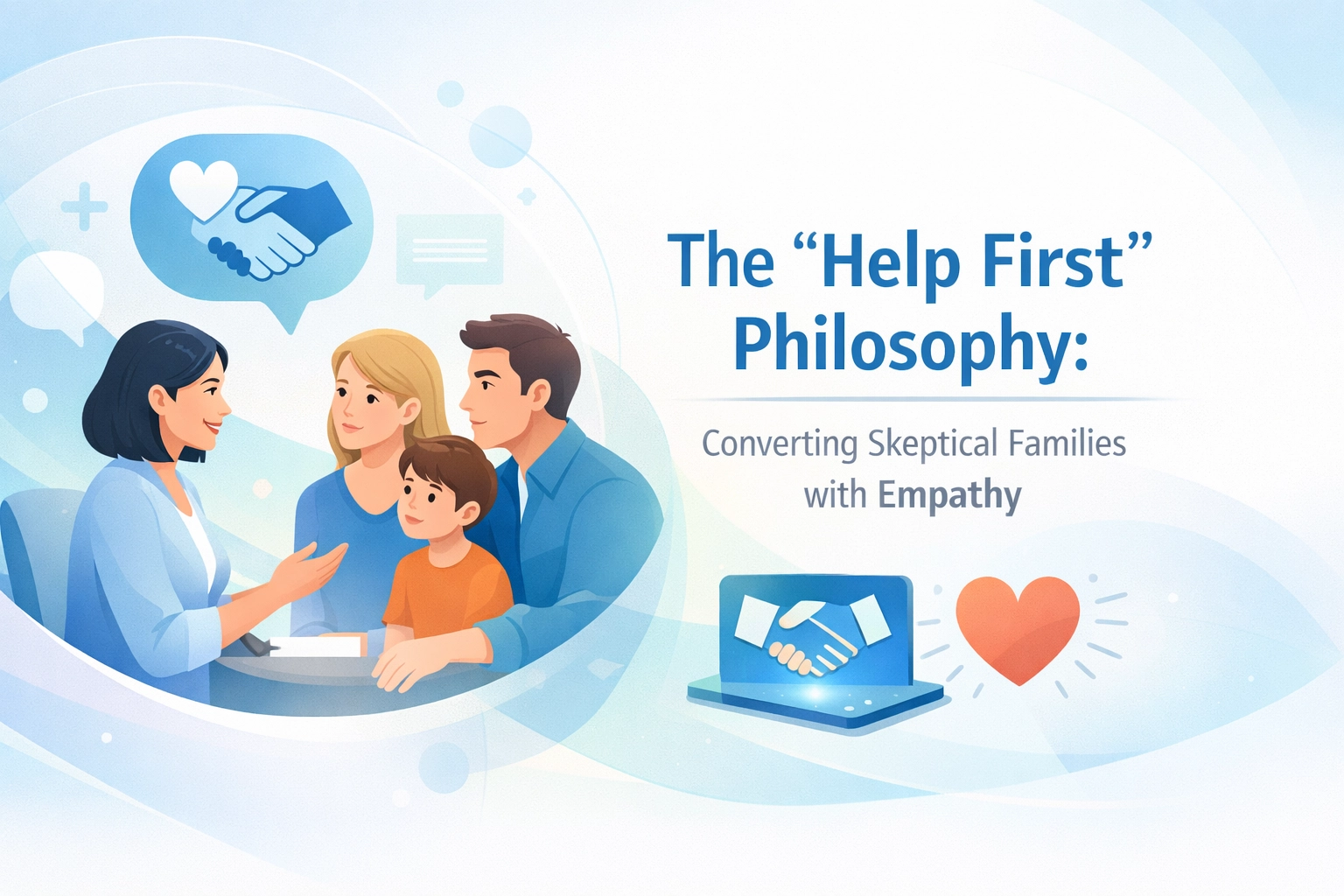
The Help First philosophy flips the entire script. Instead of "How can we get this person to choose us?" the question becomes: "How can we genuinely help this person right now, regardless of whether they admit with us?"
Sounds counterintuitive for a business, I know. But stick with me.
When your intake specialist leads with authentic help instead of a sales agenda, something interesting happens. The caller drops their guard. They start sharing real information. They begin to trust you. And trust: not urgency tactics: is what actually converts skeptical families.
Here's what Help First looks like in practice:
Traditional approach: "What insurance do you have?"
Help First approach: "I'm so glad you called. Before we talk about anything else, can you tell me what's happening right now? Is your loved one safe?"
See the difference? One is transactional. The other is human.
The Help First philosophy operates on three core principles:
- Listen before you speak: Understand their situation before offering solutions
- Educate without agenda: Give them useful information even if it doesn't benefit you directly
- Guide, don't push: Help them make the right decision for their family, even if that decision isn't you
The Conversion Power of Actually Giving a Damn
Here's where this gets interesting from a business perspective. You might think that leading with empathy instead of urgency would hurt your conversion rates. The opposite is true.
According to industry research from the National Association of Addiction Treatment Providers (NAATP), facilities that train their intake teams on empathy-first communication see conversion rate improvements of 35-60% compared to traditional sales-focused approaches.
Let me show you the difference in a side-by-side comparison:
| Traditional Sales Approach | Help First Philosophy | Impact on Caller |
|---|---|---|
| Lead with program features | Lead with understanding and validation | Caller feels heard vs. sold to |
| Ask qualifying questions immediately | Ask about their immediate crisis and safety | Caller feels cared for vs. interrogated |
| Create urgency with bed availability | Create clarity with honest information | Caller feels respected vs. manipulated |
| Focus on why you're better than competitors | Focus on what their loved one actually needs | Caller feels guided vs. confused |
| Push for immediate commitment | Offer to help regardless of their decision | Caller feels supported vs. pressured |
| Average conversion rate: 15-25% | Average conversion rate: 40-65% | 2-3x more admissions |
The data doesn't lie. When families feel genuinely helped instead of sold to, they choose you more often.
Training Your Team to Actually Help First
So how do you actually implement this in your call center? It's not just about being "nice" or having good phone manners. It requires intentional training and a complete mindset shift for your intake team.
Start with this fundamental reframe: Your intake specialists aren't salespeople. They're crisis intervention specialists who happen to work for a treatment facility.
Here are the practical training components that make Help First actually work:
Active Listening Training
Train your team to ask open-ended questions and then shut up. Seriously. The biggest mistake intake specialists make is talking too much. Teach them phrases like:
- "Tell me more about that…"
- "That sounds incredibly difficult. What's been the hardest part?"
- "I hear you. What are you most worried about right now?"
Then give them permission to just listen. A caller who talks for three minutes about their situation will trust you more than one who listened to your three-minute pitch.
Crisis De-escalation Skills
Many callers are in active crisis when they call. Your team needs to know how to:
- Assess immediate safety
- Provide emergency resources if needed
- Calm heightened emotions
- Validate without judgment
This isn't therapy: it's basic human decency combined with professional training. Organizations like NIDA (National Institute on Drug Abuse) provide excellent resources on understanding the family experience of addiction that can inform this training.
Permission to Give "Wrong" Advice
Here's the really radical part: Train your team to recommend another facility if that facility is genuinely a better fit.
"Wait, what? Tell them to go somewhere else?"
Yes. Because when you do that, something magical happens. The caller realizes you actually care about their outcome more than your census. And guess what? They usually don't go to that other facility. They choose you because you were honest.
Real Implementation: What This Looks Like on Monday Morning
Let's get tactical. You can't just tell your team to "be more empathetic" and expect change. You need systems, scripts, and accountability.
Step 1: Rewrite Your Opening Script
Old opening: "Thank you for calling [Facility Name]. How can I help you today?"
New opening: "Thank you for calling [Facility Name]. I'm [Name]. I know making this call probably wasn't easy. Before we talk about programs or logistics, can you tell me what's happening with your loved one right now?"
That extra 10 seconds completely changes the tone of the conversation.
Step 2: Eliminate Metric-Driven Pressure
If you're measuring your intake team primarily on "calls to admits conversion," you're incentivizing sales behavior, not help behavior. Add these metrics instead:
- Caller satisfaction scores (follow-up surveys)
- Crisis resource provision rate
- Average call duration (longer is often better)
- Repeat/referral call rate
Step 3: Role-Play the Hard Conversations
Have your team practice scenarios where helping first means difficult conversations:
- A caller whose insurance you don't take
- A caller whose loved one needs a higher level of care than you provide
- A caller who's in immediate crisis and needs 911, not admission
- A caller who's clearly not ready to commit
These are the moments where Help First either becomes real or reveals itself as just another tactic.

How Ads Up Marketing Builds Help First Into Your Call Center Strategy
Look, you can implement Help First philosophy on your own. Train your team, rewrite your scripts, shift your metrics. But here's what we've learned working specifically with addiction treatment facilities: the phone call is only one piece of the puzzle.
What happens before someone picks up the phone to call you matters just as much as what happens during the call.
That's where our digital marketing approach for addiction treatment centers comes in. We align your entire marketing funnel with Help First principles:
- Your ads set expectations for empathy, not sales pressure
- Your landing pages lead with education and resources, not just "call now"
- Your remarketing provides useful content to families still researching, instead of just chasing them around the internet
- Your call tracking helps you understand which marketing sources bring families who are ready to be helped vs. those just price-shopping
We work with your intake team to create conversion tracking systems that measure the right things: not just quantity of calls, but quality of connections.
When your marketing and your intake team are both operating from Help First principles, something powerful happens. The skeptical families who were one click away from hanging up? They stay on the line. They trust you. They choose you.
The Bottom Line: Help Isn't Soft, It's Strategic
Let's be clear about something: implementing a Help First philosophy in your call center isn't about being nice for nice's sake. This is a business strategy that drives real results.
Facilities that lead with empathy see:
- Higher conversion rates (40-65% vs. 15-25%)
- Better patient-facility fit (fewer early discharges)
- More referrals from satisfied families
- Stronger reputation in the community
- Intake teams with lower burnout and higher job satisfaction
But here's the thing: you can't fake this. Families can smell a scripted empathy approach a mile away. This has to be real. It has to be built into your culture, your training, and your marketing strategy from the ground up.
That's what we help facilities do at Ads Up Marketing. We don't just drive more calls to your intake line. We help you build systems that convert those calls by actually helping the families on the other end.
If your current call center conversion rates are stuck in the 15-25% range, or if you're getting plenty of inquiries but not enough admissions, let's talk. We'll walk you through exactly how Help First philosophy can transform your intake process: and your census.
Call us at 305-539-7114. We'll listen first, then figure out together if we're the right fit to help you implement these strategies. No pressure, no pitch. Just a conversation about how to help more families while growing your facility.
Because at the end of the day, that's what this whole business should be about anyway.