INSIGHTS
Scaling Your Treatment Center: From Boutique Facility to Multi-State Operation
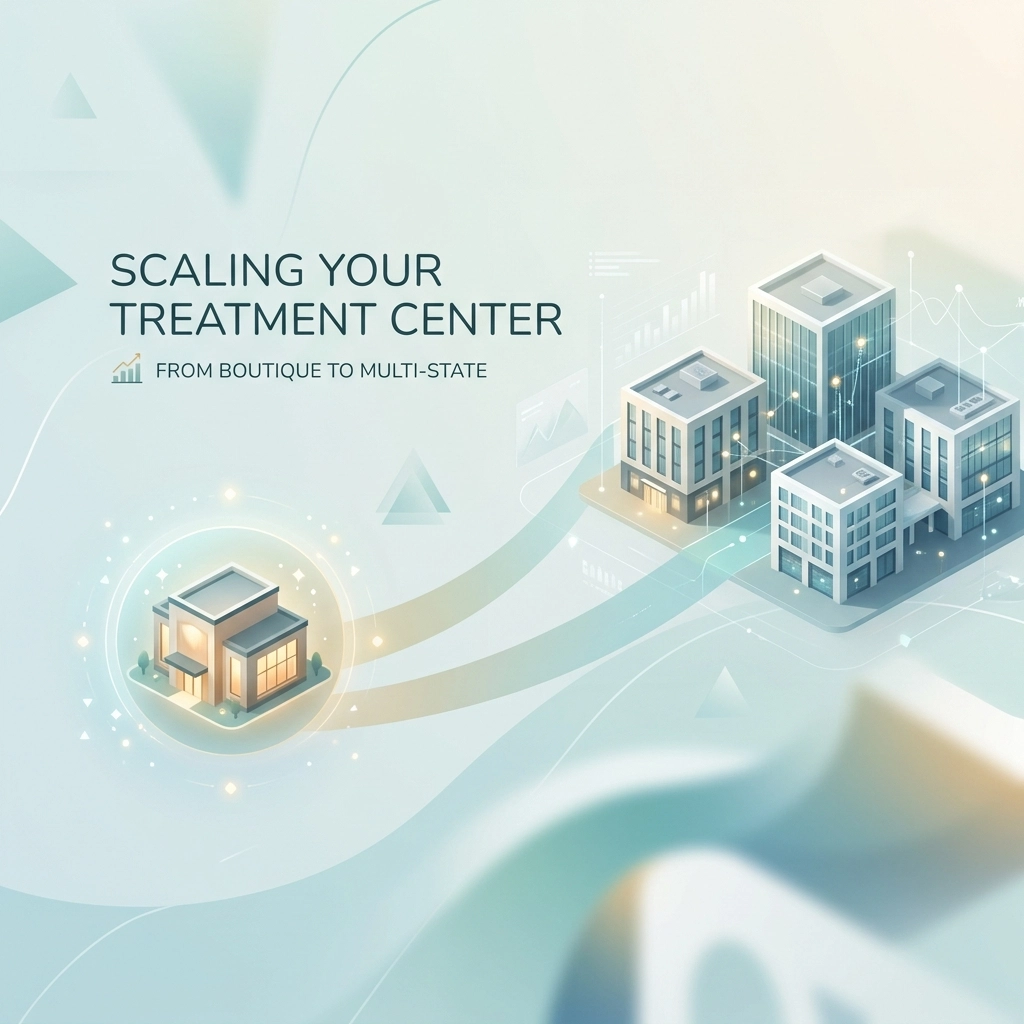
You’ve built something special. Your boutique facility is full, your clinical outcomes are stellar, and you’re finally seeing the kind of impact you dreamed of when you first opened your doors. But now, you’re looking at the map and wondering: Can we do this again? Can we take this magic and replicate it in another city or even another state?
Scaling a treatment center is the ultimate "high-stakes" business move. Done right, you increase your impact and enterprise value exponentially. Done wrong, you dilute your clinical quality and burn through capital faster than you can say "out-of-network."
If you want to move from a single-site owner to a multi-state operator, you need more than just a bigger budget. You need a blueprint. Let’s dive into how you can scale without losing the soul of your facility.
Table of Contents
- The Foundation: Stability Before Expansion
- rehab owner profitability 2026: The Financial Reality of Scaling
- The Geographic Strategy: Hubs, Spokes, and Continua
- Centralizing the "Engine Room"
- The Marketing Leap: Fueling Multiple Locations
- Preserving Culture Across State Lines
1. The Foundation: Stability Before Expansion
Before you even look at real estate in a new zip code, you have to be brutally honest about your current operation. Most scaling efforts fail because owners try to "outgrow" their problems. If your current facility has high staff turnover or inconsistent lead conversion, a second location will only amplify those headaches.
According to the National Association of Addiction Treatment Providers (NAATP), operational excellence is the prerequisite for ethical growth. You need documented Standard Operating Procedures (SOPs) for everything, from the first phone call to the alumni follow-up.
Ask yourself: Could your facility run for a month if you weren't allowed to step foot inside? If the answer is no, you aren’t ready to scale yet. You need to build a leadership team that can handle the day-to-day while you focus on the "big picture" of expansion.

2. rehab owner profitability 2026: The Financial Reality of Scaling
Let's talk numbers. Scaling requires a massive upfront investment. You aren't just paying for a new lease; you're paying for licensing, LegitScript certification, new staff training, and the "ramp-up" period where your beds are empty but your payroll is due.
In the current market, rehab owner profitability 2026 is increasingly tied to operational efficiency and the ability to negotiate better payer contracts. Multi-state operators often have more leverage with insurance companies than single-site boutiques.
Here is a breakdown of what the performance impact looks like when moving from a single boutique facility to a multi-state operation:
Performance Impact: Single vs. Multi-State
| Metric | Single Boutique Facility | Multi-State Operation |
|---|---|---|
| Average Occupancy Rate | 85-90% | 75-80% (Stabilized) |
| Marketing Cost Per Acquisition (CPA) | $2,500 – $4,500 | $1,800 – $3,500 (Economy of Scale) |
| Revenue Per Patient (Monthly) | $15,000 – $25,000 | $12,000 – $22,000 (Mix of levels) |
| Owner Compensation Range | $250k – $500k | $750k – $2M+ |
| Enterprise Value (EBITDA Multiple) | 3x – 5x | 7x – 10x+ |
Note: Data estimates based on industry benchmarks from sources like Amity Palm Beach and Ads Up Marketing internal analytics.
To ensure you stay profitable during the transition, we recommend having at least six months of operating reserves for the new location before you break ground. If you need help analyzing your current marketing ROI to see if you're ready, our free AdWords audit is a great place to start.
3. The Geographic Strategy: Hubs, Spokes, and Continua
How do you decide where to go next? Some owners follow the "sun and sand" model, opening facilities in Florida or California. Others look for underserved markets in the Midwest or Northeast.
One of the most successful scaling models is the Hub-and-Spoke model. This involves building a central "Hub" (a residential facility with high-intensity care) and surrounding it with "Spokes" (outpatient clinics, Virtual IOP programs, and sober living).
This strategy, used by major players like Recovery Centers of America, ensures a "warm handoff" between levels of care. It keeps the patient within your ecosystem longer, which isn't just better for your bottom line: it’s significantly better for their long-term recovery. Organizations like SAMHSA emphasize that a continuous, integrated care model is vital for reducing relapse rates.

4. Centralizing the "Engine Room"
As you grow, you cannot have three different HR departments or four different billing teams. To maintain rehab owner profitability 2026, you must centralize your "enterprise functions."
- Centralized Admissions: Your call center should be a well-oiled machine that handles leads for all locations. This ensures a consistent brand voice and prevents "lead leakage."
- Unified Billing and VOB: Verify insurance once, accurately, and follow up on claims from a central office.
- Digital Infrastructure: Use a single EMR system and a unified conversion tracking system so you can see exactly where every dollar is going across all states.
But here is the catch: while you centralize the back end, you must allow for local adaptation on the front end. A facility in rural Kentucky will have different community needs and referral sources than one in downtown Chicago.
5. The Marketing Leap: Fueling Multiple Locations
What worked for your first facility might not work for your fifth. When you're boutique, you can often survive on word-of-mouth and a few local referral partners. When you're multi-state, you need a marketing engine that generates high-intent leads consistently.
This is where many owners get overwhelmed. How do you rank for local SEO in three different states? How do you manage Google Ads budgets that have ballooned from $10k a month to $100k a month?
At Ads Up Marketing, we specialize in this exact transition. We help you move from basic "drug rehab leads" to a comprehensive digital marketing strategy that includes:
- SEO for Multi-Location Brands: Dominating search results for every city you operate in.
- Hyper-Targeted PPC: Using retargeting and search ads to capture families in crisis.
- Press Release Services: Building authority and trust in new markets through strategic press releases.
Scaling your marketing requires a shift from "spending money" to "investing capital." You need to know your CAC (Cost Per Acquisition) for every location and be ready to pivot when a specific market gets too competitive.

6. Preserving Culture Across State Lines
This is the hardest part. How do you keep that "small facility feel" when you have 200 employees?
The boutique experience isn't about the size of the building; it's about the intentionality of the care. To preserve this, you need to:
- Promote from within: Send your best clinical directors from Location A to launch Location B. They carry the DNA of your company with them.
- Regular Regional Meetings: Don't let your out-of-state managers feel like they’re on an island.
- Invest in Alumni: Strong alumni programs create a sense of community that transcends geography.
Ready to Scale Your Impact?
Scaling from a boutique facility to a multi-state operation is a journey fraught with regulatory, financial, and operational hurdles. But you don’t have to do it alone. Whether you need help navigating CARF accreditation or you need a marketing partner that understands the nuances of healthcare marketing, we are here to guide you.
The road to becoming a multi-state leader starts with a single conversation. Let’s look at your current numbers and build a roadmap that gets you where you want to be in 2026 and beyond.
Stop guessing and start growing. Give us a call today at 305-539-7114 or contact us here to schedule your consultation. Let's turn your vision into a legacy.