
INSIGHTS
Rehab CRM Showdown: Choosing Tools That Drive Admissions
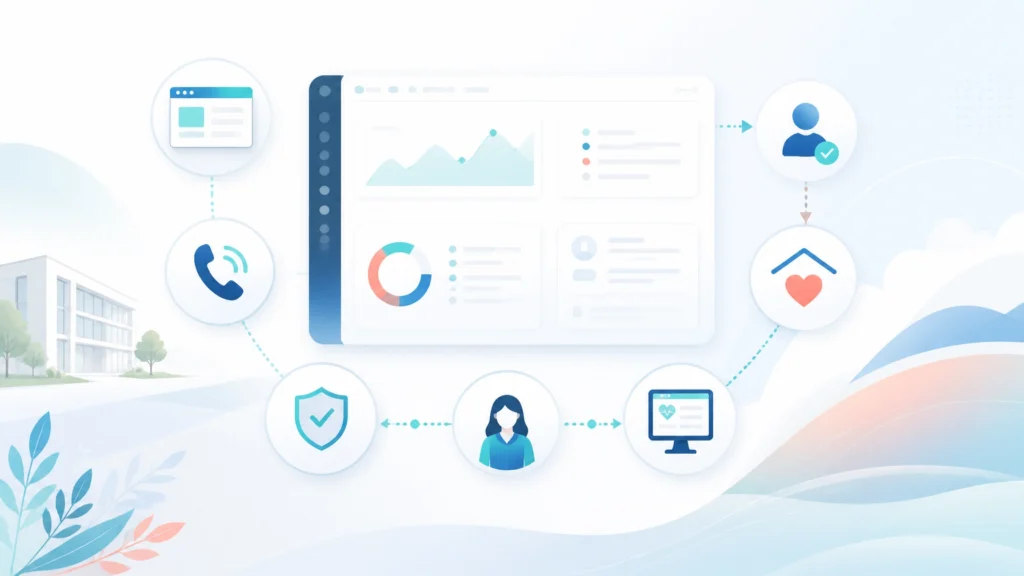
A family member submits an insurance verification form at 9:47 p.m. Your website captures the inquiry, but the notification goes to a shared inbox. The phone system stores the call in another platform. A coordinator writes notes in a spreadsheet. The EHR does not receive anything until the next morning.
By then, the family may have contacted three other facilities.
That is the operational problem a rehab admissions CRM should solve. Not simply storing contact records. Not adding another dashboard. The right system should help your team respond quickly, qualify inquiries, protect sensitive information, and move the right-fit prospect toward an appropriate level of care.
So which tools are worth considering? And how do you know whether a CRM will improve admissions: or just create another data silo?
Table of Contents
- What a Rehab CRM Should Actually Do
- Rehab CRM Options Compared
- Why Data Flow Matters More Than Feature Lists
- Compliance Questions You Cannot Skip
- Performance Impact: Disconnected vs. Connected Workflows
- How to Choose and Implement the Right System
- Final Takeaway
What a Rehab CRM Should Actually Do
A generic sales CRM may be built around opportunities, deal stages, and revenue forecasting. Those concepts are not useless, but treatment center admissions require a more specialized workflow.
Your CRM should help your team manage the journey from:
Inquiry → Contacted → Pre-screened → Benefits verified → Clinically appropriate → Authorized → Scheduled → Admitted
Each stage should have:
- A clearly assigned owner
- A defined next action
- A time-based service-level expectation
- The relevant communication history
- Referral-source information
- Insurance and verification status
- A reason for every lost or stalled inquiry
Why does this matter? Because “lead volume” is not the same as admissions performance.
A facility may receive 100 inquiries and still struggle with census if:
- Calls are not answered consistently
- Forms are not routed to the right coordinator
- Verification of benefits takes too long
- No one knows which leads are waiting on clinical review
- Marketing cannot see which campaigns produce actual admissions
Your rehab admission CRM integration strategy should connect marketing, admissions, clinical operations, and billing without giving every employee access to every detail.

Rehab CRM Options Compared
There is no single best CRM for every treatment center. The right choice depends on your facility size, EHR, number of locations, admissions volume, and internal technology resources.
| CRM option | Best fit | Main strengths | Tradeoffs to evaluate |
|---|---|---|---|
| Dedicated behavioral health admissions CRM | Centers focused on improving lead response, follow-up, and admissions conversion | Purpose-built pipelines, call and text tracking, referral attribution, admissions automation | May require integration with your EHR, billing system, or bed-management tools |
| All-in-one behavioral health platform | Organizations wanting CRM, EHR, and revenue cycle functions in one environment | Shared data model, fewer handoffs, centralized reporting, support for treatment workflows | Confirm the CRM is robust enough for attribution, call tracking, and marketing operations |
| EHR-bundled CRM module | Facilities already committed to a specific behavioral health EHR | Less duplicate data, easier clinical handoff, familiar user environment | CRM and marketing features may be less flexible than a dedicated admissions platform |
| Configured enterprise CRM | Larger organizations with internal IT, compliance, and CRM administration | Highly customizable objects, permissions, workflows, and reporting | VOB, bed awareness, consent, Part 2 controls, and EHR integrations may require extensive configuration |
| Digital intake or communication add-on | Centers that need better forms, texting, or electronic signatures | Improves one weak point quickly and can reduce manual entry | Usually not a complete CRM; it must pass clean data to the system your admissions team actually uses |
Purpose-built options commonly considered by behavioral health organizations include platforms such as Census CRM, Behave Health, Ease Health, and EHR-connected systems such as Kipu. General-purpose systems, including HubSpot or Salesforce, may be workable in the right environment, but they require careful governance and configuration.
Do not choose based on the demo alone. Ask the vendor to show your actual workflow:
- A paid search inquiry arrives.
- The call is missed.
- An automated response is triggered.
- The inquiry is assigned to a coordinator.
- Benefits information is captured.
- Clinical screening is completed.
- A bed is matched.
- The admission is sent to the EHR.
- Marketing can report the original source and eventual outcome.
If the vendor cannot demonstrate that flow, you are probably looking at a collection of features: not a functioning admissions system.
Why Data Flow Matters More Than Feature Lists
A CRM only creates value when information moves correctly.
Imagine that your PPC campaign generates a call. The call-tracking platform records it, but the CRM does not. The coordinator eventually admits the person, but the admission is marked as “organic.” Your marketing report now says the campaign generated a phone call with no revenue attached.
That is not a small reporting error. It can lead you to reduce spend on a campaign that was actually producing qualified admissions.
A connected rehab technology stack should generally include:
- Website and landing pages: Capture forms, calls, and source details.
- Call tracking: Record campaign, keyword, landing page, call outcome, and coordinator disposition.
- CRM: Manage follow-up, screening, VOB, referral relationships, and stage progression.
- EHR: Store clinical documentation after the appropriate handoff.
- Billing or RCM platform: Connect coverage, authorization, payer, and claims information.
- Analytics: Report on qualified inquiries, scheduled assessments, admissions, and revenue: not just clicks.
But this still does not drill down far enough. You also need to know where prospects are getting stuck.
Is the issue:
- A slow response after form submission?
- A missed call during overnight hours?
- An unclear insurance process?
- A clinical fit problem?
- A lack of available beds?
- A scheduling delay after approval?
The CRM should make those bottlenecks visible.
For a practical example, see Ads Up Marketing’s guide to the hidden cost of missed calls. If your call data and CRM stages are disconnected, you cannot accurately calculate how many admissions opportunities are being lost.
Compliance Questions You Cannot Skip
A CRM used by an addiction treatment center may handle highly sensitive information from the first inquiry. Under 42 CFR Part 2, protections apply to records that identify an individual as having or seeking substance use disorder diagnosis, treatment, or referral for treatment.
The regulation specifically includes information connected to referral and intake. That means your team should not assume that an inquiry is “just a marketing lead” because the person has not yet been admitted.
Before signing a contract, ask:
- Will the vendor sign a HIPAA Business Associate Agreement?
- What data is encrypted at rest and in transit?
- Can you restrict access by role and facility?
- Are audit logs available for record views, exports, and changes?
- How are consent, revocation, and expiration documented?
- How does the platform handle 42 CFR Part 2 requirements?
- Are call recordings and text messages included in the compliance scope?
- Which subcontractors or integrations can access the data?
- How is data returned or destroyed if you leave the platform?
The U.S. Department of Health and Human Services cloud-computing guidance explains that a cloud service provider handling electronic protected health information generally functions as a business associate and requires an appropriate BAA.
The 2024 Part 2 final rule also introduced important changes, including a single consent model for certain treatment, payment, and health care operations. HHS provides an overview in its 42 CFR Part 2 final rule fact sheet. Your legal or compliance team should review how those requirements apply to your specific facility and workflows.
Ethics matter here, too. The National Association of Addiction Treatment Providers emphasizes responsible treatment practices and professional standards. Technology should help your team respond with dignity and consistency: not encourage pressure-based admissions tactics.
Performance Impact: Disconnected vs. Connected Workflows
The following comparison is an operational framework, not a guaranteed benchmark. Your results will depend on staffing, program fit, payer mix, bed availability, and follow-up discipline.
| Performance area | Disconnected workflow | Connected CRM workflow |
|---|---|---|
| Speed to lead | Staff check multiple inboxes, phones, and spreadsheets | New inquiries route automatically to the right owner |
| Follow-up consistency | Reminders depend on individual memory | Tasks, alerts, and escalation rules support defined SLAs |
| VOB visibility | Insurance details are copied between systems | Verification status is visible alongside the inquiry |
| Referral attribution | Source information is lost during handoffs | Referral partner, campaign, and call source stay attached |
| Bed matching | Coordinators call around for availability | Availability can be reflected in routing and scheduling rules |
| Marketing ROI | Reports stop at clicks, forms, or calls | Reporting connects source to qualification, admission, and revenue |
| Compliance oversight | Policies rely heavily on manual behavior | Permissions, consent records, and audit history are built into workflows |

The most important result is not a prettier dashboard. It is a shorter distance between a person asking for help and a qualified, appropriate next step.
That may mean faster contact. It may mean quicker benefits verification. It may mean routing a prospect to another level of care when your program is not the right fit. In each case, better data flow supports better decisions.
How to Choose and Implement the Right System
Start with a process map before you schedule vendor demos.
Write down every step from the first website visit or phone call to admission. Include the systems involved, the employee responsible, the required information, and the usual delay.
Then score each platform on five practical categories:
1. Admissions fit
Can the system handle detox, residential, PHP, IOP, outpatient, or mental health workflows? Can you create separate pipelines for different locations and levels of care?
2. Integration quality
Does it connect with your website forms, phone system, EHR, billing platform, scheduling tools, and analytics? Is the integration real-time and bi-directional, or just a periodic export?
3. Reporting depth
Can you report on:
- Time to first response
- Contact rate
- Qualified inquiry rate
- VOB completion
- Scheduled assessment rate
- Admission rate
- Cost per qualified inquiry
- Cost per admission
- Referral-source performance
4. Compliance controls
Request documentation: not vague assurances: about BAAs, access controls, audit trails, encryption, consent management, and vendor subcontractors.
5. Implementation support
Who builds the workflows? Who migrates the data? Who trains admissions staff? How long will the implementation take? What happens when your program adds another location?
Your CRM will not fix an unclear admissions process by itself. You still need defined stages, accurate dispositions, staff accountability, and regular review.
At Ads Up Marketing, we help treatment centers connect the front end of growth to the operational reality behind it. That can include Google Ads and PPC management, local SEO for treatment centers, conversion-focused rehab website design, and analytics that show what happens after the lead arrives.
If your reports do not match what your admissions team sees every day, call Ads Up Marketing at 305-539-7114 or request a confidential marketing analysis. We can help identify whether the constraint is your CRM, your tracking, your website, your campaigns, or the handoff between them.
Final Takeaway
The best rehab CRM is not necessarily the platform with the longest feature list.
It is the one that helps your team:
- Respond to inquiries quickly
- Protect sensitive information
- Verify fit and coverage consistently
- Keep every handoff visible
- Connect marketing activity to admissions outcomes
- Improve the process without creating more manual work
Before you choose a tool, test the complete data flow. Start with a real inquiry and follow it all the way through the admissions process. If information disappears between the phone system, CRM, EHR, and reporting platform, that gap will eventually show up in lost opportunities and uncertain ROI.
You do not have to solve that alone. Call 305-539-7114 to speak with Ads Up Marketing about building a more accountable admissions and marketing pipeline.