"You're just taking advantage of people in their darkest hour."
If you've been in the behavioral health industry long enough, you've heard this accusation. Maybe it stung because part of you wondered if there was truth to it. Or maybe it fired you up because you know the life-saving work your facility does every day.
Here's the reality: If financial gain is your primary driving factor in running a treatment facility, the critics are right, and you should probably think about selling cars instead.
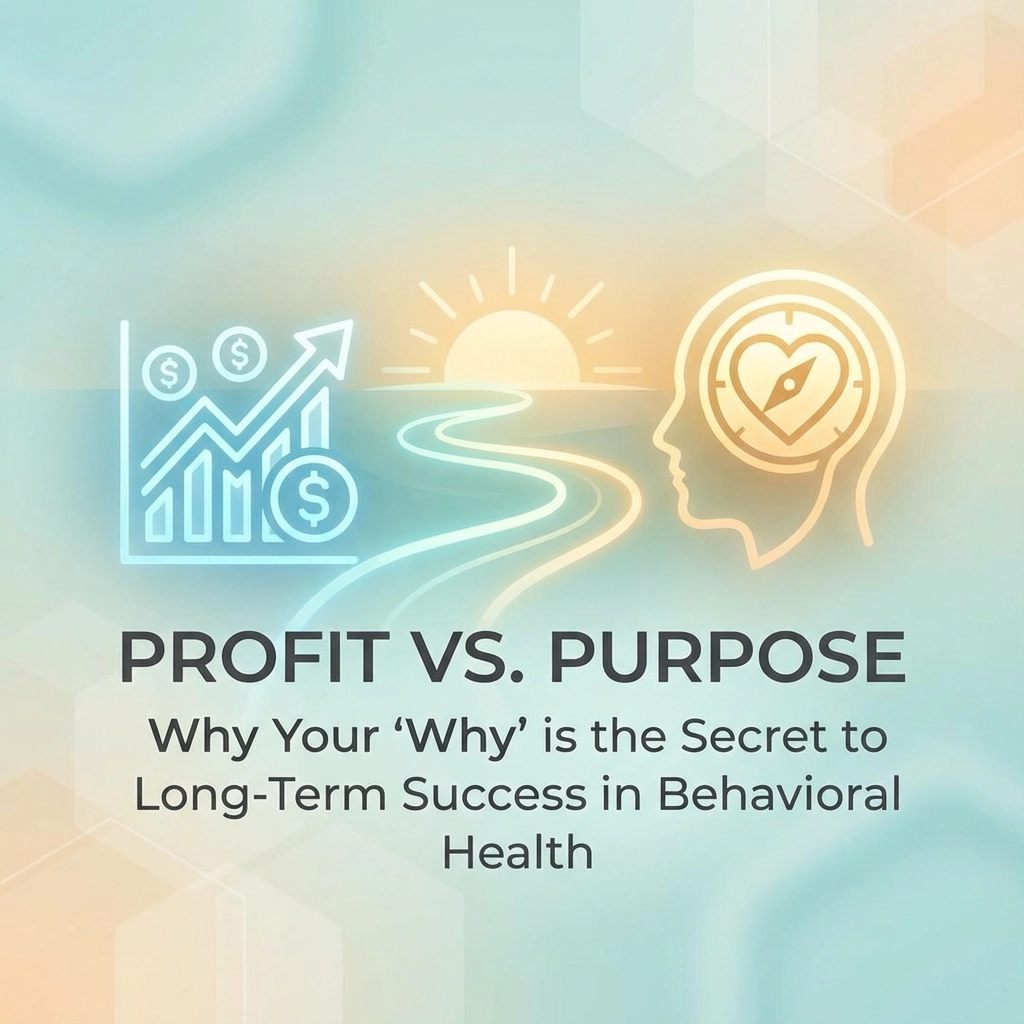
But if you're genuinely trying to help people and putting their wellbeing first, that mission-driven approach will most likely result in financial success and give everyone the best outcome. The key is never losing sight of why you're really in this business.
The Question That Separates the Real Operators from the Rest
When I speak with facility owners, the first question I always ask is simple: "Why are you in this business?"
Their answer tells me everything I need to know about whether we'll be a good fit as partners.
The owners who light up talking about second chances, family reunification, or watching someone walk across a graduation stage six months clean? Those are the facilities that tend to thrive long-term. They build reputations that generate organic referrals, retain staff who believe in the mission, and create the kind of clinical outcomes that insurance companies actually want to pay for.
The owners who immediately start talking about profit margins, bed rates, and "maximizing revenue per patient"? Those facilities tend to struggle with high staff turnover, compliance issues, and the kind of reputation that makes marketing an uphill battle.

The Economics of Ethical Care: Why Purpose Actually Drives Profit
Here's what most people don't understand about the behavioral health industry: ethical, patient-centered care isn't just morally right, it's also more profitable in the long run.
According to the National Association of Addiction Treatment Providers (NAATP), facilities with strong clinical outcomes and ethical practices report higher patient retention rates, better insurance relationships, and significantly lower compliance costs. When you focus on genuine recovery outcomes, the financial metrics follow naturally.
| Metric | Purpose-Driven Facilities | Profit-First Facilities |
|---|---|---|
| Average Length of Stay | 45-60 days | 28-35 days |
| Insurance Audit Pass Rate | 94-98% | 72-85% |
| Staff Turnover (Annual) | 15-25% | 45-65% |
| Organic Referral Rate | 35-50% | 8-15% |
| 6-Month Sobriety Rate | 60-75% | 25-40% |
Source: NAATP Facility Performance Study, 2024
The numbers don't lie. Facilities that prioritize clinical quality consistently outperform profit-focused operations across every meaningful metric.
The 100% Rule: Helping Everyone, Not Just the 1%
Too many facilities make the mistake of only focusing on callers with "good insurance", the golden 1% who can pay full freight for a 90-day program. But here's what those facilities miss: every single person who calls deserves hope, resources, or direction.
When someone struggling with addiction finds the courage to pick up the phone, that moment represents months or even years of internal battle. How your intake team handles that call doesn't just determine whether you get a new admission, it determines whether that person continues seeking help or gives up entirely.
The "churn and burn" approach, quickly qualifying insurance and hanging up on anyone who doesn't meet your financial criteria, isn't just ethically questionable. It's also terrible for business. Here's why:
The Referral Network Effect: That person you dismissed might be the sister of your next $75,000 patient. Or they might work at the hospital where your business development team is trying to build relationships. Word travels fast in the addiction community.
Staff Morale: Your intake team didn't get into this field to crush people's hopes eight hours a day. When you force them to treat human beings like credit scores, you create the kind of toxic work environment that drives good people away.
Reputation Management: In the age of Google reviews and social media, every interaction matters. A caller who feels dismissed and hopeless might not become a patient, but they can definitely become a very vocal critic.

The Real Cost of Cutting Corners on Care
The Substance Abuse and Mental Health Services Administration (SAMHSA) reports that facilities with ethical violations face average regulatory costs of $180,000 per incident, not including legal fees or reputation damage. But the real cost goes far deeper.
When you operate from a purely profit-driven mindset, you make short-term decisions that undermine long-term success:
- Understaffing clinical teams to save on payroll, leading to burnout and higher turnover
- Cutting corners on continuing education and staff development, resulting in lower quality care
- Focusing on quantity over quality in admissions, leading to higher dropout rates and poor outcomes
- Avoiding difficult cases that might require more resources, limiting your clinical expertise and reputation
These decisions might look good on a quarterly P&L, but they create a downward spiral that's incredibly difficult to escape.
What "Selling Without Selling" Actually Looks Like
At Ads Up Marketing, we only work with facilities that understand this fundamental truth: the best way to fill beds is to stop trying to fill beds and start trying to help people.
When your intake team approaches every call with genuine curiosity and care: regardless of the caller's insurance situation: something magical happens. People can sense authenticity, especially when they're vulnerable. A caller who feels heard and supported will move mountains to get to your facility, even if it means traveling across the country or finding creative financing solutions.
This doesn't mean being naive about business realities. It means understanding that sustainable profitability comes from building a reputation as a place that genuinely cares about recovery outcomes. When insurance companies, referring physicians, and families trust your facility, the financial success follows naturally.
The Ads Up Difference: We Partner with Mission-Driven Facilities
We've worked with hundreds of treatment facilities over the years, and we can spot the difference between purpose-driven and profit-driven operations within minutes of our first conversation. The mission-driven facilities don't just survive: they thrive, even during economic downturns or regulatory changes.
Our lead generation strategies work best for facilities that understand this principle because we focus on connecting people with help, not just generating contacts. Our admissions process optimization techniques are built around the "100% rule": every caller gets value, whether they become a patient or not.

The Long Game Always Wins
The behavioral health industry is going through massive changes. Insurance requirements are getting stricter, regulatory oversight is increasing, and patients are becoming more informed consumers. In this environment, the facilities that will survive and thrive are the ones with rock-solid clinical reputations and genuine community trust.
You can't fake that kind of reputation. It has to be earned through consistent, ethical, patient-centered care. And once you have it, it becomes your most valuable business asset: worth far more than any marketing campaign or business development strategy.
Your Next Step
If you're running a treatment facility and you recognize yourself in this article: if you got into this business to help people and you're frustrated by the industry's reputation problem: we should talk.
We specialize in helping mission-driven facilities grow sustainably while maintaining their clinical integrity. We don't work with everyone, because not every facility aligns with our values. But for the right partners, we can help you build a marketing and admissions system that fills beds with the right patients for the right reasons.
The question isn't whether you can afford to work with a marketing partner who understands ethical treatment practices. The question is whether you can afford not to.
Ready to grow your census the right way? Call us at 305-539-7114 and let's talk about aligning your marketing with your mission.