Focus Keyword: HIPAA compliant rehab marketing analytics
You're running a successful rehab center, and your digital marketing seems to be working. Patients are finding you through Google Ads, your Facebook campaigns are generating leads, and your remarketing is bringing people back to your site. Everything looks good on the surface.
Then you get a letter from the Office of Civil Rights. Or worse: a lawsuit alleging HIPAA violations because your analytics pixels were tracking visitors on your treatment pages.
Welcome to 2026, where the tools that made your marketing effective might also be putting your facility at serious legal risk.
The Analytics Crisis Nobody Saw Coming
Here's the problem: that Google Analytics code on your site? The Facebook pixel tracking conversions? The call tracking software recording which ads brought in phone calls? All of it could be violating HIPAA: and the federal government has made it crystal clear they're watching.
In June 2024, the Office of Civil Rights issued guidance that fundamentally changed how healthcare organizations can use digital marketing tools. The message was simple but devastating: any data sent to third-party platforms that could reveal health information is a HIPAA violation. And for rehab centers, almost everything counts as health information.
Think about it. When someone visits your page about opioid addiction treatment, that visit alone suggests they or someone they care about is dealing with substance use disorder. Traditional analytics tools record that visit, associate it with their device ID, and send it to external servers. Under current interpretations, that's transmitting Protected Health Information without authorization.

The issue gets even more complicated when you're running nationwide campaigns. Because on top of HIPAA, you're also dealing with state-specific regulations that vary wildly depending on where your ads appear and where patients are located.
When Federal Compliance Meets State Chaos
Let's say you're marketing a Florida facility. You need to comply with the Department of Children and Families' strict advertising regulations that govern how you can present treatment services. But your Google Ads are showing in California too, where Assembly Bill 374 adds another layer of requirements around patient brokering and marketing disclosures.
Running ads in Massachusetts? They've got their own rules about how you can advertise substance use disorder treatment. Targeting patients in Texas? Different requirements entirely.
You're not just managing HIPAA compliance: you're navigating a patchwork of state laws that weren't written with digital marketing in mind. And here's the kicker: most marketing agencies have no idea these regulations even exist, let alone how to build campaigns that comply with all of them simultaneously.
At Ads Up Marketing, we've spent years building systems specifically designed for this exact challenge. We know which tracking features to disable in which states, how to structure campaigns that maintain HIPAA compliance while still generating admissions, and which vendors actually have legitimate Business Associate Agreements that hold up under scrutiny.
What's Actually at Risk (Besides Everything)
Let me break down the specific ways standard marketing practices create compliance nightmares for rehab centers:
Remarketing campaigns that follow visitors around the internet after they've been on your treatment pages? That's basically broadcasting their health information to advertising networks. Every time that ad displays, you're confirming to Facebook or Google that this person visited content about addiction treatment.
Form tracking that captures what visitors type into contact forms before they hit submit? If they're entering their name alongside details about their situation, you're collecting PHI and sending it to your CRM or analytics platform without proper safeguards.
Call tracking numbers that record which ad or keyword led to each phone call? Unless your vendor has a BAA and compliant infrastructure, you're sharing patient identifiers with a third party that has no legal obligation to protect that data.
Heat mapping tools that record where visitors click and scroll on your website? If they're interacting with content about specific treatments or conditions, that behavior data could reveal health status.
The list goes on. Chat widgets, email marketing platforms, A/B testing tools, conversion tracking pixels: practically every tool in the modern marketer's toolkit becomes a potential violation when you're dealing with healthcare data.
The Compliant Path Forward
So does this mean you just shut down your analytics and fly blind? Absolutely not. You'd tank your admissions within weeks.
The solution isn't eliminating tracking. It's building privacy-first architectures that let you measure marketing performance without exposing patient data to third parties. Here's what that actually looks like:
| Traditional Approach | HIPAA-Compliant Alternative |
|---|---|
| Client-side pixels sending data directly to ad platforms | Server-side tracking with data governance layer |
| Third-party analytics processing all visitor data | First-party data platform with Business Associate Agreement |
| Standard remarketing on all pages | Conditional tracking that excludes treatment-specific pages |
| Open call tracking on all campaigns | HIPAA-compliant call tracking with encrypted transmission |
| Generic vendor agreements | Signed BAAs with every marketing technology provider |
The key is using server-side tracking and Customer Data Platforms that act as a secure middle layer. Instead of your website sending data directly to Google or Facebook, it sends data to a HIPAA-compliant environment that YOU control. You decide what gets shared externally, what stays internal, and how patient information is anonymized before any activation happens.
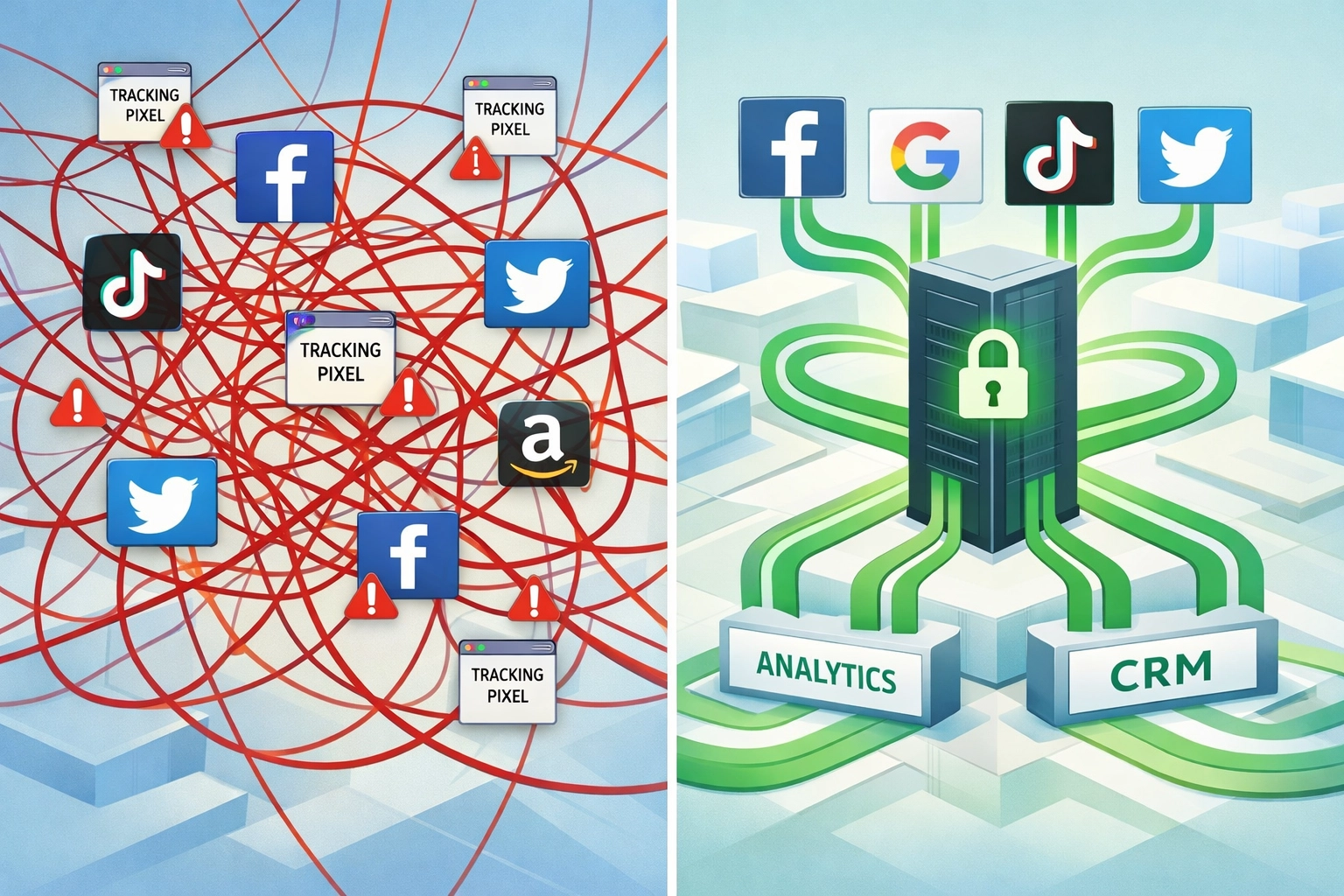
This isn't theoretical. We implement these systems for rehab centers every week. The difference is night and day: not just for compliance, but for marketing performance too. When you have proper data governance, you can actually use MORE data to optimize campaigns because you're doing it in a controlled, compliant way.
State-by-State Strategy (Because One Size Fits Nobody)
Running compliant campaigns across multiple states requires more than just good intentions. You need systems that can adapt to different regulatory environments automatically.
For Florida facilities, we build campaigns that comply with DCF requirements around substantiation of claims, proper facility credentials, and transparent pricing information. California campaigns get structured to meet their specific disclosure requirements and patient brokering prohibitions. Massachusetts facilities need different messaging frameworks entirely.
But here's where most agencies fail: they try to create separate campaigns for each state, which becomes unmanageable fast. The smarter approach is building modular campaign structures where compliance elements adjust based on geographic targeting while core messaging remains consistent.
We use location-based ad customizers, geo-specific landing page variants, and state-aware tracking configurations. Your campaigns work seamlessly across state lines, but the compliance elements adapt automatically based on where the ad displays and where the patient is located.
The Implementation Checklist You Actually Need
Talking about compliance is easy. Actually implementing it requires systematic changes across your entire marketing operation. Here's what that looks like in practice:
Vendor audit and cleanup. Every single marketing tool needs evaluation. Does it collect user data? Where does that data go? Do they have healthcare compliance capabilities? Can they sign a BAA? Most vendors will fail this test. The ones that pass become your approved vendor list.
Data flow documentation. Map exactly what happens when someone visits your site, fills out a form, or calls your number. Where does each piece of data go? Who processes it? How is it stored? This sounds tedious because it is: but it's also non-negotiable for real compliance.
Selective tracking deployment. Not every page needs the same tracking. Your homepage? Relatively safe. Your "Signs of Fentanyl Addiction" page? That needs restricted tracking that doesn't associate visitors with health conditions.
Team training that actually sticks. Your marketing team needs to understand not just the rules, but WHY certain practices create risks. When they understand the logic, they make better decisions independently instead of waiting for approval on every change.
Consent mechanisms that work. You need explicit, separate consent for marketing communications. Not buried in treatment intake paperwork: actual, clear consent that explains what data you're collecting and how you'll use it.

This is where having an agency that specializes in healthcare marketing becomes invaluable. We've already done this implementation dozens of times. We know which vendors to trust, how to structure your tech stack, and how to maintain compliance as you scale.
Why DIY Compliance Usually Fails
I get it: you're thinking you can handle this internally. Your marketing person is smart, they'll figure it out. Or maybe you'll just have your general counsel review everything.
Here's what actually happens: your marketing person doesn't know what they don't know. They disable some obvious pixels, get a couple BAAs signed, and think they're covered. Meanwhile, your form handling is still sending data to a non-compliant CRM. Your call tracking vendor's BAA has loopholes you didn't catch. Your remarketing is still active on treatment pages because someone forgot to exclude them.
And your general counsel? Unless they specialize in digital marketing compliance for healthcare, they're reviewing static website content and missing the dynamic data flows that create actual risk.
This isn't a criticism: it's just reality. HIPAA-compliant digital marketing requires expertise at the intersection of healthcare law, data privacy, marketing technology, and advertising platform mechanics. That's an extremely narrow specialty.
At Ads Up Marketing, this is literally all we do. We work exclusively with rehab centers and addiction treatment facilities. We've built relationships with the few vendors who actually understand healthcare compliance. We know which features to use and which to avoid in every major ad platform. We've seen the enforcement actions, read the guidance updates, and adjusted our systems accordingly.
The Cost of Getting It Wrong
Let's talk numbers for a second. HIPAA violations can result in fines ranging from $100 to $50,000 per violation, with annual maximums over $1.5 million. But the real cost isn't the fine: it's the investigation, the legal fees, the reputation damage, and the disruption to your admissions while everything gets sorted out.
We've talked to facilities that spent six figures defending against HIPAA complaints that could have been avoided with proper marketing infrastructure. Others have had to shut down entire marketing channels because they couldn't figure out how to make them compliant.
The cost of working with an agency that actually knows healthcare compliance? A fraction of what you'll spend if you get this wrong.
Your Next Move
If you're running digital marketing for a rehab center right now, you basically have three options:
- Keep doing what you're doing and hope you don't get caught
- Shut down your analytics and digital marketing (and watch your admissions crater)
- Build actually compliant systems that let you market effectively without legal risk
Option three is the only real choice. And while you could theoretically figure this out on your own, you'd spend months learning what we already know, and you'd probably make expensive mistakes along the way.
We've built HIPAA-compliant marketing systems for facilities across the country. We know how to generate admissions while maintaining privacy. We understand both the federal regulations and the state-specific requirements that trip up most marketers.
Ready to make your marketing both effective AND compliant? Call us at 305-539-7114 and let's talk about your specific situation. We'll audit your current setup, identify compliance gaps, and show you exactly how to build systems that protect your facility while growing your census.
Because in 2026, you can't afford to choose between marketing results and legal compliance. You need both: and we know exactly how to deliver them.