INSIGHTS
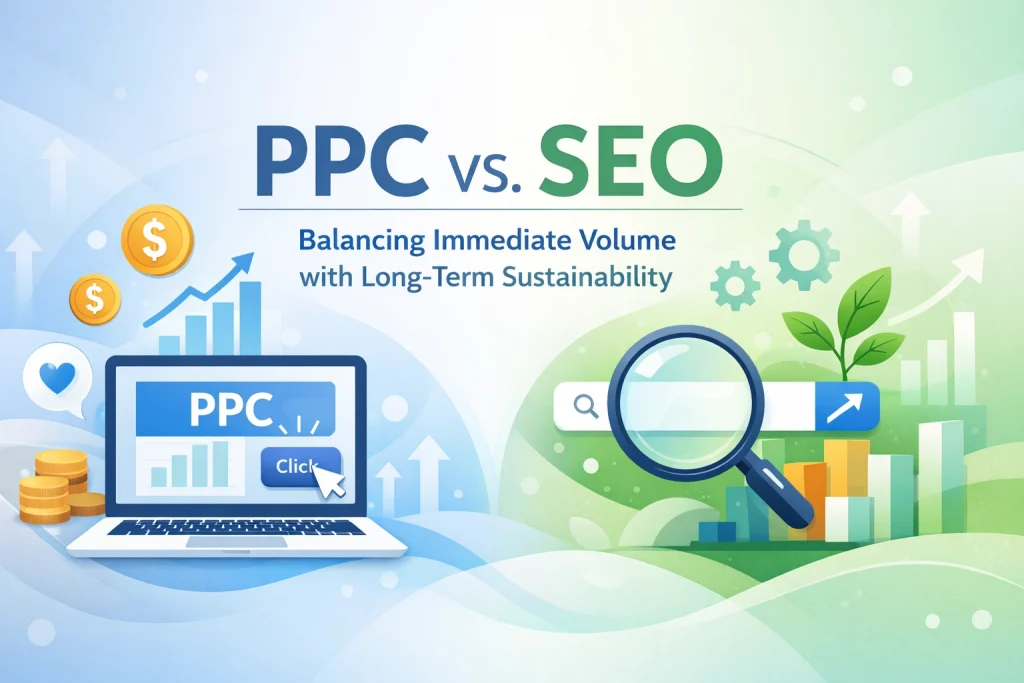
PPC vs. SEO: Balancing Immediate Volume with Long-Term Sustainability
You’re staring at your census numbers, and the math just isn't mathing. You have beds to fill, a dedicated clinical team ready to work, and a community that desperately needs your help. But the phones aren’t ringing as often as they should.
In the high-stakes world of addiction treatment marketing, you’re constantly faced with a choice: do you dump money into Google Ads to get the phone ringing this afternoon, or do you invest in SEO and hope the "organic" gods smile upon you six months from now?
It feels like a gamble, doesn't it? If you lean too hard into Pay-Per-Click (PPC), your cost-per-acquisition (CPA) starts to eat your margins alive. If you lean too hard into Search Engine Optimization (SEO), you might starve before you ever see the first page of Google.
At Ads Up Marketing, we’ve spent years analyzing the data from hundreds of treatment centers. The reality in 2026 is that the "PPC vs. SEO" debate is a false dichotomy. You don't need one or the other; you need a strategic weights-and-balances system that ensures you have volume today and sustainability tomorrow.
The Sprint: Why PPC is Your Immediate Pipeline
Let’s be real: when you need admissions now, PPC is the only lever that moves fast enough. PPC allows you to jump the line, placing your facility directly in front of families and individuals searching for "drug rehab near me" at the exact moment of crisis.
The Pros of PPC in 2026
- Guaranteed Visibility: Within hours of launching a campaign, you can appear at the top of the Search Engine Results Page (SERP).
- Hyper-Targeting: You aren't just shouting into the void. You can target specific demographics, zip codes, and even behaviors.
- Testing Ground: PPC is the ultimate laboratory. Want to know if your new "Holistic Dual Diagnosis" program resonates? A week of Google Ads will give you more data than three months of market research.
The Catch (And It’s a Big One)
The cost of entry has never been higher. In 2026, average search CPCs range from $2.69 to $5.26 across general industries, but for competitive healthcare sectors like addiction treatment, we regularly see clicks costing $50 or more.
Furthermore, according to data from major search trackers, while PPC provides volume, it stops the second your credit card is declined. It’s a "pay-to-play" model that offers zero residual value. If you stop paying, your traffic drops to zero instantly.

The Marathon: Why SEO is Your Brand Equity
If PPC is a sprint, SEO is the marathon. It’s the process of making your website the most authoritative, trustworthy, and relevant resource for people seeking help.
According to research, organic search still drives approximately 53% of all website traffic, compared to just 15% from paid search. Why? Because users trust organic results more. A top organic position conveys authority, it tells the user that Google thinks you’re the best answer to their problem.
The Pros of SEO
- Compounding ROI: This is where the magic happens. While PPC costs stay flat or rise with inflation, the cost of an organic lead actually decreases over time as your rankings solidify.
- Higher CTR: Top organic positions can see click-through rates (CTR) as high as 39.8%, while paid ads often hover between 1.2% and 6.6%.
- Trust and Authority: In a field as sensitive as mental health and substance abuse, trust is your most valuable currency. Ranking high organically builds that trust before the user even clicks.
The 2026 Challenge: AI Overviews
We have to talk about the elephant in the room: AI Overviews. In early 2026, AI-generated summaries at the top of the search results have reduced traditional organic CTRs by 34–61% for certain queries. This means your SEO strategy needs to be more sophisticated than just "ranking for keywords." You need to be the source that AI cites.
Performance Impact: The ROI Comparison
So, what does this look like for your bottom line? Let’s look at a hypothetical (but data-driven) comparison of a facility spending $10,000/month on each channel over one year.
| Metric | PPC (Year 1) | SEO (Year 1) |
|---|---|---|
| Speed to Results | Immediate (1-3 days) | Slow (4-8 months) |
| Monthly Lead Volume (Month 1) | 40-60 Leads | 0-5 Leads |
| Monthly Lead Volume (Month 12) | 50-70 Leads | 150-200 Leads |
| Cost Per Lead (Month 1) | $160 | $2,000+ |
| Cost Per Lead (Month 12) | $180 (Adjusted for inflation) | $50 |
| Long-Term Asset Value | Zero | High Brand Equity |
The Takeaway: If you only did SEO, you’d go out of business by month 4 waiting for leads. If you only did PPC, you’d be leaving hundreds of "cheap" leads on the table by month 12.
How to Balance the Two for Maximum ROI
So how do you actually execute this? At Ads Up Marketing, we recommend a "Transition Strategy."
1. The Heavy Lift (Months 1-3)
Early on, your budget should be weighted toward PPC (70/30 or even 80/20). You need the cash flow from admissions to fund your long-term SEO efforts. During this phase, we focus on conversion tracking to ensure every dollar spent on ads is accounted for.
2. The Equilibrium (Months 4-8)
As your SEO starts to gain traction for long-tail keywords, think "rehab owner profitability 2026" or "average rehab center revenue 2026", you can begin to optimize your PPC spend. You don't necessarily spend less, but you spend smarter, moving ad dollars away from keywords where you already rank #1 organically.
3. The Dominance Phase (Month 9+)
Now you’re firing on all cylinders. You own the top of the SERP. When someone searches for help, they see your ad, they see your organic listing, and they see your local map pack entry. This "omnipresence" significantly increases the likelihood of a click and an admission.

Navigating the Compliance Minefield
In the addiction treatment space, you can’t just throw up an ad and hope for the best. You have to deal with LegitScript certification and Google’s stringent healthcare policies.
We’ve found that a strong SEO foundation actually helps your PPC efforts. When Google’s crawlers see a website that is transparent, follows harm reduction frameworks, and includes clear disclosures, your Quality Score improves. Higher Quality Scores lead to lower CPCs.
It’s all connected.
Why Facility Owners Trust Ads Up Marketing
Look, I know you’re struggling with the rising costs of drug rehab leads. I’ve talked to dozens of owners who feel like they’re being squeezed by the platforms. But the truth is, the platforms aren't the problem, the strategy is.
If you’re relying on a "set it and forget it" PPC campaign or a "write four blogs a month" SEO plan, you’re going to get beat by the competition. You need a partner who understands the nuance of addiction treatment marketing.
We don't just look at clicks; we look at admissions and ROI. We understand the importance of CARF accreditation and how to market Virtual IOP programs in a post-2025 landscape.
Questions to Ask Your Current Marketing Team:
- Are we bidding on keywords where we already rank #1 organically? (If yes, you’re wasting money).
- How has our organic click-through rate changed since the rollout of AI Overviews?
- What is our blended Cost Per Admission (CPA) across both paid and organic channels?
If they can’t answer these questions with hard data, it’s time for a change.
Final Thoughts: Don't Choose, Integrate
The "PPC vs. SEO" debate is over. Success in 2026 requires a hybrid approach that leverages the speed of paid search with the compounding power of organic authority.
By balancing immediate volume with long-term sustainability, you create a marketing engine that doesn't just fill beds today, but builds a legacy for your brand tomorrow.
Are you ready to stop guessing and start growing? Whether you need a free AdWords audit to trim the fat from your current spend or a custom solution to dominate your local market, we’re here to help.
Let’s get your phones ringing for the right reasons.
Call Ads Up Marketing today at 305-539-7114 or visit our contact page to schedule a consultation.
References & Industry Authority
- SAMHSA (Substance Abuse and Mental Health Services Administration): For data on national treatment trends and standards. Link
- NAATP (National Association of Addiction Treatment Providers): For insights into ethics and marketing best practices. Link
- NIDA (National Institute on Drug Abuse): For the latest research on addiction and treatment efficacy. Link