You're spending thousands: maybe tens of thousands: every month on marketing to drive calls to your rehab facility. But here's the uncomfortable question: what happens when those calls actually come in?
If you can't answer that with hard data, you're flying blind. And in an industry where the average patient value can exceed $30,000, every dropped call, every mishandled inquiry, and every frustrated family member represents massive revenue walking out the door.
Your call center isn't just an operational necessity: it's the front door to your facility and the single most critical conversion point in your entire admissions funnel. Yet most rehab owners are tracking the wrong metrics (or worse, none at all).
Let's fix that.
Why Most Rehabs Are Measuring the Wrong Things
Walk into most rehab facilities and ask about call center performance, and you'll hear things like "we're really busy" or "we answered a lot of calls this week." That's not data: that's a feeling.
The reality? Call volume tells you nothing about performance. You could answer 500 calls a week and admit zero patients if your team isn't converting effectively. According to SAMHSA's National Helpline data, millions of people reach out for help annually, but conversion rates vary wildly based on how those initial calls are handled.
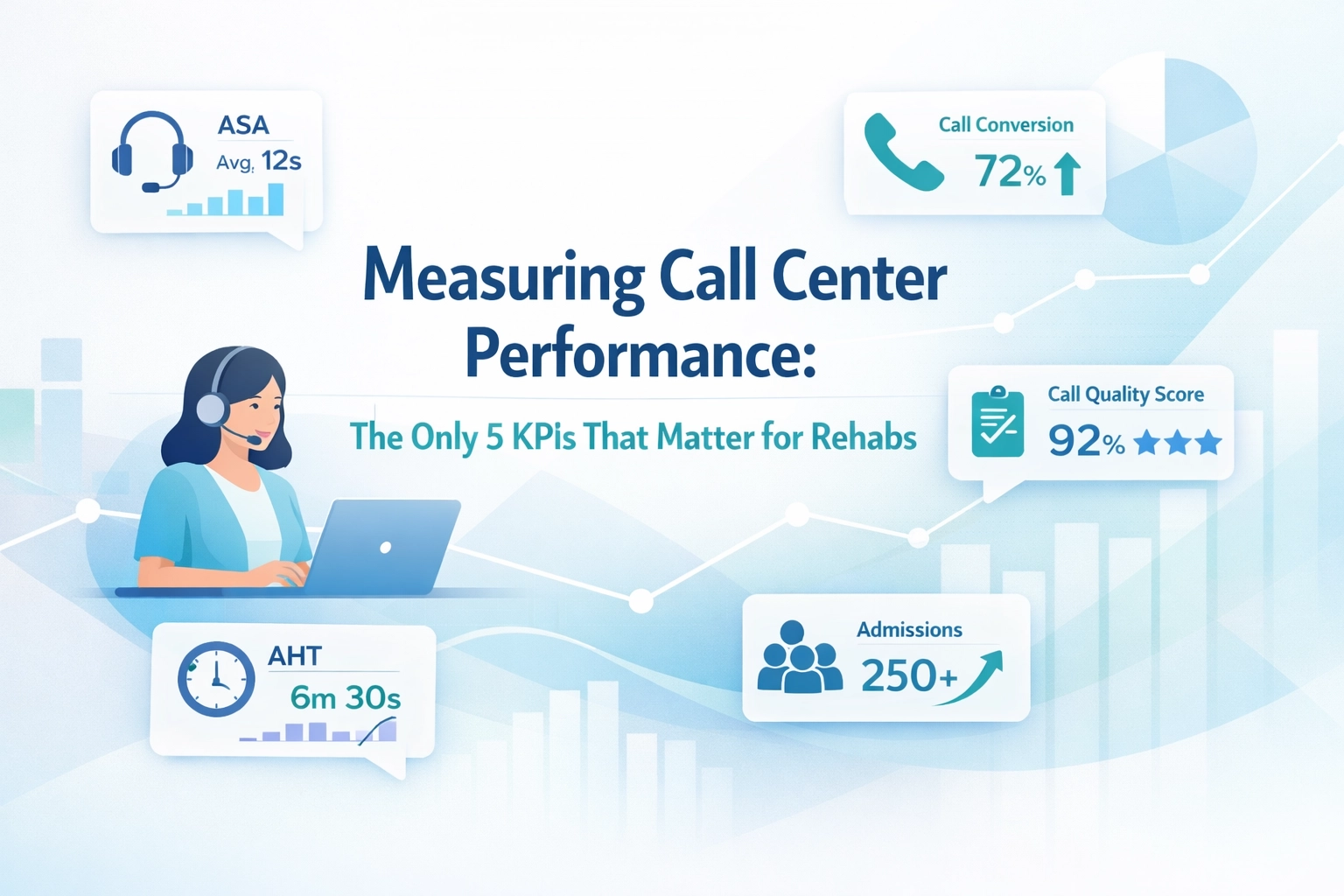
The facilities winning the admissions game aren't just busy: they're tracking the specific metrics that actually predict revenue. Here are the only five that truly matter.
The 5 KPIs That Actually Drive Admissions
1. First Call Resolution (FCR)
This is your most important metric, period. First Call Resolution measures the percentage of calls where the patient's question or concern is completely resolved without requiring a callback or transfer.
Industry benchmarks for healthcare call centers suggest targeting 70-75% FCR. But here's what that really means for your bottom line: every time you fail to resolve a call on the first attempt, you're exponentially increasing the chance that person calls a competitor instead of calling you back.
Think about it from the family's perspective. They're scared, overwhelmed, and researching multiple facilities. If your admissions team can't answer their insurance questions, explain your program, and move them toward admission in that first conversation, you've just handed them a reason to keep shopping.
What good FCR looks like:
- Agents have immediate access to insurance verification tools
- Your team can clearly articulate program details without transfers
- Post-call surveys consistently show patients felt "completely helped"
2. Average Handle Time (AHT)
Average Handle Time tracks the total duration of a call from the moment it's answered through the post-call wrap-up work. This is where most facilities get it wrong: they either want this number too low (rushing families off the phone) or don't track it at all.
The sweet spot for rehab admissions calls? Typically 15-25 minutes depending on call complexity. You're not running a cable company support line here. These are life-or-death conversations that require empathy, detailed explanation, and careful assessment.
But here's the key: if your AHT is creeping above 30 minutes consistently, you've got inefficiency problems. Your agents either lack training, don't have access to the right tools, or your processes are unnecessarily complicated.
Red flags to watch for:
- Agents spending 10+ minutes searching for information
- Multiple system logins required to complete intake
- Excessive hold times while verifying insurance
At Ads Up Marketing, we've seen facilities cut their AHT by 40% just by streamlining their technology stack and retraining their teams on efficient call flow.
3. Customer Satisfaction Score (CSAT)
This one's straightforward but crucial: how satisfied are patients and families with the call experience? In healthcare: and especially in addiction treatment: patient satisfaction isn't just a nice-to-have. It directly correlates with admissions, retention, and referrals.
Most facilities use post-call surveys with a simple 1-5 rating scale. Your target? 4.5 or higher on average. Anything below 4.0 means you're actively damaging your reputation with every call.
Here's what many rehab owners miss: CSAT isn't about being "nice" on the phone. It's about competence, clarity, and making frightened families feel confident in your facility. According to research from the National Association of Addiction Treatment Providers (NAATP), patient satisfaction at initial contact is one of the strongest predictors of admission completion.
Key satisfaction drivers:
- Minimal wait times (we'll get to that next)
- Knowledgeable, empathetic staff
- Clear next steps provided at call end
- Follow-through on promises made
4. Net Promoter Score (NPS)
While CSAT tells you if someone was satisfied, Net Promoter Score tells you if they'd actually recommend you. It's measured by asking one simple question: "On a scale of 0-10, how likely are you to recommend our facility to someone seeking treatment?"
Responses of 9-10 are "promoters," 7-8 are "passive," and 0-6 are "detractors." Your NPS is the percentage of promoters minus the percentage of detractors.
Industry benchmark for healthcare: 30-50 NPS
But here's where this gets interesting for your admissions team: NPS at the call center level predicts long-term patient outcomes. If families are promoters after just the initial call, they're far more likely to complete treatment and refer others: creating a multiplier effect on your marketing ROI.

5. Service Level / Average Speed of Answer (ASA)
This is the metric that keeps admissions directors up at night: how quickly are you answering calls? Every second a phone rings unanswered, you're losing potential admits to competitors.
The gold standard in healthcare call centers: answer 80% of calls within 20 seconds. That's often called the "80/20 rule" in the industry.
But let's be real about what happens in addiction treatment. According to data from NIDA (National Institute on Drug Abuse), individuals and families in crisis are calling multiple facilities simultaneously. If your average speed of answer is 45 seconds and your competitor answers in 15, they're having the first conversation: and often the last.
The math that matters:
- Average facility receives 200-400 calls per week
- Typical call abandonment rate at 60+ second wait times: 30-40%
- That's 60-160 lost opportunities weekly
- At even a 20% conversion rate, that's 12-32 lost admissions per week
- Potential monthly revenue loss: $360,000 – $960,000
Yeah. Speed matters.
The Performance Impact: What Good Looks Like vs. What Doesn't
Here's a comparison table showing what strong call center performance looks like versus underperforming teams:
| KPI | Underperforming | Industry Average | High-Performing | Revenue Impact |
|---|---|---|---|---|
| First Call Resolution | Below 50% | 60-65% | 75%+ | High performers convert 3x more inquiries |
| Average Handle Time | 35+ minutes or under 10 minutes | 20-25 minutes | 15-22 minutes | Optimal efficiency without sacrificing quality |
| CSAT Score | Below 3.5/5 | 3.8-4.2/5 | 4.5+/5 | 4.5+ CSAT correlates with 40% higher admission rates |
| Net Promoter Score | Below 20 | 25-40 | 50+ | NPS above 50 generates 2-3x referral volume |
| Average Speed of Answer | 60+ seconds | 30-45 seconds | Under 20 seconds | Every 10-second improvement reduces abandonment by 5-7% |

The Technology Gap That's Killing Your Conversion
Here's something most rehab owners don't realize: your call center metrics are only as good as the technology supporting them. If your team is using spreadsheets to track leads, manually logging calls, or doesn't have real-time insurance verification, you're handicapping them before they even pick up the phone.
The facilities we work with at Ads Up Marketing that consistently hit these performance benchmarks share three technology characteristics:
Integrated CRM systems that automatically log calls, track patient journey, and provide agents with complete caller history in real-time
Call recording and quality monitoring that allows supervisors to identify training opportunities and ensure compliance
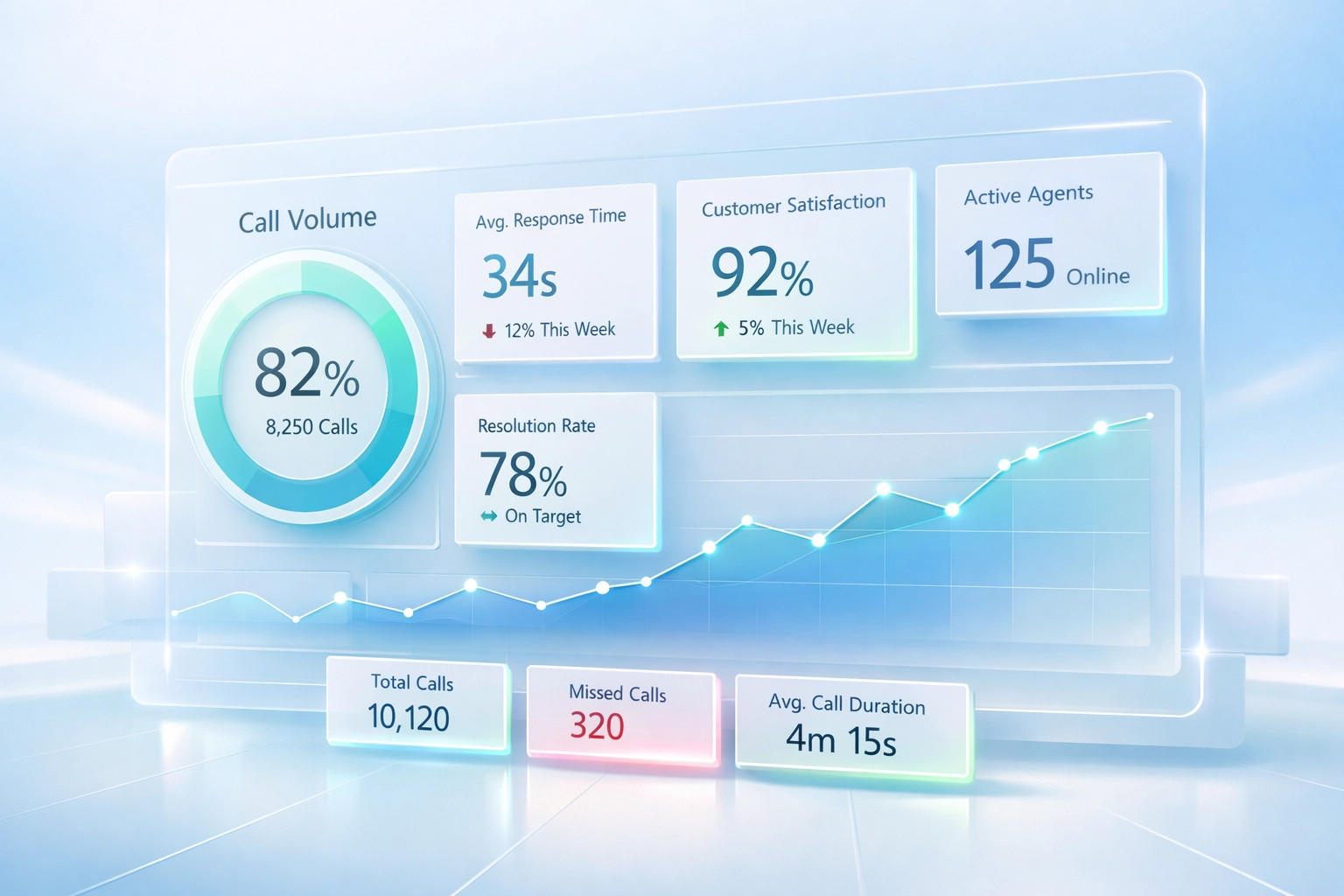
Real-time dashboards that show current performance against KPIs, allowing immediate course correction
Without these tools, you're asking your admissions team to win a Formula 1 race in a minivan.
What This Means for Your Marketing ROI
Let's connect the dots between these KPIs and your marketing spend. Say you're investing $50,000 monthly in PPC advertising and SEO services to generate 300 quality calls per month.
Scenario A: Poor Call Center Performance
- 40% FCR (120 resolved, 180 requiring callbacks)
- 50-second average speed of answer (35% abandonment before answer)
- CSAT of 3.5 (families underwhelmed)
- Actual conversations: 195 calls
- Conversion rate: 12%
- Admissions: 23 patients
Scenario B: Optimized Call Center Performance
- 75% FCR (225 resolved immediately)
- 18-second average speed of answer (8% abandonment)
- CSAT of 4.6 (families feel confident)
- Actual conversations: 276 calls
- Conversion rate: 25%
- Admissions: 69 patients
Same marketing spend. Three times the admissions. That's the difference these five KPIs make.
How We Help Facilities Fix Their Call Center Performance
At Ads Up Marketing, we don't just drive calls to your facility: we help you convert them. Our approach combines conversion tracking, analytics, and strategic consulting to identify exactly where your admissions funnel is breaking down.
We work with rehab facilities to:
✓ Implement proper call tracking and attribution systems
✓ Set up automated dashboards for real-time KPI monitoring
✓ Identify peak call times and optimize staffing accordingly
✓ Audit call recordings to improve agent scripts and training
✓ Integrate marketing data with your admissions CRM
Because here's the truth: we can drive all the calls in the world to your facility, but if your team isn't converting them, we're both wasting money.
Ready to turn your call center into your biggest competitive advantage? Call us at 305-539-7114 or contact our team to schedule a free consultation. We'll analyze your current performance and show you exactly where you're leaving money on the table.
Start Measuring What Matters
You can't improve what you don't measure. And in the addiction treatment space, the facilities that are winning aren't necessarily the ones with the biggest marketing budgets: they're the ones that have optimized every step of the patient journey, starting with that crucial first call.
The five KPIs we've covered: First Call Resolution, Average Handle Time, CSAT, NPS, and Service Level: aren't just numbers on a dashboard. They're the difference between a $50,000 marketing budget that generates 20 admissions and one that generates 60.
Your competitors are already tracking these metrics. The question is: are you?
Let's talk about getting you the data, systems, and strategy you need to turn your call center into an admissions machine. Call 305-539-7114 or visit our drug rehab marketing services page to get started today.