You've got the capital. You've assembled a team. You've found a property that seems perfect. You're ready to open your new addiction treatment center in what looks like an underserved market.
Six months later, you're staring at half-empty beds, bleeding cash, and wondering where it all went wrong.
Here's the brutal truth: most new treatment facilities fail not because they lack passion or expertise, but because they skipped the most critical step in the launch process, a comprehensive feasibility study. In the rush to "get doors open," too many owners dive headfirst into saturated markets without understanding the competitive landscape, local demand, or realistic financial projections.
That's where a proper feasibility study comes in. It's not the glamorous part of opening a treatment center, but it might be the difference between building a thriving facility and becoming another cautionary tale.
What a Feasibility Study Actually Is (And Why You Can't Skip It)
Think of a feasibility study as your facility's pre-flight checklist. You wouldn't take off without checking your instruments, right? Same principle here.
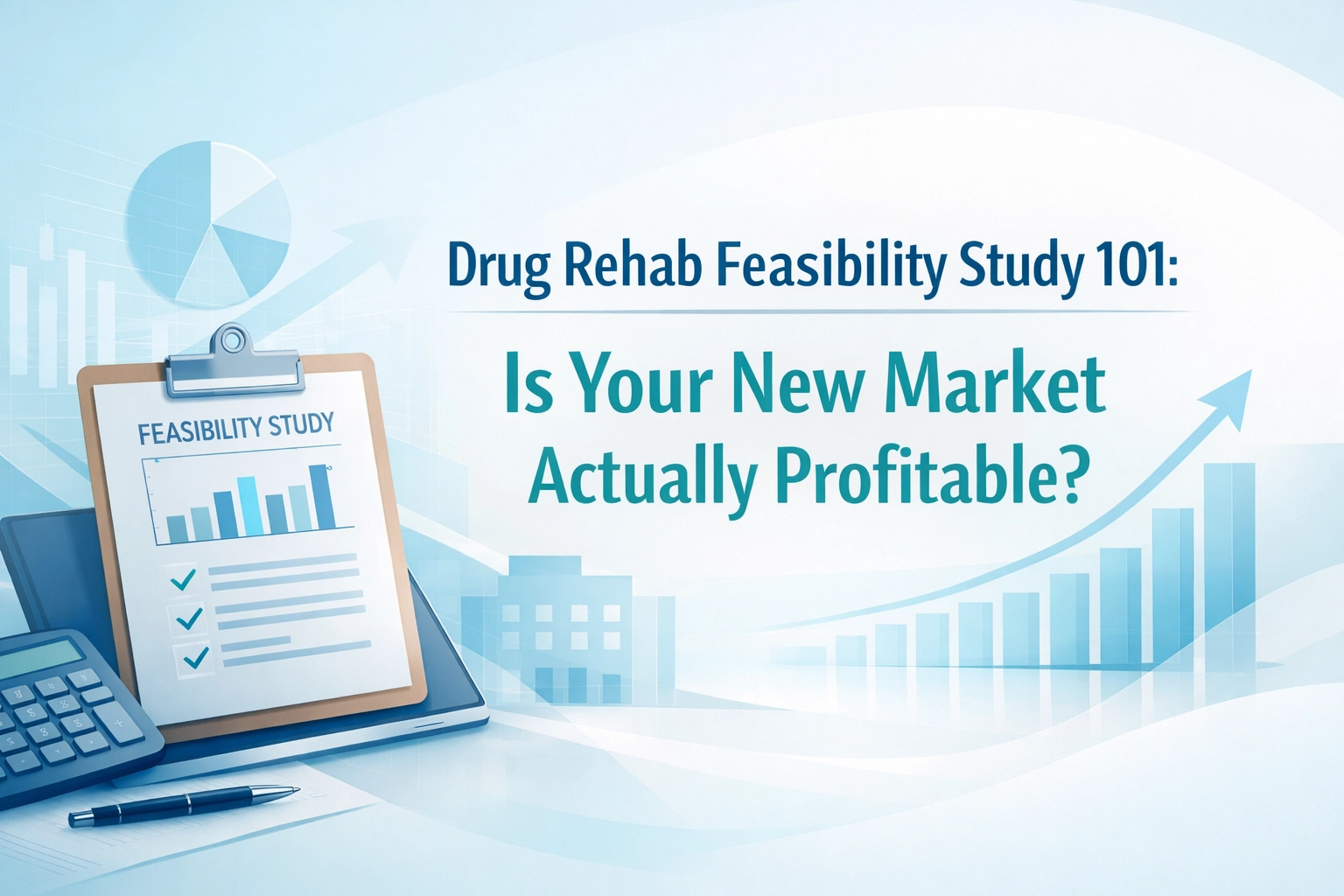
A feasibility study for a rehab center evaluates whether your planned facility can actually survive and thrive in your target market. It's not just about asking "Can we make money?", it's about understanding market demand, competitive saturation, regulatory hurdles, operational requirements, and realistic financial projections.
According to research from industry consultants, feasibility studies examine essential factors like local demographics, addiction rates, and competitor analysis to provide a comprehensive view of your center's potential impact and sustainability. The study should answer questions like:
- Is there sufficient demand for your specific treatment modality in this location?
- What's the competitive landscape look like, and where do you fit?
- What's your realistic patient census going to be in months 1, 6, 12, and 24?
- Can you actually staff this facility given local labor markets?
- What regulatory or zoning challenges might derail you?
Skip this step, and you're essentially gambling your entire investment on gut feeling.

The Real Cost of Getting It Wrong
Let's talk numbers for a second. Opening a residential treatment facility typically requires anywhere from $500,000 to $2 million+ in startup capital, depending on size and scope. Monthly operational costs can easily run $150,000 to $400,000+ before you see a single admission.
Now imagine you've spent 18 months and $1.2 million getting doors open, only to discover:
- Three competitors already dominate referral relationships in your area
- Local insurance networks are closed or heavily restricted
- Zoning regulations you didn't catch will require another $200k in modifications
- The demographic you're targeting doesn't actually exist in sufficient numbers
This isn't hypothetical. We've seen it happen. And it's completely avoidable.
A well-structured feasibility study typically costs between $15,000 and $50,000. Compare that to the hundreds of thousands (or millions) you could lose by launching blind. It's the smartest insurance policy you'll ever buy.
Your Step-by-Step Feasibility Study Checklist
Here's how to conduct a feasibility study that actually protects your investment:
1. Define Your Service Model and Target Population
Before you can evaluate market viability, you need crystal clarity on what you're offering. Are you targeting:
- Adult residential treatment?
- Detox plus residential?
- Dual diagnosis or specialty programs?
- Specific demographics (gender-specific, LGBTQ+, executives)?
Your service model will determine everything else: your competition, your pricing, your staffing needs, even your location requirements.
2. Conduct Comprehensive Market Demand Analysis
This is where most people get lazy. They look at state-level addiction statistics and call it good. That's not nearly enough.
Your market analysis should include:
- Local addiction prevalence data: County-level substance abuse statistics, overdose rates, treatment gap analysis
- Insurance penetration: What percentage of your target population has commercial insurance vs. Medicaid vs. uninsured?
- Historical treatment seeking behavior: How many people in your area sought treatment last year? Where did they go?
- Demographic trends: Population growth, income levels, age distribution
The Substance Abuse and Mental Health Services Administration (SAMHSA) provides state and regional data that can help inform your analysis, though you'll need to dig deeper for county-level insights.
3. Map Your Competitive Landscape
Who are you really competing against? And don't just count the facilities: evaluate their positioning.
Create a competitive matrix that includes:
- Number of treatment beds in your target service area
- Service models and specializations
- Average length of stay and pricing
- Insurance networks and payor mix
- Occupancy rates (if available)
- Strengths and weaknesses of each competitor
This analysis will reveal whether you're entering a saturated market or if there's genuine white space for your offering.

4. Build Realistic Financial Projections
This is where optimism meets reality. Your financial model needs to account for:
- Startup capital requirements (facility, licensing, initial staffing, marketing)
- Monthly fixed costs (rent/mortgage, utilities, insurance, compliance)
- Variable costs per patient (clinical staffing, meals, supplies)
- Realistic census ramp-up (most facilities take 12-18 months to reach stable occupancy)
- Revenue per patient by payor source
- Break-even timeline
Here's a simplified view of what feasibility-informed planning looks like:
| Metric | Without Feasibility Study | With Strategic Feasibility Study |
|---|---|---|
| Time to Break-Even | 24+ months | 12-18 months |
| First-Year Occupancy | 40-50% | 65-75% |
| Startup Capital Overruns | 30-50% over budget | 5-15% over budget |
| Probability of Closure (Year 1-2) | ~35% | ~8% |
| Investor Confidence | Moderate | High |
The numbers don't lie. Planning matters.
5. Evaluate Regulatory and Compliance Requirements
Every state has different licensing requirements for addiction treatment facilities. Some states are notoriously difficult (looking at you, California and Florida). Others are more straightforward.
Your feasibility study should outline:
- State licensure requirements and timeline
- Local zoning restrictions
- Certificate of Need (CON) requirements if applicable
- Accreditation pathways (The Joint Commission, CARF)
- Insurance network credentialing timelines
The National Association of Addiction Treatment Providers (NAATP) offers resources on ethical standards and regulatory compliance that should inform your planning process. Operating ethically isn't just the right thing to do: it's a competitive advantage in a market that's increasingly scrutinizing treatment center practices.
6. Assess Operational Requirements and Staffing Feasibility
Can you actually staff this facility? It's a more complex question than it seems.
Consider:
- Availability of licensed clinicians in your area (LCSWs, LPCs, addiction counselors)
- Competitive salary requirements
- Medical director and psychiatric availability
- Support staff (case managers, admissions, utilization review)
- 24/7 coverage needs
Some markets have robust behavioral health workforces. Others are deserts. Know which one you're entering.
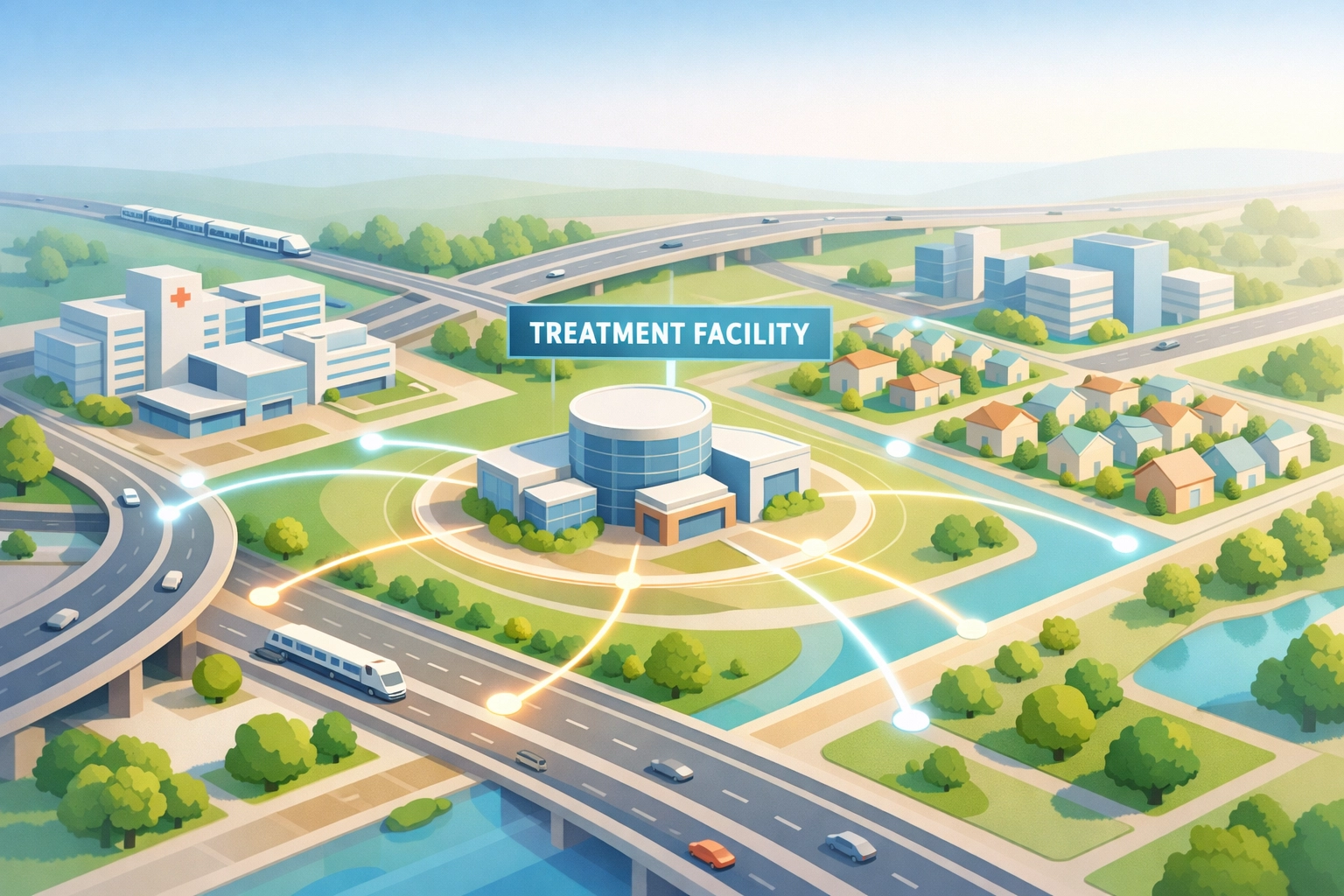
7. Analyze Location, Accessibility, and Referral Networks
Your facility's location impacts everything from referral relationships to patient retention to staffing costs.
Key considerations:
- Proximity to major referral sources (hospitals, detox centers, court systems)
- Accessibility for families
- Neighborhood compatibility and community acceptance
- Distance from triggers (bars, dealers) vs. isolation concerns
The "Hidden" Risks a Feasibility Study Uncovers
Beyond the obvious market and financial analysis, a thorough feasibility study reveals risks you probably haven't considered:
Payor Mix Vulnerability: What happens if 80% of your projected revenue depends on one insurance network, and they deny your credentialing application?
Referral Concentration Risk: If three hospital systems control 70% of local referrals and they already have preferred provider relationships, how do you break in?
Regulatory Changes: Is your state considering Medicaid reimbursement changes that could tank your business model?
Competitive Response: Will established competitors drop their rates or ramp up marketing when you enter the market?
These aren't just theoretical concerns. We've watched facilities struggle or close because they didn't anticipate these dynamics.
How We Help Treatment Centers Make Data-Driven Launch Decisions
At Ads Up Marketing, we've worked with dozens of treatment facilities navigating market entry decisions. While we're not a full-service feasibility consulting firm, we bring critical market intelligence to the table: especially around digital market analysis, competitive positioning, and patient acquisition costs.
Here's what we can help you evaluate:
- Digital market demand analysis: What are people in your target area actually searching for? What treatment-related keywords have search volume? What does cost-per-click data tell us about market competition?
- Competitive digital footprint assessment: How saturated is the digital landscape? Who dominates paid search and SEO in your market?
- Patient acquisition cost modeling: Based on market competition and search volume, what will it realistically cost to acquire patients in your first year?
- Marketing budget planning: How much should you allocate to digital marketing in months 1-12 based on your census ramp goals?
We've helped facility owners avoid costly mistakes by showing them, with data, when a market is too saturated to support another entrant: or when there's genuine opportunity.
Curious what the digital landscape looks like in your target market? Give us a call at 305-539-7114 and we'll walk you through what we're seeing.
When a Feasibility Study Says "Don't Do It"
Here's the hardest truth: sometimes the answer is no.
Maybe the market is genuinely saturated. Maybe your service model doesn't align with local demand. Maybe the regulatory hurdles are insurmountable without significantly more capital.
A good feasibility study will tell you this. And that's not failure: that's saving you from a much more expensive lesson down the road.
We've had uncomfortable conversations with facility owners where the data clearly said, "This market won't support your vision." Those conversations hurt in the moment, but they prevent financial catastrophe.
The Bottom Line: Don't Gamble Your Future on a Hunch
Opening a treatment center is one of the most important decisions you'll make. The people you serve deserve a facility that's built on a solid foundation. Your investors deserve stewardship of their capital. And you deserve to sleep at night knowing you made an informed decision.
A feasibility study isn't a luxury. It's not bureaucratic busywork. It's the single most important step between your vision and a thriving treatment center.
Whether you commission a full feasibility study from a specialized consultant or start by gathering preliminary market intelligence, the key is to make decisions based on data, not optimism.
Ready to evaluate whether your market can support your vision? We'd love to help you understand the digital demand landscape in your target area. Call us at 305-539-7114 or visit our consultation page to get started. Let's make sure your next move is your smartest move.