
INSIGHTS
Decoding the $10,000 CPA: Why Quality Leads Cost More
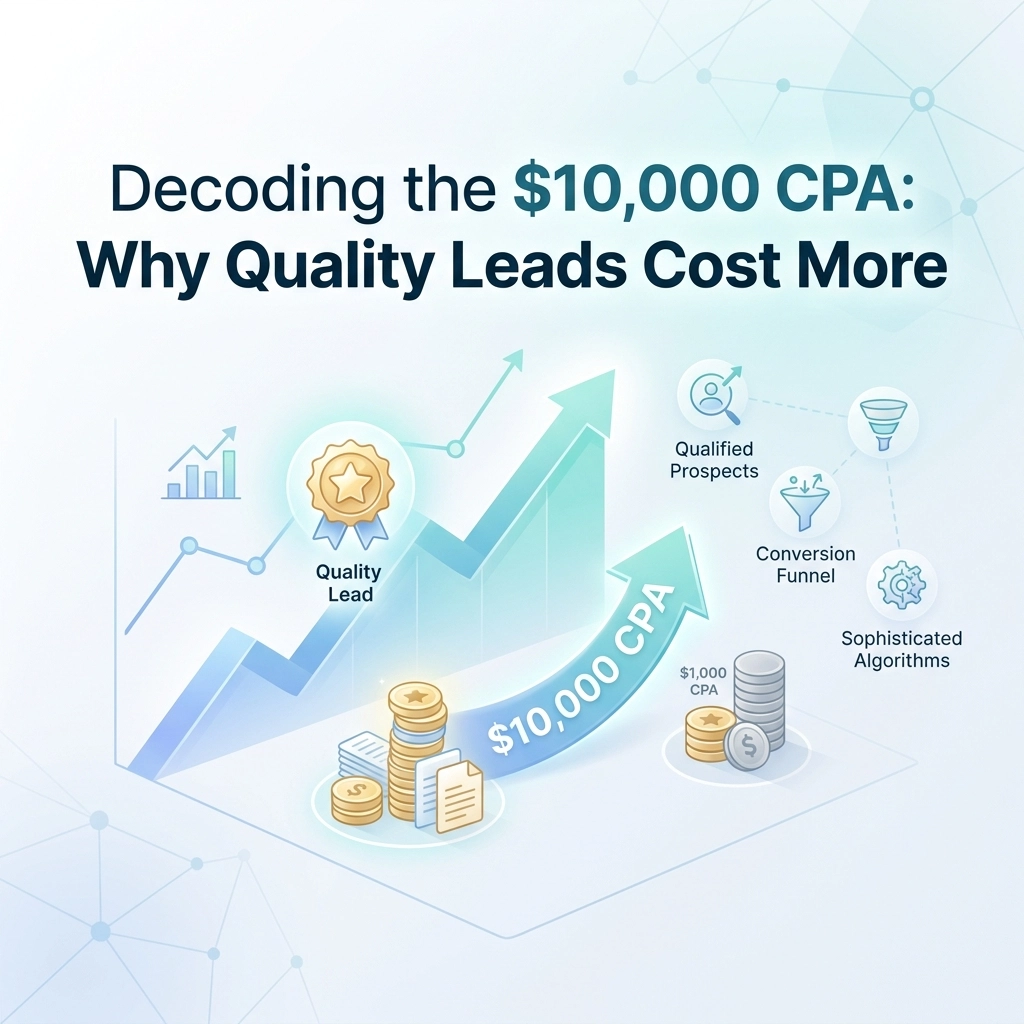
You’re sitting in your office, looking at the monthly marketing report, and you see a number that makes your stomach drop: $10,000. That’s not your total spend: that’s your Cost Per Acquisition (CPA) for a single admission.
Your first instinct might be to pick up the phone and fire your marketing agency. After all, you’ve heard stories of "leads" costing $50 or $100. But before you pull the plug, I want you to take a deep breath and look at the bigger picture. In the world of high-end behavioral health and addiction treatment, that $10,000 figure isn't a failure. For many of the most successful facilities in the country, it’s actually the benchmark for a healthy, sustainable business.
The truth is, the "cheap lead" era is over. Between LegitScript certification requirements and the massive increase in competition on Google Ads, the price of entry has gone up. But more importantly, the value of a high-intent lead has never been higher.
Table of Contents
- The Great CPA Misconception
- Quality vs. Quantity: The Math of Failure
- Why Behavioral Health Leads Are Premium Real Estate
- The Hidden Costs of "Cheap" Leads
- Performance Impact: $1,000 CPA vs. $10,000 CPA
- Calculating the Real ROI: Revenue vs. Acquisition
- How to Optimize Your Spend with Ads Up Marketing
The Great CPA Misconception
When we talk about CPA, we need to be very clear about what we’re "acquiring." There is a massive difference between a Cost Per Lead (CPL) and a Cost Per Acquisition (CPA).
A lead is just a name and a phone number. An acquisition is a person walking through your front door, signing the intake papers, and beginning their journey to recovery.
If you’re paying $100 per lead and it takes 100 leads to get one admission, your CPA is $10,000. If you’re paying $1,000 per lead but every other lead converts, your CPA is $2,000.
So what’s the connection between price and intent? Usually, the more a lead costs to generate, the further they are along in the decision-making process. A "cheap" lead is often someone who clicked a vague Facebook ad because they were curious. A "expensive" lead is someone searching for "residential dual diagnosis treatment near me" on Google at 2:00 AM.

Quality vs. Quantity: The Math of Failure
I see this all the time: a facility owner gets addicted to "volume." They want the phones ringing off the hook. They hire a call center, they buy thousands of shared leads, and they wait for the census to climb.
But it doesn't.
Why? Because your admissions team is spending 90% of their time talking to people who don't have the right insurance, aren't ready for treatment, or were looking for a completely different service. This is what we call "The Math of Failure."
| Metric | High-Volume / Low-Quality | High-Intent / Quality |
|---|---|---|
| Monthly Spend | $50,000 | $50,000 |
| Cost Per Lead | $250 | $2,500 |
| Total Leads | 200 | 20 |
| VOB Conversion Rate | 10% | 70% |
| Admission Rate | 2.5% | 25% |
| Total Admissions | 5 | 5 |
| CPA | $10,000 | $10,000 |
As you can see in this breakdown, the CPA is the same. But in the high-intent scenario, your team only had to handle 20 calls to get those 5 admissions. In the high-volume scenario, they had to grind through 200 calls.
Which team do you think is more burnt out? Which team is providing better care to the families on the other end of the line?
Why Behavioral Health Leads Are Premium Real Estate
The behavioral health industry is unique. According to SAMHSA, millions of Americans need treatment, but the barrier to entry for providers is incredibly high.
To run Google Ads for addiction treatment, you must be LegitScript certified. You have to navigate complex state regulations and maintain high clinical standards. This keeps the "cowboys" out of the market, but it also means that the remaining players are all bidding on the same limited pool of high-intent keywords.
Furthermore, the Lifetime Value (LTV) of a patient in a residential program can range from $25,000 to over $50,000 depending on the length of stay and levels of care provided. If you spend $10,000 to acquire $40,000 in revenue, you are looking at a 4:1 return. In what other investment can you get that kind of margin consistently?

The Hidden Costs of "Cheap" Leads
But this still doesn't drill down into the operational nightmare of low-quality leads. When you focus solely on lowering your CPL, you introduce hidden costs that don't show up on your marketing dashboard:
- Sales Team Attrition: Top-tier admissions coordinators don't want to spend their day being hung up on or told "I never filled out a form." They want to help people. Low-quality leads lead to high staff turnover.
- Opportunity Cost: Every minute your team spends on a "junk" lead is a minute they aren't spending nurturing a family who is actually ready to commit to your alumni programs.
- Brand Damage: Aggressive follow-up on low-intent leads can make your facility look desperate or "salesy," which is the last thing a family in crisis wants to feel.
Performance Impact: $1,000 CPA vs. $10,000 CPA
Let's look at how this impacts your actual bottom line over a 30-day period.
Performance Impact Table
| Benefit Category | The "Cheap" Lead Approach | The Quality Lead Approach ($10k CPA) |
|---|---|---|
| Sales Efficiency | Low (100+ calls per admission) | High (4-8 calls per admission) |
| VOB Quality | Mostly Medicaid/Uninsured | High-reimbursement PPO/Private Pay |
| Length of Stay | Often shorter (low clinical fit) | Longer (high clinical fit) |
| Staff Morale | Frustrated / Burnt out | Empowered / Successful |
| Predictability | High volatility | Stable and scalable |
The bottom line is clear: A $10,000 CPA on a high-intent, high-reimbursement lead is infinitely more valuable than a $1,000 CPA on a lead that will never clear VOB.
Calculating the Real ROI
I know you're struggling with the pressure to keep costs down. Every business owner is. But in healthcare, and specifically in drug rehab marketing, you have to view marketing as a clinical procurement process.
Are you procuring patients who your clinical team can actually help? Are you procuring patients whose insurance will actually pay for the care you provide?
If you aren't sure where your money is going, you need a conversion tracking audit. Most facilities think they have a "marketing problem" when they actually have a "data problem." They see a high CPA and panic, not realizing that the one $10,000 acquisition stayed for 45 days and referred two friends, while the "cheap" acquisitions all checked out AMA within 72 hours.

How to Optimize Your Spend with Ads Up Marketing
So, how do you handle the reality of the $10,000 CPA? You don't just "pay it" and hope for the best. You optimize every inch of the funnel to ensure that when you do spend that money, it’s working as hard as possible.
At Ads Up Marketing, we specialize in decoding these numbers for rehab owners. We don't just send you a spreadsheet of clicks; we look at your admissions, your VOB success rates, and your actual revenue.
We help you by:
- Refining Keyword Intent: Moving away from broad "rehab" terms and toward high-intent, specialized search phrases.
- Improving Landing Page Conversions: Ensuring that when a high-intent user clicks, they actually pick up the phone.
- Implementing Custom Solutions: Whether it's local SEO for rehabs or advanced retargeting strategies, we tailor the approach to your facility’s specific needs.
Don't let a "high" CPA number scare you into making bad business decisions. If you want to see how your current marketing spend stacks up against industry benchmarks, or if you're tired of chasing low-quality leads that go nowhere, let's talk.
Call us today at 305-539-7114 or visit our Free AdWords Audit page to get a professional set of eyes on your campaigns.
The cost of a quality lead is high because the value of a saved life: and a successful business: is even higher. Let us help you find the right balance.