
INSIGHTS
Build-Out vs. Lease: The Real Cost of Expanding Your Treatment Center
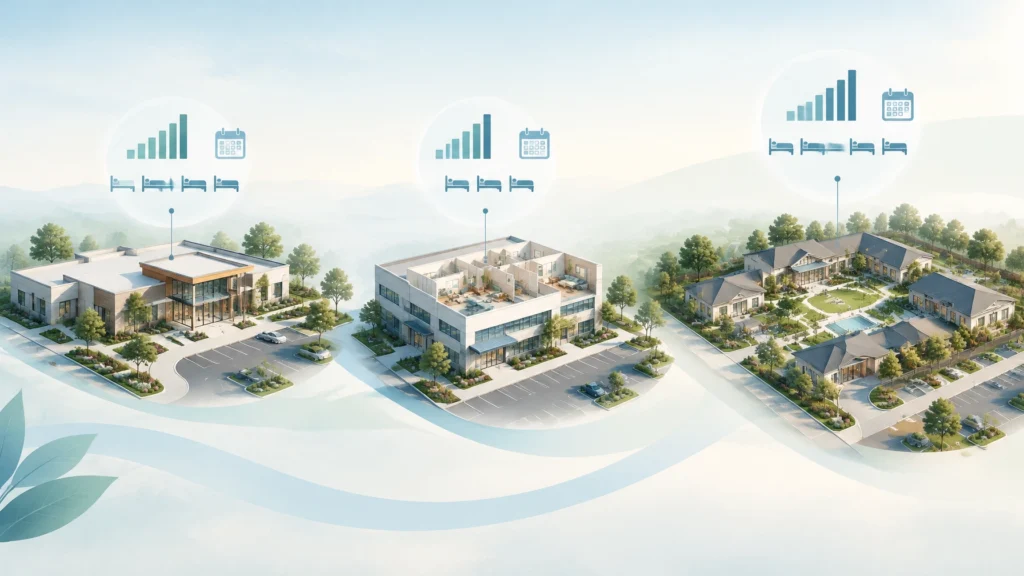
Expanding your treatment center can look like a simple bed-count decision on a spreadsheet. Then you price the site, discover zoning may not allow the planned use, and learn the building needs a different level of renovation than anyone expected.
The real question isn’t just which option has the lowest upfront cost? It’s which path gets your program licensed, open, and serving the right number of clients, without leaving you short on working capital or admissions.
Here’s how to compare a ground-up build, a lease in existing clinical space, and a turnkey acquisition, including the break-even math and marketing runway each option needs.
Table of contents
- Three expansion paths, three cost profiles
- Allow for approvals, not just construction
- Budget marketing before the doors open
- Calculate your break-even bed count
- Choose the path that fits your plan
Three expansion paths, three cost profiles
Before comparing bids, get specific about the service you’re expanding. An outpatient clinic, a residential substance-use program, and an inpatient psychiatric facility have different physical-plant, staffing, and approval requirements. A “treatment center” square-foot estimate is not a substitute for a project scope.
| Expansion path | Main cost drivers | Capital profile | Planning timeline to first admission* |
|---|---|---|---|
| Ground-up build | Land, site work, design, permits, construction, equipment, financing, and startup costs | Highest upfront capital; most control over layout and future capacity | Often 24–36+ months |
| Lease existing clinical space | Rent, tenant improvements, code upgrades, deposits, equipment, and any change-of-use work | Lower initial real-estate outlay; recurring rent and landlord terms matter | Often 9–18 months |
| Acquire a turnkey facility | Purchase price or lease obligations, diligence, repairs, equipment, transition costs, and licensing review | Higher acquisition or long-term occupancy commitment; may shorten delivery if the site fits | Often 3–12 months |
*These are broad planning ranges, not promised timelines. Facility type, location, construction scope, approvals, and readiness can change them substantially. A license or permit does not automatically transfer with a property.
For a rough new-construction reference, Terrapin Construction Group’s 2026 behavioral-health cost estimator puts residential treatment construction at about $385–$585 per square foot. Treat that as an early screening estimate from a construction estimator, not a bid or a fully loaded project budget.
Actual large projects show why scope matters. In 2025, Flintco reported that Oklahoma County’s new 56,000-square-foot, 60-bed Behavioral Care Center had a $44.4 million project cost. That’s about $793 per square foot, but it is a specific public behavioral-health project, not a standard price for a privately operated rehab. Flintco’s project announcement describes specialized beds, assessment areas, and clinical technology as part of the facility.
The MUSC Health Leatherman Behavioral Care Pavilion offers another useful reference: its project page lists 98,544 square feet and a $73.3 million construction cost. These examples are not directly comparable (program, location, and scope differ) but both make the same point: don’t compare a lease improvement allowance with a construction budget that excludes land, financing, equipment, or startup.
For an existing clinic, the “cheap” lease can change fast if you need new clinical rooms, upgraded life-safety systems, accessibility work, or a different occupancy classification. A turnkey site may save time, but only if its layout, condition, permitted use, and license status actually match your program. Verify all of that before treating “turnkey” as “ready to admit.”

Allow for approvals, not just construction
So what’s the connection between square footage and your time to first admission? The building has to be approved for the service you intend to provide. Local zoning, building and fire inspections, state licensure, and payer requirements may all affect the opening date.
The details vary by state and municipality. For one concrete example, North Carolina’s mental-health licensure application packet requires zoning documentation for residential programs and notes that new 24-hour residential construction must go through plan review. The application process also includes a six-month period for applicants to complete review requirements after initial contact with the licensure team. That is a state-specific application rule, not a nationwide promise that licensing takes six months.
Before signing a lease, buying a property, or closing on land, ask the relevant professionals to confirm:
- Whether the planned use and bed count are allowed at that address
- Which local permits, inspections, and occupancy approvals are required
- Which state license applies to the exact program and level of care
- Whether adding beds or changing services requires an amended approval
- Whether the physical layout and building systems can meet your program’s requirements
A property that already housed a provider can still need new approvals for a new operator, service, or bed count. Put those questions into diligence early; discovering the answer after closing is an expensive way to meet the planning department.
Budget marketing before the doors open
A newly built or acquired site does not fill itself. Your expansion needs a plan to tell the right people what you offer, where you’re located, and how to start an appropriate admissions conversation. It also needs trained people to answer and track those inquiries.
SAMHSA’s 2023 National Substance Use and Mental Health Services Survey counted 114,000 designated beds at substance-use treatment facilities and reported a 96% overall utilization rate for those beds. That’s a national snapshot, not proof that your local market has room for another program. Assess your referral relationships, payer mix, competition, and service demand before you build your revenue forecast around broad national figures.
Here’s a transparent marketing example you can adapt. Assume a 30-bed expansion, a target of 80% occupancy, and an average stay of 45 days. That target census is 24 occupied beds, requiring roughly 16 admissions per month to maintain it at steady state. If your own measured, fully loaded marketing cost is $2,500 per admission, the model implies about $40,000 a month in demand-generation costs at that volume, or $240,000 for six months.
That is an illustration, not an industry benchmark. Replace the sample cost with your actual cost per admission and use admissions, not clicks or form fills, as the outcome. Decide what portion of your SEO, paid search, content, website, and admissions support budget is truly incremental to this location.
If your opening date is approaching and the admissions forecast is still a guess, get the marketing plan and measurement in place now. Ads Up Marketing works exclusively with behavioral health and addiction treatment providers. We can help you evaluate your rehab PPC options, SEO strategy, and treatment-center website design before launch. Contact our team or call 305-539-7114.
Calculate your break-even bed count
A useful expansion model turns new beds into monthly contribution, not just gross revenue.
In the example below, assume you collect $1,000 per occupied bed-day and spend $550 per day on variable costs such as care delivery. That leaves $450 in contribution per occupied bed-day. Assume the location’s monthly fixed costs are $180,000, including occupancy, fixed staffing, debt service, and the planned monthly marketing budget.
| Performance impact measure | Example calculation | Result |
|---|---|---|
| Contribution per occupied bed per 30-day month | $450 × 30 | $13,500 |
| Break-even occupied beds | $180,000 ÷ $13,500 | About 14 beds |
| Break-even occupancy, based on 30 beds | 14 ÷ 30 | About 47% |
| Contribution at 24 occupied beds | 24 × $13,500 | $324,000/month |
| Amount above assumed fixed costs at 24 beds | $324,000 − $180,000 | $144,000/month |
This is a simplified operating model, not a profit forecast. Adjust for payer mix, collections, staffing thresholds, length of stay, debt terms, rent escalations, and any costs that change with census. If you have to add a nursing shift at 20 occupied beds, for example, fixed costs may jump right around the point you thought you’d be comfortably above break-even.
A helpful comparison is to model each property path with the same service mix, occupancy ramp, and admissions assumptions. Then compare total cash needed before opening, monthly fixed costs, and the number of occupied beds required to cover them. That tells you more than the rent or purchase price alone.

Choose the path that fits your plan
Ground-up construction can make sense when the program needs a specialized design and you have the capital and patience for approvals and delivery. Leasing existing clinical space may reduce the initial real-estate commitment, but only if renovation and lease terms work for your use. A turnkey acquisition may offer speed, but diligence still needs to confirm that the facility, approvals, and operating economics fit.
Before committing, build a side-by-side model that includes:
- All-in pre-opening cash, including renovation or construction, equipment, professional fees, financing, and working capital.
- Time to first admission, with realistic allowances for zoning, inspections, licensing, staffing, and payer readiness.
- A marketing ramp budget based on your own cost per admission and the census you need to reach.
- Break-even beds and a downside case, such as a slower opening or lower collections.
I know expansion can feel urgent, especially when your current census is strong or you’re seeing unmet need. But a disciplined comparison now gives you a better chance of opening a sustainable program, not just a new address.
If you want a second set of eyes on your admissions and marketing assumptions before you make the capital decision, talk with Ads Up Marketing at 305-539-7114. We can help you connect the facility plan to measurable demand, admissions, and ROI.