Here's a question that probably keeps you up at night: Why are you spending thousands of dollars per admission only to watch patients disappear after 30 days, never to be seen again?
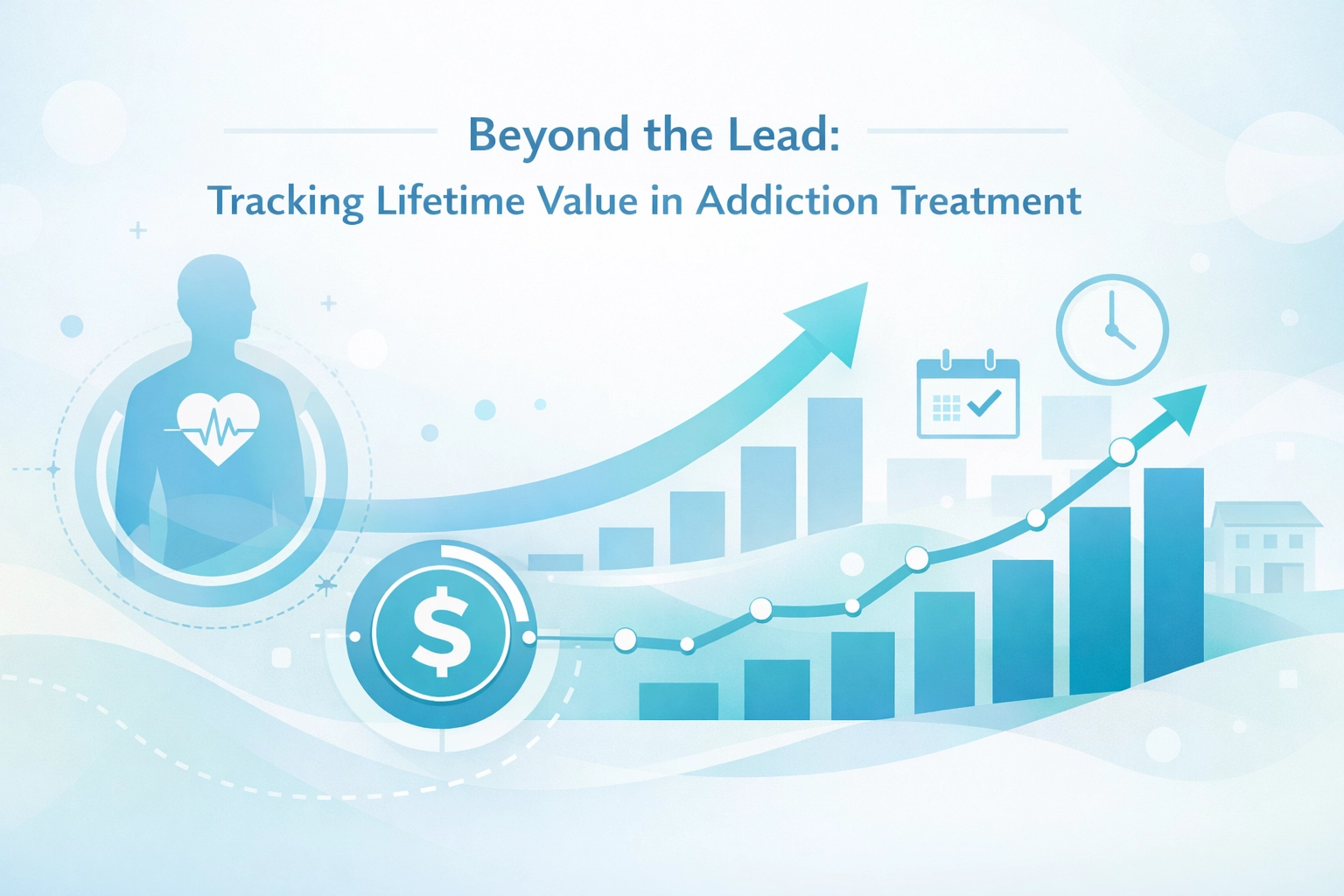
If you're running an addiction treatment facility, you're probably laser-focused on one metric: cost per lead. But that singular focus is costing you a fortune and missing the bigger picture entirely. The real money: and the real outcomes: aren't in the initial admission. They're in the lifetime relationship you build with each patient who walks through your doors.
Let me explain why your current tracking is broken and what you should be measuring instead.
The Expensive Mistake Most Treatment Centers Make
You're tracking leads like you're selling widgets. You calculate your Google Ads spend, divide by admissions, and call it a day. But substance use disorder isn't a one-and-done transaction. Research from behavioral health finance experts shows that patients with SUDs are 5 to 10 times more expensive than average patients during active use: but here's the kicker: when properly managed through ongoing care, their total cost drops by approximately 50%.
So what's the connection to your marketing ROI? Everything.
When you only track the initial admission, you're ignoring:
- Alumni program re-enrollments
- Step-down care services
- Outpatient therapy continuation
- Sober living referrals
- Family program participation
- Medication management follow-ups
Each of these touchpoints represents revenue. More importantly, they represent the actual value of acquiring that patient in the first place.

Why Lifetime Value Tracking Changes Everything
Let's get specific about what you're leaving on the table. The traditional addiction treatment model treats each episode as isolated. Patient completes 30-day residential? Great. They're gone. But SUD is a chronic condition, not an acute one: and your financial tracking needs to reflect that reality.
Think about it this way: would a diabetes clinic only count the revenue from a patient's first visit? Of course not. They'd factor in years of ongoing monitoring, medication, and check-ups. Your facility should be doing the same thing.
According to SAMHSA's guidelines on continuing care, successful recovery often involves multiple levels of care over extended periods. That's not a bug: it's a feature. And it should be reflected in how you calculate marketing ROI.
What Your LTV Calculation Should Actually Include
| Revenue Stream | Traditional Tracking | Lifetime Value Tracking |
|---|---|---|
| Initial admission | ✓ Counted | ✓ Counted |
| IOP/PHP step-down | ✗ Not tracked back to source | ✓ Attributed to initial lead |
| Outpatient continuation | ✗ Treated as new patient | ✓ Part of patient journey |
| Alumni re-engagement | ✗ Not connected | ✓ Planned touchpoint |
| Sober living referrals | ✗ Lost revenue | ✓ Partnership value tracked |
| Family program add-ons | ✗ Missed opportunity | ✓ Calculated in LTV |
When you track lifetime value properly, that $8,000 cost-per-admission suddenly doesn't look so expensive if that patient generates $45,000 over three years of ongoing care.
The Data You're Not Capturing (But Should Be)
Most treatment centers we work with at Ads Up Marketing come to us with the same problem: they can tell us how many leads they got last month, but they can't tell us which marketing channel produced patients who stayed engaged the longest.
That's a massive blind spot.
You need tracking systems that connect:
- Initial lead source (which Google ad, Facebook post, or SEO article brought them in)
- All subsequent revenue touchpoints (every service they use over time)
- Reengagement patterns (when they return and for what services)
- Referral generation (which satisfied patients bring others)
This isn't just academic. This data tells you where to invest your marketing budget. If your Google Ads for drug rehab are generating patients who complete treatment but never return, while your local SEO brings in patients who stay engaged for years, you need to know that.
Want to know which of your campaigns are actually worth the investment? Call us at 305-539-7114 and we'll show you how to set up proper conversion tracking that follows the patient journey, not just the first click.

The Reengagement Cycle: Your Most Valuable Metric
Here's something counterintuitive: a patient who relapses and returns to your facility multiple times might actually be more valuable than one who completes treatment once and disappears.
I know that sounds wrong at first. But stick with me.
According to research published by the National Institute on Drug Abuse, relapse rates for substance use disorders range from 40-60%: similar to other chronic diseases like hypertension and asthma. That's not a failure of treatment. That's the nature of chronic conditions.
The facilities that win are the ones who:
- Maintain touchpoints with alumni
- Create pathways for easy re-entry
- Track which former patients re-engage
- Calculate the lifetime revenue from planned reengagement
Your marketing should reflect this reality. Are you running retargeting campaigns to stay top-of-mind with alumni? Are you tracking which patients opened your monthly newsletter versus which ones re-admitted? These connections matter.
Building a Tracking System That Actually Works
Let me be brutally honest: most treatment centers don't have the infrastructure to track lifetime value properly. Your admissions software talks to your billing system, which doesn't talk to your CRM, which definitely doesn't talk to your marketing platform.
It's a mess.
Here's what you actually need:
1. Unified patient identifiers across all systems so you can follow the same person through multiple episodes of care
2. Marketing attribution that persists beyond the first conversion: when someone calls you six months after completing IOP, you need to know where they originally came from
3. Revenue tagging by patient source so every dollar generated gets attributed back to the marketing channel that acquired that patient
4. Automated reporting that shows you LTV by acquisition channel, not just volume metrics
This is exactly what we help facilities implement through our conversion tracking services. We don't just set up basic call tracking: we build systems that follow patients through their entire journey with your facility.
The ROI Reality Check
Let's run some real numbers. Say you're spending $150,000 per month on marketing and generating 20 admissions. That's $7,500 per admission. Seems expensive, right?
But what if you knew:
- 40% of those patients return for step-down care (average value: $12,000)
- 25% re-engage within 18 months (average value: $18,000)
- 15% refer a family member or friend (average value: $28,000)
- 60% attend alumni events and use your outpatient services periodically (average value: $8,000)
Suddenly that $7,500 acquisition cost for a patient with a potential lifetime value of $35,000+ looks like a steal.
But this still doesn't drill down to the channel level. Which specific campaigns are generating the highest-LTV patients? That's where sophisticated tracking separates the winners from the facilities that burn through marketing budget without knowing what's working.

Making the Shift: From Episodes to Relationships
The treatment centers that thrive over the next five years won't be the ones with the biggest marketing budgets. They'll be the ones who understand that addiction treatment is a relationship business, not a transaction business.
That means:
- Treating marketing as patient acquisition, not just lead generation
- Measuring success in years, not days
- Building systems that nurture long-term engagement, not just initial admissions
- Investing in channels that attract patients who stay, even if they cost more upfront
We've worked with dozens of treatment facilities to make this exact shift. The facilities that commit to proper lifetime value tracking consistently see their actual marketing ROI improve by 200-300% compared to their old episode-based calculations: not because we're driving more leads, but because they're finally measuring what actually matters.
Take the Next Step
If you're still tracking marketing success based on cost-per-lead or even cost-per-admission, you're flying blind. The facilities winning market share right now are the ones tracking lifetime value, understanding patient journeys, and investing accordingly.
We've built tracking systems for treatment centers ranging from small outpatient clinics to national residential networks. We know the specific challenges of attribution in behavioral health, the compliance requirements around patient data, and how to build reporting that actually helps you make decisions.
Ready to stop guessing and start knowing which marketing investments actually pay off? Let's talk. Call 305-539-7114 or visit our drug rehab marketing page to see how we help treatment centers track what matters and scale what works.
Your patients aren't one-time transactions. Stop tracking them like they are.