You just spent $45,000 on marketing last month. Your admissions are up. But here's the million-dollar question: which channels actually drove those admissions, and which ones are bleeding your budget dry?
Most rehab owners I talk to are flying blind. They know Google Ads costs them $8,000 monthly. They see SEO expenses at $4,500. Facebook runs another $3,200. But when I ask, "Which channel brought in the 12 admissions you got last month?": crickets.
That's the attribution gap, and it's costing you serious money.
What Attribution Modeling Actually Means for Your Facility
Attribution modeling isn't some abstract marketing concept. It's the difference between knowing you spent money and knowing which specific ad, keyword, or social post put someone in a bed.
Think of it this way: A potential patient sees your Facebook ad on Monday. Googles "luxury rehab near me" on Wednesday and clicks your paid ad. Visits your website organically on Friday. Then calls Saturday morning and admits the following Tuesday.
Which channel gets credit for that admission? All of them? The first one? The last one?
Without proper attribution modeling, you're guessing. And guessing with a $50,000 monthly marketing budget is a dangerous game.

The Real Cost of Not Tracking Attribution
According to SAMHSA's National Survey of Substance Abuse Treatment Services, there are over 15,000 addiction treatment facilities in the United States, all competing for the same patients. When your competitors know exactly which marketing channels work and you don't, they're optimizing while you're hoping.
I've seen facilities waste six figures annually on channels that look good on paper but deliver zero actual admissions. One client was dumping $12,000 monthly into display advertising because it generated "impressions" and "clicks." When we implemented proper attribution tracking, we discovered it had contributed to exactly zero admissions in eight months.
That's $96,000 they'll never get back.
Breaking Down Attribution Models That Actually Matter
Different attribution models assign credit differently. Here's what each one tells you and when it matters:
First-Touch Attribution
This model gives 100% credit to the first marketing touchpoint someone encounters. Great for understanding what's getting you on someone's radar initially.
If your Google Ads are consistently showing as the first touch before admissions, you know your targeting and messaging are attracting the right people. If organic search dominates first-touch, your SEO game is strong.
Last-Touch Attribution
The opposite approach: 100% credit goes to the final interaction before admission. This tells you what's closing the deal.
A lot of facilities default to this because it's simple. Someone called from your Google Ad, they admitted, Google gets the credit. But you're missing the entire journey that brought them there.
Linear Attribution
Every touchpoint gets equal credit. Sounds fair, right? It is: if you're trying to understand the full journey without weighting any interaction more heavily.
The downside? It doesn't tell you which touchpoints were actually influential versus just present.
Multi-Touch (Data-Driven) Attribution
This is where it gets real. Multi-touch attribution uses actual conversion data to assign credit based on which touchpoints statistically influence admissions most.
According to research from the National Institute on Drug Abuse, the decision to seek treatment involves multiple influences and touchpoints: family pressure, health crises, financial concerns. Your marketing attribution should reflect that complexity.
Attribution Models Comparison
| Model Type | Credit Distribution | Best For | Limitation |
|---|---|---|---|
| First-Touch | 100% to first interaction | Understanding initial awareness channels | Ignores nurturing touchpoints |
| Last-Touch | 100% to final interaction | Identifying closing channels | Misses the journey |
| Linear | Equal credit to all touchpoints | Seeing full patient journey | Doesn't weight importance |
| Multi-Touch | Data-driven weighted credit | Accurate ROI across journey | Requires robust tracking setup |
| Position-Based | 40% first, 40% last, 20% middle | Balancing awareness and conversion | Somewhat arbitrary weighting |
How Attribution Actually Works in Practice
Let's get practical. When we set up attribution tracking for rehab facilities, here's what we're connecting:
Call tracking numbers that show which ads triggered phone calls. Not just "someone called": exactly which Google Ad keyword, Facebook campaign, or SEO landing page they came from.
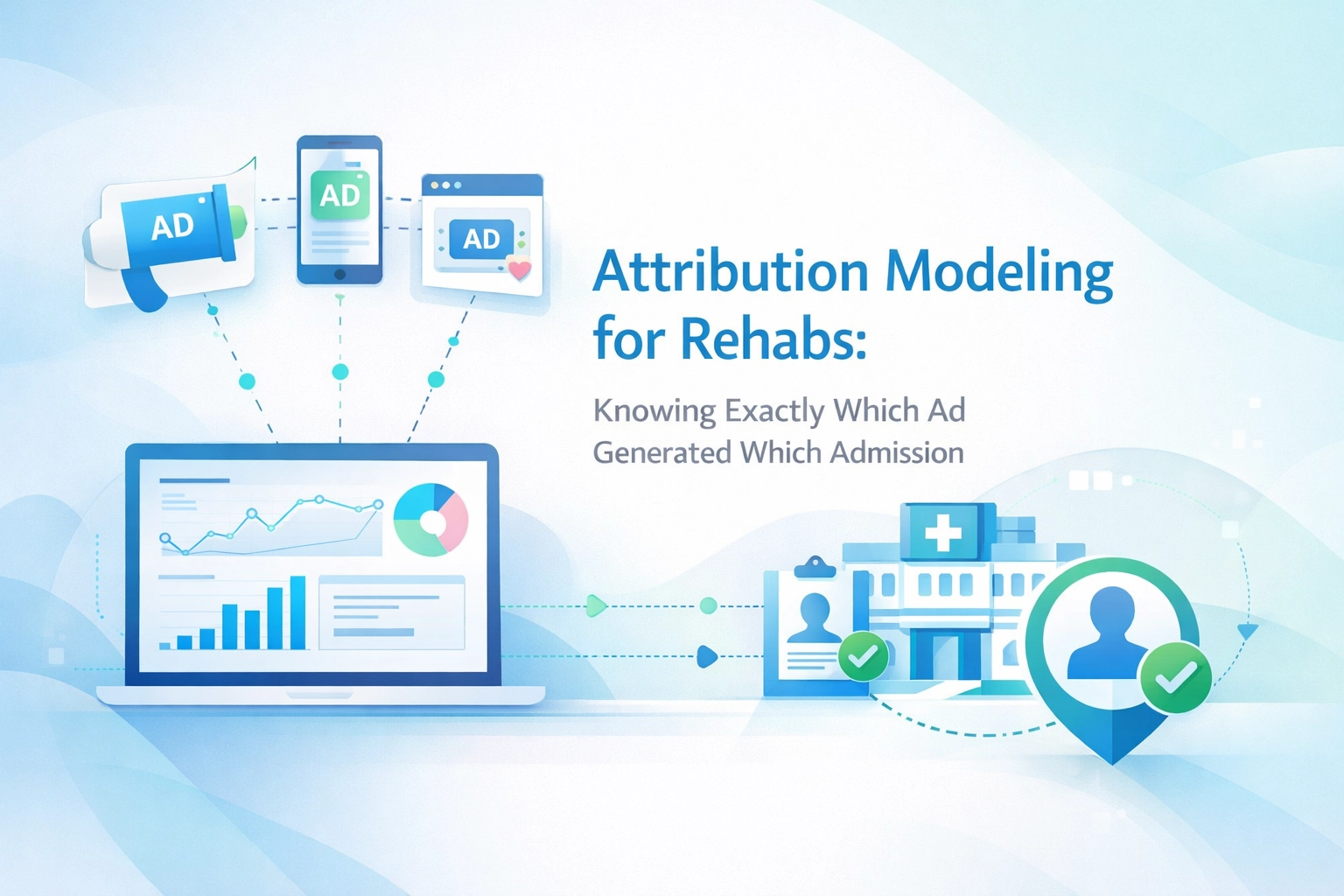
CRM integration that ties marketing touchpoints to actual admissions. You see the complete journey: ad click → website visit → chat interaction → phone call → VOB → admission.
Cross-device tracking because your potential patients aren't using just one device. They're researching on their phone during lunch, their laptop at night, maybe even their tablet on the weekend.
When this all connects in an attribution dashboard, you're looking at data like: "Google Ads 'intervention services' keyword generated 4 admissions last month at an average CPA of $4,200. Facebook video ads generated 7 inquiries but zero admissions."
That's actionable intelligence.

The Multi-Channel Reality of Patient Acquisition
Here's what a real patient journey looks like in 2026:
Someone sees your facility mentioned in a blog post (organic content). They don't take action. Three weeks later, they search "best alcohol rehab Florida" and click your Google Ad. They browse but don't call. Two days pass, and your retargeting ad catches them on Facebook. They visit your site again, download your insurance guide, and finally call after getting a text reminder about your 24/7 admissions line.
Which channel gets credit?
With proper multi-touch attribution, you'd see:
- Blog post: 15% credit (initial awareness)
- Google Ad: 35% credit (high-intent search)
- Facebook retargeting: 25% credit (re-engagement)
- Website content: 15% credit (education/trust-building)
- Text follow-up: 10% credit (final conversion push)
Now you know where to invest more and what's actually moving the needle.
Setting Up Attribution That Doesn't Require a Data Science Degree
Look, you didn't get into this business to become a marketing analytics expert. You're here to help people recover. But ignoring attribution is like running a facility without tracking bed occupancy rates: you're managing blind.
The good news? You don't need to build this yourself.
Google Analytics 4 offers attribution modeling built-in, but it needs to be configured correctly for healthcare marketing. Learn more about GA4 attribution models.
Call tracking platforms like CallRail or CallTrackingMetrics integrate with your ads and CRM to show call sources.
Marketing automation platforms like HubSpot or specialized addiction treatment CRMs can connect the dots between marketing touches and actual admissions.
But here's the reality: setting this up correctly requires expertise in HIPAA-compliant tracking, healthcare marketing regulations, and technical implementation. One misconfiguration and you're either violating patient privacy or collecting garbage data.
Why Most Facilities Get Attribution Wrong
I've audited dozens of rehab marketing setups, and here are the most common attribution failures:
Tracking only vanity metrics. Website visits and click-through rates don't pay your bills. Admissions do. Your attribution model must connect to actual patient outcomes.
Ignoring phone calls. If 80% of your admissions start with a phone call but you're only tracking online conversions, you're missing most of your story.
Cookie-based tracking only. Privacy regulations and browser changes are killing cookies. You need first-party tracking solutions that don't rely on third-party cookies.
Not accounting for offline touchpoints. Someone attends your community presentation, then Googles your facility and calls. If you're not asking intake "How did you hear about us?" and connecting that to digital touchpoints, you're missing critical data.
The ROI Impact of Proper Attribution
When you know exactly which channels drive admissions, three things happen immediately:
Budget reallocation. You stop funding underperformers and double down on what works. One facility we work with moved $15,000 monthly from display ads (zero admissions) to Google Search campaigns (2-3 admissions monthly). Result? 40% more admissions with the same budget.
Better creative decisions. You see which ad messaging, landing pages, and offers actually convert. Not what gets likes or impressions: what drives phone calls and admissions.
Faster optimization cycles. Instead of waiting months to "see if this works," you're making data-driven adjustments weekly or even daily based on attribution insights.
Getting Started Without Overwhelming Your Team
Start simple. You don't need perfect attribution on day one. Here's a practical roadmap:
- Implement call tracking with unique numbers for each major channel (Google, Facebook, SEO landing pages)
- Set up Google Analytics 4 with proper conversion tracking for calls, form submissions, and chat interactions
- Create a basic attribution dashboard that shows admissions by channel: even if it's just a spreadsheet initially
- Train your intake team to ask and record "How did you hear about us?" consistently
- Review attribution data monthly and adjust budgets based on what's actually working
But if you want this done right, with HIPAA compliance, proper technical setup, and ongoing optimization: that's exactly what we do at Ads Up Marketing.

Why DIY Attribution Usually Fails in Healthcare
Healthcare marketing has unique challenges. You're dealing with HIPAA compliance, complex patient journeys, emotional decision-making, and often family involvement in the research process.
Generic attribution setups don't account for:
- Multiple decision-makers (patient, family, interventionist)
- Long consideration periods (weeks or months)
- Insurance verification delays creating gaps between interest and admission
- Referral sources (doctors, courts, therapists) that interact with your marketing
This isn't e-commerce where someone sees an ad, clicks, buys. This is life-changing treatment decisions with six-figure price tags and intense emotional stakes.
Let's Build Your Attribution System
If you're tired of guessing where your marketing dollars actually go, we should talk.
At Ads Up Marketing, we specialize in attribution modeling specifically for addiction treatment facilities. We set up HIPAA-compliant tracking, integrate your CRM and ad platforms, and give you clear dashboards showing exactly which campaigns drive admissions: not just clicks or calls, but actual patients in beds.
We handle the technical complexity so you can focus on running your facility.
We've built attribution systems for facilities from 20 beds to 200+ beds. Whether you're spending $10,000 or $100,000 monthly on marketing, you deserve to know what's working.
Ready to stop guessing and start knowing? Call us at 305-539-7114 or visit our website to schedule a free attribution audit. We'll review your current tracking setup, identify gaps, and show you exactly what proper attribution could reveal about your marketing ROI.
Because in 2026, flying blind isn't just inefficient: it's leaving money on the table that your competitors are picking up.