
INSIGHTS
Scaling Your Facility: Moving from 10 Beds to 50 with Data-Driven Marketing
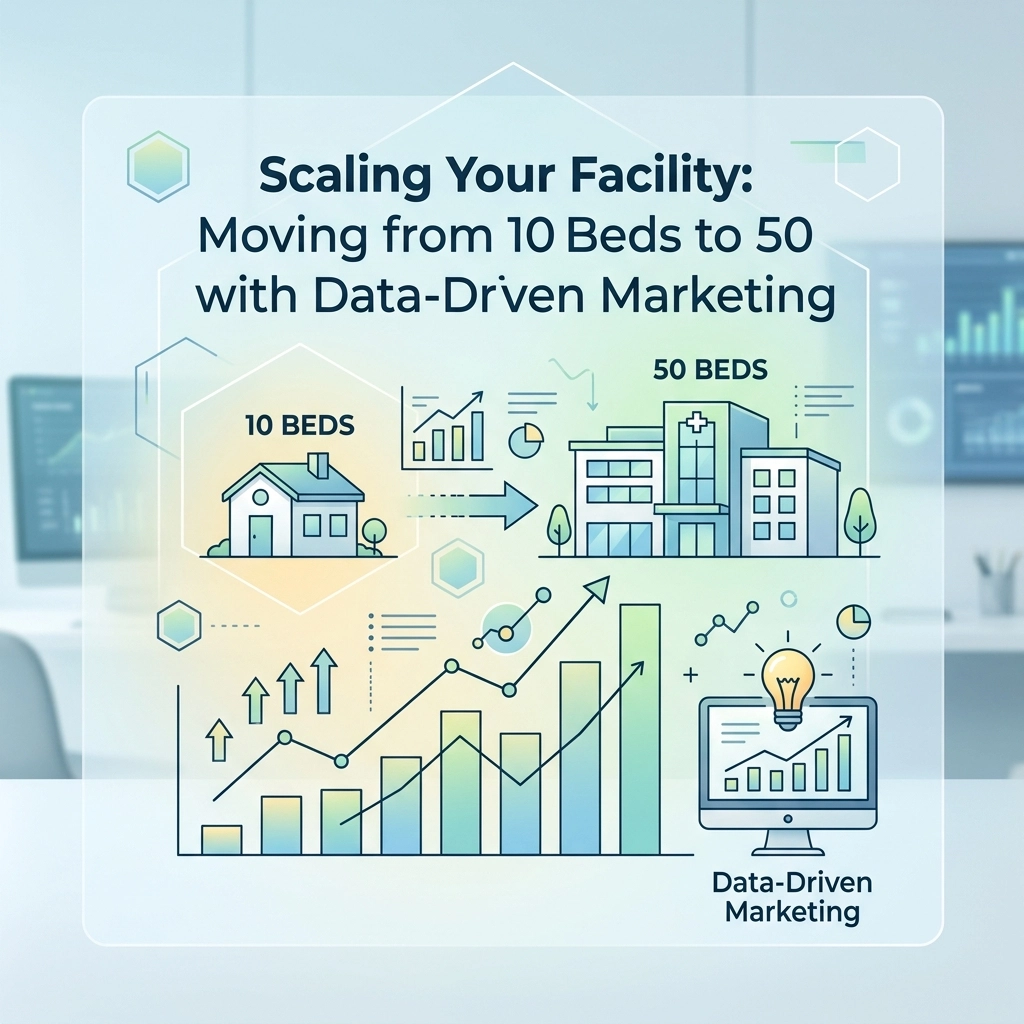
You’ve done it. You’ve successfully managed a 10-bed facility, kept the lights on, and more importantly, helped people find the path to recovery. But now, you’re looking at the numbers and realizing that while 10 beds provide a service, 50 beds provide a legacy: and a significantly healthier bottom line.
However, the jump from 10 to 50 isn't just a "multiplication" problem. It’s a complete structural evolution. If you try to run a 50-bed facility the same way you ran a 10-bed "mom and pop" operation, you’re going to burn out, bleed cash, or worse, compromise patient care.
Scaling safely requires moving away from "gut feelings" and moving toward a data-driven infrastructure. You need to know exactly how much it costs to acquire a patient, what your optimal occupancy rate is, and where your next 40 patients are coming from before you ever sign the lease on a larger building.
The "Messy Middle" of Facility Scaling
The transition from 10 to 50 beds is often called the "messy middle." At 10 beds, you can manage almost everything through personal relationships and manual oversight. You know every patient's name, every staff member's quirks, and exactly where every dollar goes.
At 50 beds, that personal oversight becomes impossible. You need systems. According to SAMHSA, the demand for quality behavioral health services is higher than ever, but the cost of entry is also rising. To scale, you have to transition from being the "Chief Everything Officer" to a data-driven strategist.
Are you prepared to handle a 500% increase in lead volume? Do you have the tracking in place to know which marketing channels are actually driving admissions versus just generating "noise"? This is where most owners stumble, but it’s also where Ads Up Marketing steps in to bridge the gap.
Leveraging Data for Market Demand
Before you add a single bed, you need to conduct a forensic analysis of your local and national market. Scaling without market data is like flying a plane in a fog bank without an altimeter.
- Geographic Saturation: Is your local area underserved? You can check local SEO trends to see how many people are searching for "rehab near me" in your specific zip codes.
- Competitor Benchmarking: Who owns the other 400 beds in your 20-mile radius? If they are under-occupying, why?
- Payer Mix Analysis: Will your 50-bed facility rely on private pay, out-of-network (OON), or in-network (INN) contracts? The data on reimbursement rates will dictate your entire marketing budget.

The Performance Impact: 10 Beds vs. 50 Beds
To understand the financial shift, let’s look at how the metrics change when you scale. Rehab owner profitability in 2026 depends entirely on managing these margins.
Performance Impact Comparison Table
| Metric | 10-Bed Facility (Current) | 50-Bed Facility (Target) | Why It Matters |
|---|---|---|---|
| Monthly Lead Volume | 15 – 30 | 150 – 250 | Scaling requires a robust digital "engine." |
| Avg. Cost Per Lead (CPL) | $80 – $120 | $60 – $90 | Efficiency must increase as volume grows. |
| Admissions Team | 1 (Often the Owner) | 3 – 5 Dedicated Reps | You need a call center structure. |
| Marketing Channels | Word of Mouth / Local | PPC / SEO / Social / Retargeting | Diversification prevents "dry spells." |
| Break-Even Occupancy | 60% | 75% | Higher overhead means less room for error. |
Note: Estimates based on average market data for mid-range residential treatment centers.
The Marketing Engine: From Referrals to Digital Dominance
When you have 10 beds, you can survive on professional referrals and community word-of-mouth. When you have 50, those sources usually dry up or become inconsistent. You need a predictable, scalable way to generate drug rehab leads.
1. Data-Driven Google Ads
Google Ads is the fastest way to fill beds, but it's also the easiest way to lose money if you aren't LegitScript certified. For a 50-bed facility, you should be looking at an aggressive Google Ads strategy that targets high-intent keywords. But here’s the catch: you don’t just want clicks; you want admissions.
2. Conversion Tracking is Non-Negotiable
You must know exactly which ad resulted in a phone call, and which phone call resulted in a VOB (Verification of Benefits), and which VOB resulted in an intake. Without conversion tracking, you are essentially gambling with your marketing budget.

Scaling Admissions: The Data Behind the Phone Call
So, the marketing is working, and the phones are ringing. Great! But can your team handle it? Moving to 50 beds means your admissions department needs to function like a high-performance sales team.
- Speed to Lead: Data shows that if you don't answer a lead within 5 minutes, your chances of conversion drop by 80%.
- Call Recording & Analytics: Are your reps empathetic? Are they asking the right clinical questions? Use data to audit your calls and improve conversion rates.
- CRM Integration: You cannot manage 200 leads a month on a spreadsheet. You need a CRM that tracks every touchpoint in the patient journey.
If your current intake process feels "clunky," it’s time to look into custom solutions that automate the follow-up process. Don't let a $30,000 admission slip through the cracks because someone forgot to call them back.
Maintaining Quality During Growth
One of the biggest fears owners have when scaling is that the "magic" of their program will disappear. How do you maintain the clinical integrity that helped your first 10 patients?
Data helps here, too. By tracking patient outcomes and utilizing alumni programs, you can prove that your clinical model works at scale. Organizations like the NAATP emphasize that ethical marketing and clinical excellence must go hand-in-hand.
As you grow, you’ll likely need to seek higher levels of accreditation to stay competitive and maintain trust. Whether it's CARF accreditation or Joint Commission standards, having the data to prove your facility’s safety and efficacy is vital.
The "Safety" in Data-Driven Scaling
Scaling safely means having a "Plan B" for your occupancy. What happens if a major insurer drops your contract? What happens if Google changes its algorithm?
By diversifying your marketing: using a mix of SEO, social media, and even press releases: you create a safety net. You aren't beholden to a single source of truth.
But this still doesn’t drill down to the most important part: Your time.
As an owner moving toward a 50-bed operation, your time is best spent on high-level strategy and clinical leadership, not fiddling with Facebook Ads or trying to figure out why your website isn't ranking. You need a partner who understands the healthcare space specifically.

Ready to Scale Your ROI?
Moving from 10 to 50 beds is a massive undertaking, but it is one of the most rewarding moves you can make as a business owner and a healthcare provider. The difference between a facility that thrives and one that struggles during this transition is the quality of the data driving their decisions.
At Ads Up Marketing, we specialize in helping treatment centers scale. We don't just "run ads"; we build growth engines based on hard numbers and years of healthcare marketing experience. We know the average rehab center revenue in 2026 and exactly what it takes to get you there.
Stop guessing and start growing. If you're ready to see how your facility can make the jump to 50 beds with a predictable flow of admissions, let’s talk.
Call us today at 305-539-7114 to schedule your free AdWords audit or to discuss a custom digital marketing service plan tailored to your expansion goals.
The beds are waiting. Are you ready to fill them?

Frequently Asked Questions (FAQ)
What is the average cost to market a 50-bed facility?
Marketing budgets vary by location and payer mix, but typically, facilities should allocate 10-15% of their target gross revenue to marketing during a scaling phase to ensure consistent occupancy.
How long does it take to fill 40 additional beds?
With a data-driven PPC and SEO strategy, most facilities see a significant ramp-up in admissions within 90 days, though reaching full 90% occupancy can take 6-9 months depending on the market.
Do I need a dedicated call center for 50 beds?
While you don't necessarily need a 24/7 outsourced center, you do need at least 2-3 full-time, trained admissions specialized who can handle the lead volume during peak hours.
Is SEO or PPC better for scaling?
You need both. PPC provides the immediate volume needed to pay the new bills, while SEO builds long-term equity and lowers your average Cost Per Acquisition (CPA) over time.
For more information on how we can help you navigate this transition, contact us today.