
INSIGHTS
Turning High-Intent Leads for Detox Into Admitted Patients: The Revenue Pipeline
A prospect searches “detox near me,” clicks your ad, and calls your facility. It looks like a win.
Then the call goes to voicemail.
Or the form sits untouched until morning. Or the admissions coordinator answers but cannot confirm insurance, explain the next step, or schedule an arrival. The family keeps searching. The opportunity disappears.
High-intent detox leads are valuable, but they are not revenue until they move through your admissions pipeline. That means you need to measure what happens between the first inquiry and the completed admission: not just clicks, impressions, and form fills.
This guide breaks down the detox lead conversion metrics that matter, where revenue leaks usually occur, and how Ads Up Marketing helps treatment centers connect marketing performance to actual admissions.
Table of Contents
- Why high-intent detox leads require a full-funnel view
- The detox admissions revenue pipeline
- The metrics that drive detox ROI
- Performance Impact: Where pipeline improvements create revenue
- How to improve lead-to-admission conversion
- Compliance belongs in the pipeline
- Build a more accountable admissions engine
Why High-Intent Detox Leads Require a Full-Funnel View
Someone looking for detox may be dealing with an urgent, emotionally difficult situation. A parent may be searching on behalf of an adult child. A person may be calling between moments of crisis. The decision window can be short, and families often contact several providers.
The need is significant. According to SAMHSA’s 2024 National Survey on Drug Use and Health, 52.6 million people aged 12 and older needed substance use treatment in 2024, while 10.2 million received treatment.
So what’s the connection to ROI?
Your marketing does not need to manufacture the need for care. It needs to help the right person find an appropriate, legitimate treatment option: and then your team needs to respond with speed, empathy, and clarity.
That is why the most useful question is not:
“How many leads did we generate?”
It is:
“How many qualified detox opportunities became completed admissions, and what did each admission cost?”
The Detox Admissions Revenue Pipeline
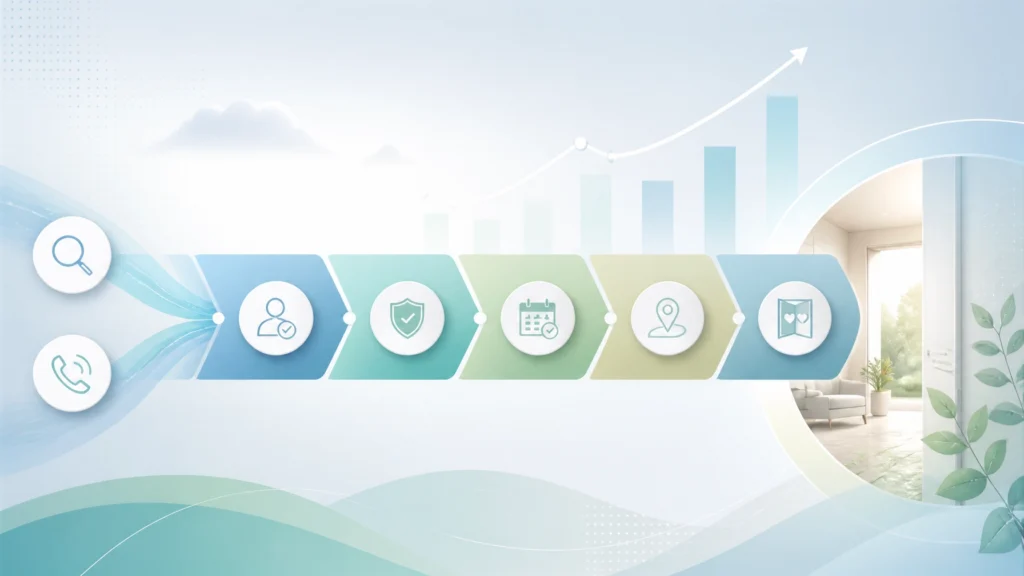
Think of your pipeline as a series of measurable stages:

-
High-intent inquiry
A person calls, submits a form, starts a chat, or requests information about detox. -
Connected conversation
Your team reaches the person and has a meaningful conversation: not just a missed call or voicemail. -
Qualified opportunity
The inquiry matches your clinical services, location, capacity, payer requirements, and level of care. -
Assessment or verification
Your team gathers the appropriate information, verifies insurance when applicable, and determines the next safe step. -
Scheduled arrival
The prospective patient or family agrees to an arrival date, transfer, assessment, or intake appointment. -
Completed admission
The person actually arrives and is admitted into the appropriate program.
But this still doesn’t drill down far enough. You also need to understand where people exit the pipeline.
For example:
- A high number of inquiries but low connection rate may point to slow response times.
- A strong connection rate but weak qualification rate may indicate poor targeting or unclear messaging.
- A high scheduled-arrival rate but low completed-admission rate may reveal transportation, follow-up, insurance, or communication problems.
- A strong admission volume with rising acquisition costs may indicate that your campaigns need better attribution and budget control.
The Metrics That Drive Detox ROI
1. Cost per high-intent inquiry
This is the cost to generate a call, form submission, or other meaningful inquiry from someone actively seeking detox.
It is useful, but incomplete. A cheap inquiry is not automatically a good inquiry. If it does not match your services, payer mix, or geography, it can consume staff time without producing an admission.
2. Lead-to-contact rate
This measures how many inquiries become two-way conversations.
Track it separately for:
- Phone calls answered live
- Missed calls returned
- Web forms contacted
- Text or chat inquiries
- After-hours inquiries
If your lead-to-contact rate is weak, review your speed-to-lead process. A response several hours later may be operationally understandable, but it can be commercially expensive.
3. Qualified opportunity rate
Not every inquiry is appropriate for your program. Qualification should reflect your actual admissions criteria, such as:
- Detox services offered
- Age and clinical requirements
- Location and travel feasibility
- Insurance or self-pay fit
- Current capacity
- Need for a different level of care
This metric helps you evaluate whether your PPC strategy is attracting viable demand instead of chasing volume.
4. Opportunity-to-scheduled-arrival rate
This is one of the clearest indicators of admissions performance. It shows whether your team can move a qualified person from conversation to a defined next step.
A lower rate may be caused by:
- Unclear program explanations
- Slow insurance verification
- No immediate bed availability
- Weak follow-up
- Lack of transportation support
- A disconnect between the ad promise and the actual patient experience
5. Scheduled-arrival-to-admission rate
A scheduled arrival is not the same as a completed admission. Track the percentage of scheduled patients who actually arrive and enter care.
If this number is low, study the final 24 to 48 hours:
- Did someone confirm the arrival?
- Was the family given clear instructions?
- Did transportation fall through?
- Did the person change their mind?
- Did another provider admit them first?
- Did your team respond appropriately to a new concern?
6. Cost per admission
This is the number your leadership team ultimately needs.
A simple formula is:
Total marketing and admissions acquisition cost ÷ completed admissions = cost per admission
Use the same time period for both sides of the equation. Also define what you include. Depending on your reporting model, this might include paid media, agency fees, call tracking, creative, landing pages, and admissions support.

Performance Impact: Where Pipeline Improvements Create Revenue
The following example is illustrative, not a universal industry benchmark. Your results will vary based on geography, payer mix, level of care, capacity, seasonality, and clinical eligibility.
| Pipeline stage | Scenario A | Scenario B | Why it matters |
|---|---|---|---|
| Monthly inquiries | 200 | 200 | Same marketing volume |
| Connected conversations | 110 | 160 | Faster, more consistent response |
| Qualified opportunities | 55 | 96 | Better targeting and intake qualification |
| Scheduled arrivals | 24 | 48 | Stronger follow-up and clearer next steps |
| Completed admissions | 15 | 34 | Less leakage before arrival |
| Acquisition cost at $40,000 spend | $2,667 | $1,176 | More efficient use of the same budget |
The lesson is straightforward: you may not need more leads first. You may need more value from the leads you already generate.
That is why Ads Up’s conversion tracking services focus on the full path from source to outcome. Clicks and form fills are early signals. Qualified conversations, scheduled arrivals, and admissions are closer to the business result.
How to Improve Lead-to-Admission Conversion
Create one shared stage definition
Marketing, admissions, and leadership should agree on what counts as:
- A lead
- A connected inquiry
- A qualified opportunity
- A scheduled arrival
- An admission
- A lost opportunity
Without shared definitions, every department may report a different version of reality.
Respond quickly without sounding robotic
Speed matters, but speed alone is not the strategy. People need to feel heard.
Your first response should:
- Confirm that someone received the inquiry
- Offer a direct way to continue the conversation
- Avoid making unsupported promises
- Provide a clear next step
- Use respectful, nonjudgmental language
A live conversation handled well is often more valuable than another automated message.
Use call reviews to find pipeline leaks
Your admissions and call center support should include regular quality reviews. Listen for:
- Missed questions
- Unclear explanations of detox services
- Delayed follow-up promises
- Confusing insurance conversations
- Unnecessary transfers
- Lack of a specific next step
The goal is not to force every call into a rigid script. It is to help your team stay consistent, accurate, and genuinely helpful.
Connect marketing data to admissions data
A campaign may appear expensive when measured by cost per lead but efficient when measured by cost per qualified admission. Another campaign may produce a high volume of calls that rarely progress.
Use source data, call tracking, CRM stages, and admissions outcomes together. Our guide to attribution modeling for rehab marketing explains why first-touch and last-touch reporting can tell very different stories.
Improve the page before increasing the budget
If your landing page makes broad promises but your admissions team offers a narrower service, conversion quality will suffer.
Your website design and conversion path should make it easy to understand:
- What level of care you offer
- Who your program is designed for
- Where you are located
- What the next step looks like
- How to contact your team now

Compliance Belongs in the Pipeline
ROI is important. In behavioral health, it cannot be separated from ethics, privacy, and clinical fit.
The NAATP Code of Ethics prohibits patient brokering, compensated patient referrals, buying and selling patient leads, and misleading advertising. It also requires treatment providers to accurately represent their services, licensing, locations, and levels of care.
That means your pipeline should not reward your team for admitting people who are inappropriate for your program. A qualified opportunity must still be an appropriate opportunity.
You should also review tracking and remarketing practices carefully. The U.S. Department of Health and Human Services HIPAA marketing guidance explains when written authorization may be required for uses or disclosures of protected health information for marketing. Your compliance counsel should evaluate your specific technology, tracking configuration, vendors, and workflows.
Good marketing helps people find suitable care. Good admissions work helps them take the next appropriate step. The two should reinforce each other.
Build a More Accountable Admissions Engine
High-intent detox leads do not become revenue because a campaign generated them. They become admissions when every stage of the pipeline is visible, measured, and improved.
Start with these five actions:
- Audit your current inquiry-to-admission stages.
- Measure response time and lead-to-contact rate.
- Separate qualified opportunities from raw lead volume.
- Track scheduled arrivals and completed admissions by source.
- Review call quality and follow-up every week.
At Ads Up Marketing, we work exclusively with addiction treatment centers and behavioral health facilities. We combine PPC, SEO, conversion tracking, website strategy, and admissions support so you can see what is working after the click: and where your facility is losing viable opportunities.
If you want a clearer view of your detox admissions funnel, call 305-539-7114 or contact Ads Up Marketing for a confidential review. We can help you connect marketing spend to qualified opportunities, completed admissions, and a more predictable return on investment.