
INSIGHTS
Multi-State Marketing Laws: Staying Compliant Across State Lines
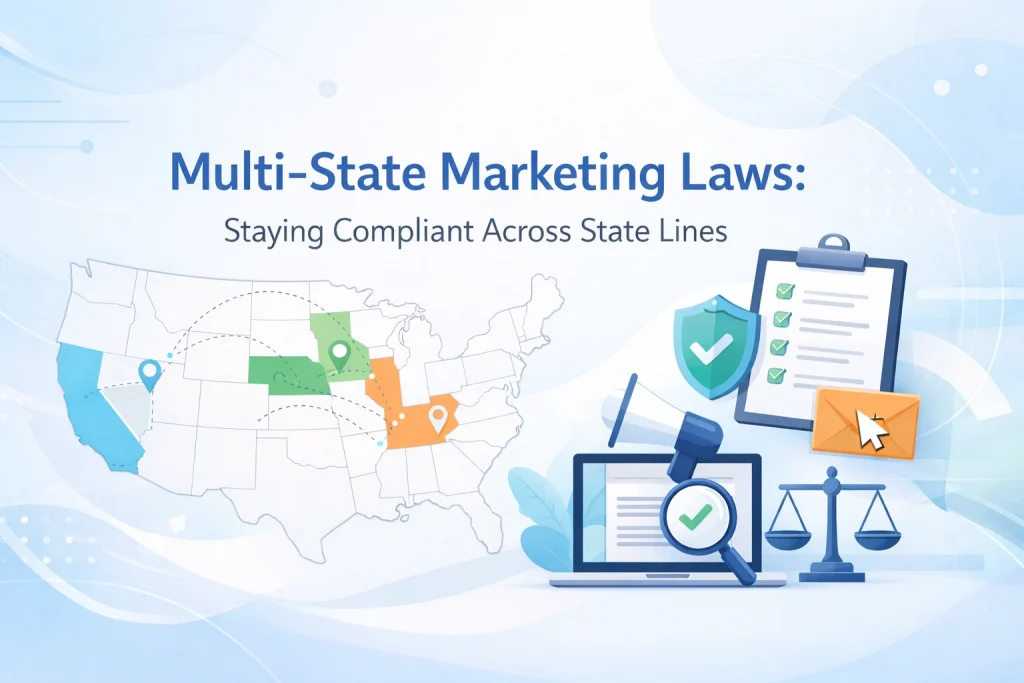
You’ve spent years building your treatment center’s reputation. You’ve got the staff, the clinical excellence, and the heart to help people recover. But one stray Facebook ad targeting a resident in a state with strict consumer protection laws: one you didn't even realize you were violating: could put your entire operation at risk.
In the addiction treatment space, "oops" isn't a legal defense. When you’re marketing across state lines, you aren't just dealing with federal guidelines like HIPAA or the FTC; you’re dealing with a patchwork of 50 different rulebooks. If you aren't careful, the cost of an oversight can far exceed your monthly ad spend.
Table of Contents
- The Fragmentation of Multi-State Marketing Laws
- Federal Guidelines: The Baseline
- Privacy Laws: Beyond HIPAA
- Healthcare-Specific State Bans and "Patient Brokering"
- Performance Impact: Compliance vs. Risk ROI
- The Role of Ethics and Accreditation
- Navigating the Compliance Maze with Ads Up Marketing
The Fragmentation of Multi-State Marketing Laws
Why is this so complicated? Because the internet doesn't have borders, but the law does. If you are sitting in a facility in Florida but your Google Ads are appearing for a family in California, you are legally "doing business" in California.
Each state has its own definition of what constitutes deceptive trade practices. While the FTC Act provides a federal floor, states often build much higher ceilings. For example, some states have specific registration requirements for "telemarketers" that could technically apply to your call center operations if they aren't structured correctly.
So what’s the connection between your digital strategy and these local laws? It’s all about nexus. If you target patients in a specific region, you are subject to that region's consumer protection laws. I know you're struggling to keep up with the clinical side of things; adding a law degree to your resume shouldn't be a requirement to run a successful rehab.

Federal Guidelines: The Baseline
Before we get into the weeds of state-level nuances, we have to look at the big players: the FTC and the Lanham Act. The FTC prohibits "unfair or deceptive acts or practices." In the context of healthcare marketing, this usually means you can't make clinical claims you can't back up with data.
If your website says you have a "90% success rate," you better have the peer-reviewed data to prove it. If you don't, you aren't just lying to patients; you're inviting a federal investigation. The Lanham Act also allows competitors to sue you for false advertising.
But this still doesn't drill down into the specific "gotchas" that hit rehab owner profitability 2026. High-intent keywords are expensive. If your Google Ads are flagged for non-compliance, your cost-per-acquisition (CPA) doesn't just go up: it hits a brick wall.
Privacy Laws: Beyond HIPAA
You know HIPAA. You live and breathe patient privacy. But have you heard of CCPA (California) or CPA (Colorado)? These are state-level data privacy laws that affect how you track visitors on your website before they ever become patients.
If your website uses conversion tracking to see which ads are working, you are collecting data. Under the Multi-State Privacy Agreement (MSPA), there is now a framework to help digital advertisers comply across different states, but it requires technical setup.
The average rehab center revenue 2026 is heavily dependent on efficient digital scaling. If you lose the ability to track your leads because you haven't updated your privacy policy or cookie consent banners for specific states, your marketing becomes a "black box" where money goes in and you have no idea where the admissions are coming from.

Healthcare-Specific State Bans and "Patient Brokering"
This is where things get serious. States like Florida and California have aggressive anti-patient brokering laws. These laws are designed to stop "body snatching," but they are written so broadly that a poorly structured marketing contract can accidentally violate them.
For example, paying a marketing agency a "fee per admission" is a massive red flag and illegal in many jurisdictions under laws like the Eliminating Kickbacks in Recovery Act (EKRA) and state equivalents. This is why at Ads Up Marketing, we focus on SEO and local search strategies that build long-term authority rather than shady "pay-for-lead" schemes.
Are you checking if your social media marketing mentions "free airfare" or "subsidized rent"? In many states, these are considered illegal inducements. Even if your facility is in a state where this is gray-area, if your ad hits a user in a state where it's black-and-white illegal, you could be liable.
Performance Impact: Compliance vs. Risk ROI
To see the real-world business impact, let's look at how compliance affects the bottom line. Many owners think cutting corners on compliance saves money. The reality is quite the opposite when you factor in "Legal Drag" and "Brand Equity Loss."
Compliance ROI Comparison (Est. 2026 Data)
| Metric | Compliant Strategy (Ads Up Model) | High-Risk/Non-Compliant Strategy |
|---|---|---|
| Ad Platform Stability | 99% Uptime; Verified by LegitScript | Frequent account bans & appeals |
| Avg. Cost Per Lead (CPL) | $150 – $350 (Sustainable) | $400+ (Due to high churn & penalties) |
| Legal Risk Exposure | Minimal (Standard audits) | High (Potential for $10k+ fines per day) |
| Admission Conversion Rate | 8-12% (Built on trust) | 3-5% (High skepticism from patients) |
| Long-term Asset Value | High (Strong SEO & Brand) | Low (Disposable domains/accounts) |
Maintaining a clean record isn't just about staying out of jail; it's about rehab owner profitability 2026. A stable, compliant marketing engine allows you to forecast your revenue with precision.
The Role of Ethics and Accreditation
If you want to market across state lines, you need stamps of approval. LegitScript is the most well-known, but organizations like the National Association of Addiction Treatment Providers (NAATP) also set ethical marketing standards.
Following NAATP's Quality Assurance Guide isn't just a "nice to do." It's a signal to both Google and your potential patients that you are a legitimate provider. When we develop custom solutions for our clients, we ensure that every landing page and every ad copy reflects these ethical standards.
Don't forget about CARF accreditation. While it’s a clinical accreditation, having it prominently displayed on your site builds the trust necessary to convert out-of-state leads who can't just drive by your facility to check it out.

Navigating the Compliance Maze with Ads Up Marketing
Does all of this sound overwhelming? It should. You’re a healthcare provider, not a regulatory attorney. But that’s why we’re here.
At Ads Up Marketing, we specialize in drug rehab marketing. We don't just "run ads." We build compliant, ethical, and high-performing growth engines. We understand the difference between a lead and a compliant lead. We know how to navigate the complexities of retargeting without violating privacy laws, and we stay on top of shifting state regulations so you don't have to.
If you’re worried that your current marketing might be crossing a line: or if you’re seeing your drug rehab leads dry up because of platform restrictions: it’s time for a professional audit.
Stop guessing and start growing. Let us take the compliance weight off your shoulders so you can focus on what you do best: saving lives.
Contact Ads Up Marketing today at 305-539-7114 or get a free AdWords audit to see where you stand.
Ready to Scale Safely?
- Step 1: Learn about us and our commitment to ethical marketing.
- Step 2: Explore our digital marketing services.
- Step 3: Contact us today for a consultation.
References:
- Federal Trade Commission (FTC): Advertising FAQ's for Small Business
- SAMHSA: Laws and Regulations
- NAATP: Ethics and Marketing Standards