INSIGHTS
Social Media Compliance: What Your Clinicians Can and Can’t Share
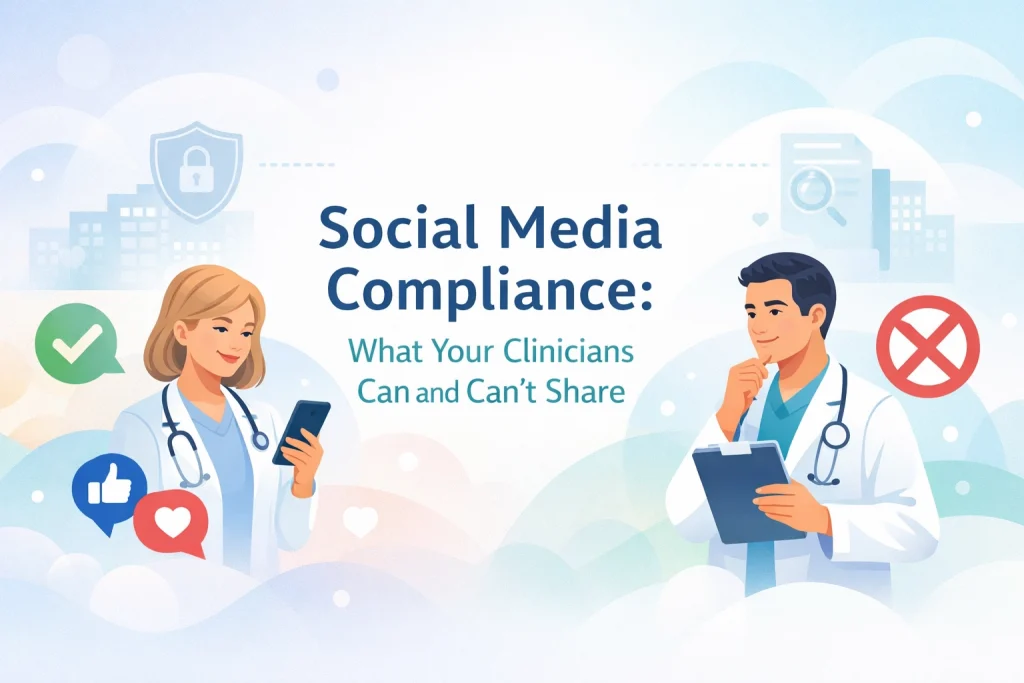
You’ve seen it happen. A well-meaning clinician at your facility snaps a quick selfie in the hallway to celebrate a patient’s "graduation" day. They post it to their personal Instagram with a heartfelt caption about how much they love their job. Within an hour, it has fifty likes. Within twenty-four hours, your compliance officer is having a heart attack, and your facility is staring down a potential HIPAA violation that could cost thousands.
It’s a gut-punch, isn't it? You want your team to be proud of where they work. You want to humanize your brand, especially in behavioral health and addiction treatment where trust is everything. But the line between "authentic storytelling" and "legal nightmare" is thinner than you think.
In the world of social media compliance for clinicians 2026, the rules have tightened. Between evolving HIPAA regulations and the FTC’s crackdown on health claims, your staff needs more than just a "be careful" talk. They need a roadmap.
Why Your Clinicians Are Your Biggest Marketing Asset (and Your Biggest Risk)
In our experience at Ads Up Marketing, we’ve found that showing your medical team reduces pre-admission anxiety. Prospective patients want to see the faces of the people who will be caring for them. It builds a bridge of empathy before they ever pick up the phone.
However, clinicians aren't marketers. They are healers. Their primary focus is on the patient in front of them, not the nuances of understanding patient privacy and HIPAA in your digital marketing strategy.
When a clinician shares something they shouldn't, the consequences aren't just "digital." We’re talking about:
- Massive Fines: Civil penalties for HIPAA violations can reach into the millions depending on the level of negligence.
- Loss of Licensure: Clinicians risk their hard-earned credentials.
- Brand Erosion: If a patient feels their privacy was violated, that trust is gone forever, and they’ll tell the world about it.
The "Hard No" List: What Clinicians Can Never Share
Let’s get the scary stuff out of the way first. Even if a clinician’s social media account is set to "private," these are absolute deal-breakers.
1. Any Form of Protected Health Information (PHI)
This seems obvious, but PHI is more than just a name. It includes:
- Full faces of patients (even in the background).
- Tattoos, birthmarks, or unique jewelry.
- Specific admission or discharge dates.
- Room numbers or specific clinical locations.
- Full names or even recognizable initials.
2. The "Anonymous" Case Study
We see this all the time. A clinician posts: "Today I saw a 24-year-old male from Miami who finally realized he’s worthy of recovery."
Stop right there.
If that patient’s friends or family see that post and can reasonably identify him based on the age, location, and the fact that they know he’s in treatment, that is a HIPAA violation. According to the U.S. Department of Health & Human Services (HHS), information is only truly de-identified if there is no reasonable basis to believe it can be used to identify an individual.
3. Acknowledging Patients Online
If a former patient leaves a glowing comment on a clinician’s post like, "You saved my life at your center!", the clinician cannot reply with, "It was so great working with you in group therapy!"
By doing so, the clinician is publicly confirming that the individual was a patient at a specific healthcare facility.

The "Green Light" List: What Clinicians Can (and Should) Share
So, does this mean your staff should just stay off the internet? Not at all. When done correctly, your team can be your brand’s best ambassadors.
1. General Educational Content
Your clinicians are experts. They can share tips on mindfulness, the science of addiction, or the importance of self-care. As long as they aren't giving specific medical advice to an individual or referencing a patient, this is gold for your SEO and brand authority.
2. Professional Milestones
Did your Lead Nurse just get a new certification? Did your Clinical Director speak at a national conference? Share it! This builds professionalism as a sales tool and shows that your facility employs top-tier talent.
3. Behind-the-Scenes (The "Safe" Kind)
Photos of the facility (without patients), staff appreciation lunches, or your therapy dog are all safe and highly engaging. These posts humanize the "corporate" side of healthcare without risking privacy.
The Compliance ROI: A Comparison
Is the effort of training your staff worth it? Let’s look at the numbers.
| Feature | The "Wild West" Approach | The Ads Up Compliance Strategy |
|---|---|---|
| Risk Level | Extremely High (Potential Fines) | Extremely Low (Vetted Content) |
| Brand Trust | Volatile | High and Sustainable |
| Staff Engagement | Confused & Fearful | Empowered & Informed |
| SEO Impact | Minimal/Accidental | Strategic & Intentional |
| Admission Impact | Risky (Negative PR) | Positive (Trust-Based Conversions) |
But What About Patient Consent?
You might be thinking, "What if the patient signs a waiver?"
Yes, a patient can provide written authorization for their image or story to be shared. However, as research from the National Association of Addiction Treatment Providers (NAATP) suggests, even with a signature, you must be careful.
Patients in early recovery are in a vulnerable state. They might sign a waiver today and regret it six months from now. If they revoke that consent, you have to scramble to remove that content from every corner of the internet. This is why we often recommend a compliance as a competitive advantage approach, focus on the staff and the facility, not the patients.
Actionable Steps for Your Facility Today
How do you fix this before the next "graduation" photo goes viral for the wrong reasons?
- Update Your Social Media Policy: If your policy hasn't been touched since 2022, it’s obsolete. It needs to specifically address personal vs. professional accounts.
- Conduct "Social Media Rounds": Just like clinical rounds, do a quick audit of what’s being posted. Are staff tagging the facility in risky posts?
- Provide a "Safe Content" Folder: Give your clinicians high-quality, pre-approved photos of the facility or educational graphics they can share on their own pages.
- Train on the "Mosaic Effect": Teach your team that multiple small pieces of non-PHI can be put together to identify a patient.

How Ads Up Marketing Protects Your Brand
Managing social media compliance for clinicians 2026 is a full-time job. You’re trying to hit your 50-bed milestone and manage operational systems, you shouldn't have to spend your nights policing Instagram.
At Ads Up Marketing, we don't just "do social media." We provide a protective layer for your brand. We understand the nuances of LegitScript and rehab advertising. We know that one wrong post can undo years of hard work.
We help you create a content strategy that:
- Humanizes your clinicians without breaking HIPAA.
- Builds trust with families through professional, compliant visuals.
- Drives admissions by focusing on your facility's unique strengths.
So, are you ready to stop worrying about what your staff is posting and start using social media as the powerful growth tool it was meant to be?
Don't leave your compliance to chance. Let’s build a strategy that protects your patients and grows your facility. Call us today at 305-539-7114.
Frequently Asked Questions
Can clinicians post about their work day in general?
Yes, but they should avoid specific details that could lead to "jigsaw identification." Saying "Today was a tough day in the clinic" is fine. Saying "Today was tough because a local celebrity just admitted for detox" is a major violation.
Should we allow staff to take photos in clinical areas?
We recommend a strict "no photos in clinical areas" policy unless it is a scheduled shoot with a designated marketing officer present to ensure no PHI is in the frame.
What happens if a clinician accidentally posts PHI?
The post must be removed immediately. The facility must then follow its HIPAA breach notification protocols, which may include notifying the patient and, in some cases, the Department of Health and Human Services.
How does social media compliance affect my SEO?
Search engines favor authoritative, trustworthy content. By ensuring your staff's online presence is professional and compliant, you build the "E-E-A-T" (Experience, Expertise, Authoritativeness, and Trustworthiness) that Google looks for in healthcare sites.
For more tips on optimizing your digital presence, check out our guide on 7 mistakes you're making with detox center marketing.
Need help navigating the complexities of healthcare marketing? We're here to help you scale safely. Reach out to Ads Up Marketing at 305-539-7114.