
INSIGHTS
Attribution Modeling in Rehab Marketing: Tracking the Full Journey
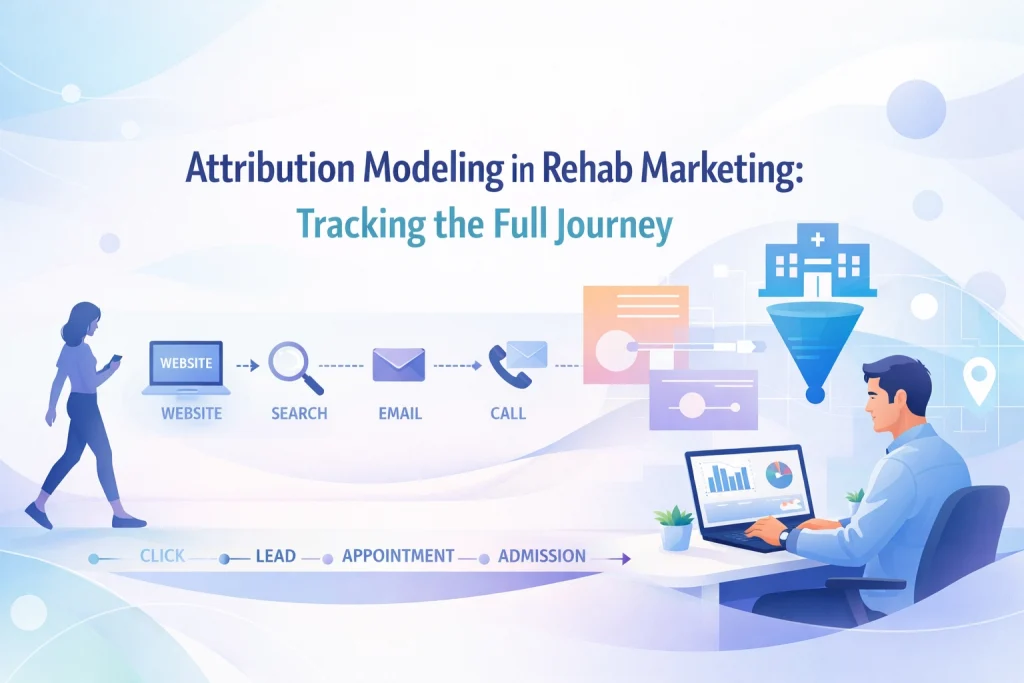
Do you ever feel like you’re throwing money into a black hole? You see your monthly spend on Google Ads, you know your SEO team is working hard, and you’re even running some social media campaigns. But when a new patient actually walks through your doors or finishes a 30-day program, do you know exactly which of those efforts got them there?
If you’re relying on "gut feelings" or a basic "how did you hear about us?" intake question, you’re likely losing money. In the addiction treatment industry, the journey from "I need help" to "I’m checking in" is rarely a straight line. It’s a winding road of late-night searches, phone calls, insurance verifications, and family discussions.
If you want to stop guessing and start scaling, you need to master rehab marketing attribution modeling. Let’s break down how to track a lead from that very first search all the way to final discharge.
Table of Contents
- The Problem with "Last-Click" Thinking
- Why the Rehab Journey is Unique
- Choosing the Right Attribution Model
- Performance Impact: Multi-Touch vs. Single-Touch
- The Technical Side: How to Connect the Dots
- Why CFOs and Owners Need This Data
- How Ads Up Marketing Closes the Loop
- Frequently Asked Questions
The Problem with "Last-Click" Thinking
Most rehab centers make the mistake of using "Last-Click Attribution." This means giving 100% of the credit for a new admission to the very last thing the person did before calling you.
For example, if someone clicks a retargeting ad and calls, the retargeting ad gets the credit. But what about the three weeks of research they did before that? What about the informative blog post they read on your site via local SEO?
If you only look at the last click, you might decide to cut your SEO budget because it "isn't converting." In reality, without that SEO work, the person would have never known your facility existed in the first place. You’d be cutting off the top of your funnel and wondering why your phone stopped ringing two months later.
Why the Rehab Journey is Unique
In most industries, the sales cycle is short. You want a pair of shoes; you buy the shoes. In healthcare, and specifically addiction treatment, the stakes are infinitely higher.
According to the Substance Abuse and Mental Health Services Administration (SAMHSA), millions of Americans need treatment but only a fraction receive it. The gap between realizing there is a problem and actually entering a facility can span days, weeks, or even months.
During this time, a prospective patient (or their family member) might:
- Search for "signs of opioid addiction" on Google.
- Visit your website three times.
- Read reviews on a third-party site.
- Download an insurance verification guide.
- Talk to a call center representative.
- Finally click an ad and admit.
If you aren't tracking every one of those steps, you don't have a marketing strategy, you have a guessing game.

Choosing the Right Attribution Model
So, how do we fix the "black hole" of data? We use different models to weigh the importance of each interaction. Based on research into long-cycle marketing, here are the most effective models for rehab:
- Linear Attribution: This gives equal credit to every single touchpoint. If they visited your site 5 times via 5 different channels, each channel gets 20% of the credit. It’s great for understanding the overall ecosystem of your marketing.
- Position-Based (U-Shaped) Attribution: This is a favorite for many facility owners. It gives 40% credit to the first touch (the discovery) and 40% to the last touch (the conversion), with the remaining 20% spread across the middle. It honors both the SEO that found them and the Google Ads that closed them.
- Time Decay Attribution: This gives more credit to the interactions that happened closest to the time of admission. It’s useful if you have a very high-volume, short-window admission process, like for a Virtual IOP.
- Data-Driven Attribution: This is the "gold standard." It uses machine learning to look at all your conversion data and determine which touchpoints actually move the needle.
Performance Impact: Multi-Touch vs. Single-Touch
To understand why this matters for your bottom line, let’s look at the ROI comparison. When you move from simple tracking to advanced attribution, your cost per admission (CPA) usually drops because you stop wasting money on "dead-end" keywords.
| Metric | Last-Click Attribution | Multi-Touch Attribution (U-Shaped) | Impact on Strategy |
|---|---|---|---|
| Visible CPA | $3,500 | $2,800 | More accurate budget allocation |
| Budget Waste | High (over-bidding on "closing" terms) | Low (investing in the full funnel) | Higher net profit per bed |
| Channel Insight | "SEO doesn't work" | "SEO feeds 60% of our leads" | Prevents cutting vital top-funnel channels |
| Scaling Ability | Limited | High | Predictable growth |
The Technical Side: How to Connect the Dots
You might be thinking, "Lee, this sounds great, but how do I actually do it?"
It starts with conversion tracking. You need a system where your website data talks to your CRM (Customer Relationship Management) software.
- UTM Parameters: Every ad, email, and social post must have unique tracking codes.
- Call Tracking: Use dynamic number insertion (DNI) so you know exactly which keyword triggered a phone call.
- CRM Integration: When a lead is "converted" in your CRM to an "admission," that data needs to push back into Google Ads. This tells Google, "Hey, this specific search resulted in a real person in a bed, find me more people like this."
- HIPAA Compliance: This is non-negotiable. Your tracking must be secure and compliant. We often help clients navigate LegitScript certification to ensure all their tracking and advertising meet industry standards.

Why CFOs and Owners Need This Data
For a facility owner, marketing isn't an expense: it's an investment. But you can't manage what you can't measure.
If you know that it takes an average of 7 touchpoints and $2,500 in marketing spend to generate one admission with an average length of stay of 28 days, you can calculate your Marketing ROI with precision.
Let’s talk numbers. If your average revenue per patient is $20,000 and your total cost to acquire that patient (including digital marketing services) is $3,000, your ROI is healthy. But if you don't know where that $3,000 is going, you can't optimize it. Advanced attribution allows you to see if your alumni programs are driving referrals or if your social media marketing is actually building the trust necessary for a family to call.
How Ads Up Marketing Closes the Loop
Look, tracking a journey from the first Google search to the final discharge is complicated. Most agencies will give you a report showing "clicks" and "impressions." But clicks don't pay the bills: admissions do.
At Ads Up Marketing, we specialize in the "full-loop" approach. We don't just run ads; we help you build the infrastructure to track every single dollar. Whether it's optimizing your Google Ads or creating custom solutions for your specific facility needs, we focus on the data that matters to your bottom line.
Stop guessing which parts of your marketing are working. Let’s get you a clear picture of your patient journey so you can grow your facility with confidence.
Ready to see the full picture? Call us today at 305-539-7114 or contact us here for a free audit of your current tracking setup.
FAQ
Q: What is the best attribution model for a small rehab center?
A: For most facilities, a Position-Based (U-Shaped) model is the best place to start. It recognizes the importance of the first time they found you and the last action they took to call you.
Q: How does call tracking work with HIPAA?
A: We use HIPAA-compliant call tracking software that encrypts data and ensures that Protected Health Information (PHI) is handled according to federal regulations. You can learn more about our approach to compliance through our consulting services.
Q: Why does my Google Ads data not match my CRM admissions?
A: This is common and usually due to "attribution lag." A person might click an ad today but not admit for two weeks. Proper attribution modeling helps bridge this gap by looking at the entire history of that lead.
Q: Can I track leads that come from SEO?
A: Absolutely. By using tools like Google Search Console and integrated CRM tracking, we can see which organic keywords are driving the highest quality drug rehab leads.
Q: How long does it take to set up full-journey tracking?
A: Most facilities can have a robust tracking system in place within 30 to 60 days, depending on their current CRM and website setup.
Don't leave your ROI to chance. Reach out to the experts at Ads Up Marketing at 305-539-7114 and let’s start tracking what matters.