INSIGHTS
The Anatomy of a 3 AM Crisis Call: Advanced Intake Techniques
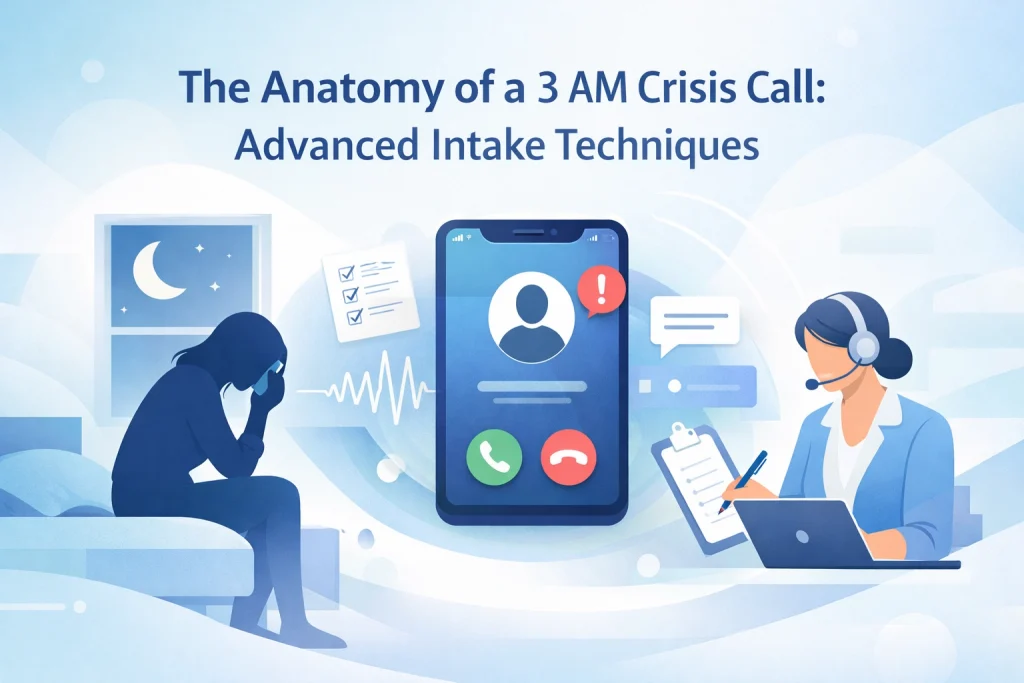
There's something uniquely vulnerable about a 3 AM phone call.
The person on the other end isn't just reaching out, they're reaching out when everyone else is asleep, when the world is quiet, and when their crisis has become unbearable. If you're running a treatment facility, these calls represent some of your most critical intake opportunities. But they also require a completely different approach than your standard business-hours conversation.
Let me walk you through what actually works when someone calls in the middle of the night.
Why 3 AM Calls Hit Different

When someone picks up the phone at 3 AM, they've already exhausted their usual coping mechanisms. They've scrolled through their contacts, maybe stared at the ceiling for hours, and finally decided that right now is when they need help. According to SAMHSA's National Helpline data, crisis calls spike during late-night and early morning hours, with a significant portion of callers reporting immediate safety concerns or acute distress.
These aren't casual inquiries about your program amenities. These are people in active crisis.
Your intake specialist needs to understand the psychological state of a 3 AM caller:
- Heightened emotional vulnerability – defenses are down, raw emotion is up
- Decision-making fatigue – they've likely been cycling through the same thoughts for hours
- Isolation amplification – darkness and silence make everything feel more desperate
- Urgency vs. impulsivity – they need help now, but that doesn't mean they're thinking clearly
So what's the connection between understanding this psychology and actually converting the call into an admission? Everything.
The First 30 Seconds Are Make-or-Break
Your intake specialist's first response sets the entire tone. And here's what most facilities get wrong: they launch into scripted questions before they've established any human connection.
When that call comes in at 3 AM, the first thing out of your specialist's mouth should acknowledge the courage it took to make that call. Something like:
"I'm really glad you called. I know it's not easy to reach out, especially right now."
That's it. Simple. Human. Real.
Research from the National Institute on Drug Abuse shows that perceived empathy during initial contact significantly increases the likelihood of following through with treatment. People don't care how much you know until they know how much you care, and that's exponentially true at 3 AM.
Active Listening When It Actually Matters
Active listening isn't just a buzzword. During a crisis call, it's the difference between an admission and a hang-up.
Here's what active listening looks like in practice during a middle-of-the-night crisis:
Reflective responses: "It sounds like you've been carrying this alone for a while" or "You're telling me you're scared about what happens next, that makes complete sense."
Minimal encouragers: Simple "mm-hmm" sounds, "I hear you," or "keep going" that let them know you're fully present without interrupting their flow.
Paraphrasing for clarity: "So if I'm understanding correctly, you tried to quit on your own twice, and it's gotten worse both times. Is that right?"
Your specialist should be typing quietly (if at all), not clicking through loud form fields. The focus is on the person, not the paperwork. Documentation comes after connection.

Empathy-Driven Intake Questions (Not Interrogation)
There's a massive difference between gathering information and conducting an interrogation. Your 3 AM caller needs the former, and they'll bail on the latter.
Traditional intake forms ask rigid questions in a linear order. Advanced intake techniques adapt to the emotional state of the caller. Here's how:
| Traditional Approach | Advanced 3 AM Technique |
|---|---|
| "What's your insurance provider?" | "Let's figure out together what options you have. Do you have insurance we can check, or should we look at other ways to make this work?" |
| "How long have you been using?" | "When did you first notice this was becoming too much to handle on your own?" |
| "What substances?" | "What are you most worried about right now?" |
| "Previous treatment?" | "Have you tried to get help before? What was that experience like?" |
See the shift? You're getting the same information, but you're framing it through the lens of understanding rather than data collection.
The National Alliance for Medication Assisted Recovery emphasizes that the intake experience directly impacts long-term engagement. If someone feels judged or processed during their most vulnerable moment, they're gone.
De-Escalation Without the Pressure Tactics
Let's be honest: some facilities use high-pressure conversion tactics on crisis calls. Push for immediate commitment, create false urgency, manipulate vulnerability.
That's not just ethically questionable. It's also terrible business long-term.
Advanced intake techniques focus on de-escalation first, conversion second. When someone's in crisis, your job is to help them feel safe enough to make a clear-headed decision about treatment.
Grounding techniques over sales techniques: If your caller is spiraling, help them get present. "Let's take a breath together for a second. You're safe right now talking with me. Can you tell me where you are physically right now?"
Offering control, not removing it: "Here's what I think could really help based on what you've told me. But you're the one who decides what happens next. What feels right to you?"
Transparency about the process: Walk them through what admission looks like, what the first 24 hours involve, what they can expect. Mystery creates anxiety.
According to the Substance Abuse and Mental Health Services Administration, treatment outcomes improve significantly when individuals feel they had agency in their admission decision rather than feeling coerced or pressured.
Converting Concern Into Action (The Right Way)
But this still doesn't drill down to the actual conversion, right? You've built rapport, you've de-escalated, you've gathered information. Now what?
Here's where advanced intake specialists separate themselves: they create a clear, simple path forward that feels collaborative.
The bridge question: "Based on everything you've shared with me, I really think we can help you. The next step is [specific action]. Does that feel like something you're ready to do?"
Addressing hesitation directly: If they waver, don't push harder. Get curious. "What's making you hesitate? Let's talk through that."
Same-day admission offer (when appropriate): "We have a bed available right now, and I can have someone meet you this morning. Would that feel like a relief?"
Follow-up plan (when not ready): "I completely understand if you're not ready to commit right now. Can I call you back in a few hours after you've had some rest? Or would you prefer to call me back?"
You're not manipulating. You're guiding someone through a decision they've already indicated they need to make by picking up the phone at 3 AM.
Documentation That Doesn't Interrupt Connection
Your specialist needs to document the call, obviously. But typing frantically while someone's pouring their heart out? That's not it.
Advanced techniques involve:
- Taking minimal notes during the call (key phrases, safety concerns, contact info)
- Full documentation immediately after the call ends
- Using speech-to-text or recording (with consent) for accuracy
- Entering CRM data in batches rather than real-time during emotional moments
The goal is to make the caller feel like the most important person in the world at that moment: because they are.
The Follow-Through That Seals It

Here's what separates good call centers from great ones: what happens after the 3 AM call.
Within 2-4 hours (by morning), there should be a follow-up. A text, an email, another call: whatever was agreed upon. Something like:
"Hi [Name], this is [Specialist] from [Facility]. Just wanted to check in after our conversation a few hours ago. Thinking of you. Call me anytime at [number]."
That simple touch point can be the difference between someone following through or ghosting.
How Ads Up Marketing Supports Your 3 AM Success
Look, you can have the best clinical program in the world, but if your intake process at 3 AM isn't dialed in, you're losing admissions to facilities that understand crisis call psychology.
At Ads Up Marketing, we work specifically with treatment facilities to optimize every touchpoint in your patient journey: especially the critical first call. We understand that drug rehab marketing isn't just about getting leads; it's about having the infrastructure to convert those leads with empathy and effectiveness.
Our call center support services help facilities train intake specialists in advanced crisis call techniques, implement proper documentation systems, and create follow-up protocols that actually work. We've seen admissions increase by 30-40% when facilities upgrade their intake approach from standard to advanced.
We also help you track which marketing channels are driving your 3 AM calls, optimize your messaging for crisis moments, and ensure your conversion tracking captures the full story of how someone went from searching to admission.
Your Next Step
If you're reading this at 3 AM yourself, stressed about your facility's intake conversion rates, we should talk. If you're reading this during business hours and realizing your team needs these advanced techniques, we should definitely talk.
Crisis calls are happening right now. The question is whether your facility is equipped to handle them with the psychological awareness and empathy-driven techniques that actually convert vulnerable moments into life-changing admissions.
Call us at 305-539-7114 and let's build an intake process that honors the courage it takes for someone to reach out at their darkest hour: and gives them the help they're desperately seeking.
Because at 3 AM, when someone finally asks for help, your response matters more than you know.