INSIGHTS
Rehab Admissions Objection Handling Scripts: Turning Hesitation into Commitment
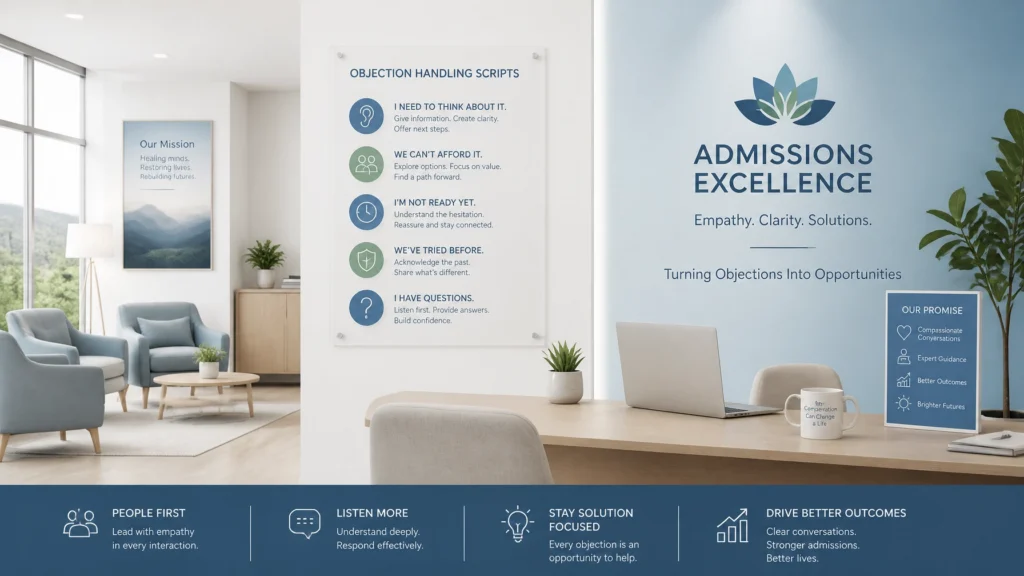
Picture this: You’ve invested thousands of dollars into your digital campaigns, your PPC leads are finally rolling in, and your phone is ringing. Your admissions coordinator answers with a welcoming tone, listens to a family in absolute crisis, shares your program details: and then hits a brick wall. The caller says, "We need to think about it," or "I just don't think we can afford private treatment right now." Within hours, that warm lead goes cold, and your valuable ad spend slips through your fingers.
If this scenario sounds painfully familiar, you are certainly not alone. In the high-stakes world of addiction treatment, most facilities lose up to 40% of prospective admissions simply because their intake teams lack structured, empathetic, and repeatable ways to navigate common caller hesitations. When a family is grappling with substance use disorder, hesitation is rarely a flat rejection; it is a cry for clarity, reassurance, and professional guidance.
Implementing structured rehab admissions objection handling scripts transforms your call center from a passive intake desk into a proactive engine of compassion and conversion. Let’s dive into how you can train your team to turn hesitation into commitment without ever sounding pushy or aggressive.
Table of Contents
- The Real Cost of Unresolved Admissions Objections
- The Core 4-Step Framework for Every Objection
- Script 1: "I Need to Think About It" (Uncovering the Hidden Barrier)
- Script 2: "My Insurance Won't Cover It / I Can't Afford This"
- Script 3: "I Can't Leave Work or My Family Right Now"
- Script 4: "I Tried Treatment Before and It Didn't Work"
- Performance Impact: Ad-Spend ROI Comparison
- Building Your Internal Call Center Training Program
- Conclusion & Next Steps
The Real Cost of Unresolved Admissions Objections
When running a behavioral health facility, facility owners often obsess over Cost-Per-Click (CPC) and Cost-Per-Lead (CPL). But as we frequently emphasize when reviewing behavioral health operations, the real financial leak happens right on the phone. According to industry insights from organizations like the National Association of Addiction Treatment Providers (NAATP), facilities that fail to optimize their intake workflows waste thousands in marketing dollars every single month.
So what's the connection between your marketing campaigns and your phone lines? Every ad dollar spent driving a call is wasted if your admissions team accepts "I'll call you back" as the final answer. When someone calls seeking help for alcohol or drug rehab, time is literally a matter of life and death. If your team stops at the first surface-level objection, the prospective client will likely dial another facility: or worse, give up entirely.
For more insights into plugging these operational leaks, check out our deep dive on why your rehab call center is your biggest revenue leak.

The Core 4-Step Framework for Every Objection
Before diving into specific word-for-word scripts, your team needs a reliable cognitive framework. Effective objection handling is never about arm-twisting or high-pressure sales tactics; it is about building deep trust and emotional safety.
Whenever an objection arises on a call, train your staff to use this four-step sequence:
- Acknowledge and Empathize: Validate the caller's emotion immediately. Never dismiss their fear or financial anxiety.
- Clarify the Real Concern: Surface the underlying worry beneath the generic excuse.
- Provide Concrete Information: Offer factual, transparent solutions regarding insurance, FMLA leave, or clinical programming.
- Call to a Low-Pressure Next Step: Guide them naturally toward an intake assessment or insurance verification.
As noted in guidance published by the Substance Abuse and Mental Health Services Administration (SAMHSA), empowering individuals with transparent, supportive information during crisis moments significantly improves long-term engagement.
Script 1: "I Need to Think About It" (Uncovering the Hidden Barrier)
When a caller says, "We need to talk it over and call you back," they are almost always masking a deeper fear: whether it is financial exposure, shame, or logistical chaos at home.
The Script:
"I completely understand, and this is a major decision for your family. It makes total sense that you'd want a moment to process everything.
Usually, when people say that, it’s because there is one specific thing weighing most heavily on their mind: whether that's figuring out insurance coverage, worrying about taking time away from work, or wondering if treatment will truly help this time. Which of those feels biggest for you right now?"
Why it works: Instead of letting them hang up to ruminate in anxiety, you gently categorize the three most common fears and invite them to name the real obstacle. Once they name it, you can address it directly.
Script 2: "My Insurance Won't Cover It / I Can't Afford This"
Financial fear is the single most common barrier to entry in addiction treatment. Many families assume private rehab is entirely out of reach without verifying their actual benefits under the Mental Health Parity and Addiction Equity Act.

The Script:
"I hear that concern every single day, and it is completely valid: treatment can feel overwhelming when you look at sticker prices before knowing your benefits.
Insurance coverage for behavioral health has evolved significantly, and policies often cover far more than families expect. The best thing we can do right now is run a complimentary verification of benefits so you have exact numbers instead of guessing.
If you're open to it, I can take your policy information right now, and our specialist can verify your exact deductible and copays in about 15 minutes. There is zero financial obligation: this is simply to give you absolute clarity."
To understand more about optimizing your intake economics, review our comprehensive analysis on cost per admission and what you should really be paying.
Script 3: "I Can't Leave Work or My Family Right Now"
Adults struggling with substance use often hold the weight of entire households and careers on their shoulders. Admitting they need inpatient or intensive outpatient care feels like abandoning their responsibilities.
The Script:
"I completely understand. Life doesn't pause just because addiction flares up, and it's completely normal to worry about your job or your family responsibilities right now.
Our team helps professionals navigate this every single day. We routinely coordinate with employers, provide necessary medical documentation, and help you utilize federal protections like the Family and Medical Leave Act (FMLA) or Employee Assistance Programs (EAP) to protect your job while you get well.
If nothing changes in the next month, how much more time might be lost to this struggle at work and at home? Let's look at a timeline that actually protects your career while prioritizing your health."
Script 4: "I Tried Treatment Before and It Didn't Work"
Skepticism and previous relapse histories breed profound doubt. When a caller says, "What's the point? I went to rehab last year and started using again right after," they are expressing heartbreak and frustration.
The Script:
"Thank you for being completely honest with me. That takes courage, and it is entirely understandable to feel skeptical if a previous program didn't give you the tools you needed to stay sober.
Can you share a little about what felt missing last time: was it the length of stay, the type of therapy, or the aftercare support after discharge?
That helps tremendously. Here is how our clinical model approaches things differently: [briefly highlight customized dual-diagnosis care, family integration, or robust alumni aftercare]. We cannot change what happened in the past, but we can build a personalized plan around what didn't work for you previously. Would you be open to an initial clinical assessment so we can see precisely what level of care fits your life today?"
For a deeper look into crafting compassionate and high-converting intake conversations, explore the anatomy of a high-converting admissions call.
Performance Impact: Ad-Spend ROI Comparison
Implementing standardized objection handling scripts directly impacts your bottom-line admissions rate. Consider the performance metrics below illustrating the difference between unmanaged intake calls versus a trained, script-supported call center framework:
| Metric | Unoptimized Call Center | Optimized Script-Led Center | Performance Impact |
|---|---|---|---|
| Inquiry-to-Assessment Conversion | 22% | 58% | +36% increase in booked assessments |
| Cost Per Admission (CPA) | $4,850 | $2,120 | 56% reduction in acquisition cost |
| Insurance Verification Drop-off | 45% | 12% | 33% better retention of warm leads |
| 30-Day Facility Occupancy | 64% | 88% | 24% boost in census stability |
As research from the National Institute on Drug Abuse (NIDA) highlights, timely and barrier-free entry into treatment dramatically improves long-term recovery outcomes. When your call center removes friction, you win twice: you improve patient outcomes and drastically maximize your marketing return on investment.

Building Your Internal Call Center Training Program
Putting these scripts into practice requires more than just printing a PDF and handing it to your admissions staff. To ensure sustainable success:
- Conduct Weekly Role-Playing Sessions: Have your admissions team practice these exact responses in mock calls until the tone feels natural, empathetic, and conversational rather than robotic.
- Track Objection Trends: Log every time a caller hesitates and note which responses successfully convert them into assessments.
- Implement Rapid Follow-Up Protocols: If a caller does not commit immediately, ensure your team sends an empathetic SMS summary within 10 minutes and a helpful follow-up email within 30 minutes, backed by resources from trusted institutions like SAMHSA.
Conclusion & Next Steps
Handling admissions objections with empathy and precision is the single most effective lever you can pull to turn hard-earned marketing leads into committed admissions. You pour immense resources into your digital presence: don't let preventable hesitations undermine your facility's growth.
If your facility is ready to supercharge its admissions conversion rates, streamline its intake operations, and scale census sustainably, we are here to help. At Ads Up Marketing, we specialize exclusively in digital marketing, call center optimization, and growth strategy for addiction treatment centers and behavioral health facilities.
Let's discuss how we can turn your facility's inquiries into lifelong recovery success stories. Call us today at 305-539-7114 or reach out through our contact page to speak directly with our behavioral health growth specialists.