
INSIGHTS
Drug Rehab Feasibility Study 101: Is Your New Location Destined for Success?
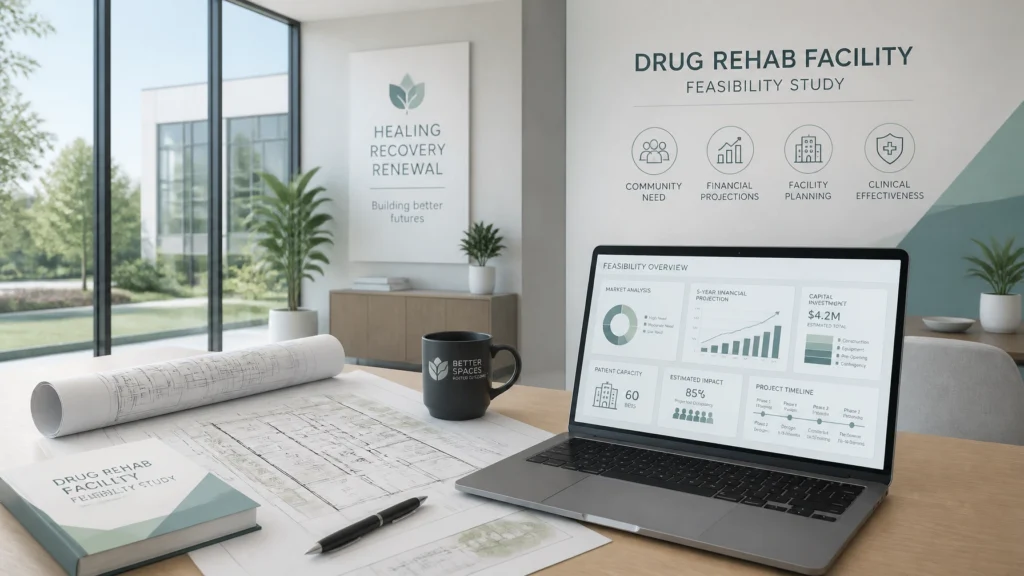
Opening a new addiction treatment center or expanding into a second location is one of the most exciting milestones in your entrepreneurial journey. You can already picture the lives you'll change, the clinical team you'll assemble, and the impact your facility will have on the community. But beneath the vision and the blueprints lies a stark business reality: without rigorous preparation, even the most compassionate rehab center can struggle to keep its doors open.
Have you ever wondered why some facilities thrive while others quietly close their doors within the first year? The difference rarely comes down to clinical dedication alone. It comes down to preparation, local market intelligence, and executing a thorough drug rehab feasibility study before signing a lease or breaking ground.
In this guide, we'll walk you through the essential components of building a foolproof feasibility study, evaluating local demand, navigating zoning hurdles, and protecting your capital investment.
Table of Contents
- What Is a Drug Rehab Feasibility Study and Why Do You Need One?
- Step 1: Quantifying Market Demand and Local Need
- Step 2: Evaluating the Competitive Landscape
- Step 3: Mastering Zoning, Licensing, and Regulatory Compliance
- Step 4: Financial Modeling and Performance Impact
- Partnering with Industry Experts for Sustainable Growth
What Is a Drug Rehab Feasibility Study and Why Do You Need One?
A drug rehab feasibility study is a comprehensive diagnostic evaluation of your proposed project. It assesses whether your intended location, service model, and financial structure can succeed in a specific geographic market. Think of it as your strategic roadmap. Instead of relying on intuition or gut feeling, a feasibility study relies on hard data: demographics, addiction prevalence, competitor bed counts, payer mix, and local zoning laws.
When you are scaling your operations or launching your first facility, understanding when to expand to a second location requires absolute clarity. Lenders, investors, and state licensing boards will all look for this study before granting capital or approval.
"Hope is not a strategy when millions of dollars in capital and patient welfare are on the line. Data-driven validation protects your investment and ensures sustainable care delivery."
Step 1: Quantifying Market Demand and Local Need

You cannot successfully market a treatment center if you don't understand the exact contours of local substance use patterns. Before selecting a site, consult reputable public health data sources such as the Substance Abuse and Mental Health Services Administration (SAMHSA) and the National Institute on Drug Abuse (NIDA) to evaluate regional addiction prevalence.
When analyzing your target catchment area, look closely at:
- Overdose and Treatment Statistics: Review county-level public health reports detailing opioid, stimulant, and alcohol-related emergency department visits.
- The Treatment Gap: Calculate the ratio of individuals actively seeking care versus the total licensed bed capacity or outpatient slots currently available in the region.
- Insurance Coverage Breakdown: Understand whether the local population relies primarily on commercial insurance, Medicare, Medicaid, or self-pay models.
Knowing your numbers early prevents you from opening an upscale private-pay luxury center in an area where families desperately need accessible, in-network or Medicaid-supported care.
Step 2: Evaluating the Competitive Landscape
Every market has existing players. Your feasibility study must identify who they are, what they offer, and where their operational gaps lie. Are local facilities facing capacity bottlenecks? Do patients have to travel two hours out of county to find specialized co-occurring mental health care or gender-specific detox?
By partnering with organizations like the National Association of Addiction Treatment Providers (NAATP), you can benchmark your facility against national standards and industry best practices.
Identify your potential competitors by analyzing:
- Levels of Care Offered: Do they focus solely on residential inpatient, or do they offer robust Partial Hospitalization (PHP), Intensive Outpatient (IOP), and Medication-Assisted Treatment (MAT)?
- Digital Footprint and Referral Networks: How strong is their online visibility? Are they dominating search engines, or are local hospitals struggling to find reliable discharge partners?
- Community Reputation: Read public reviews and speak informally with local interventionists and healthcare workers to understand what patients love: and what they complain about: regarding current facilities.
Step 3: Mastering Zoning, Licensing, and Regulatory Compliance

Perhaps the most common trap facility owners fall into is securing a magnificent property before verifying local zoning laws. You might find an ideal secluded building, only to discover that local zoning ordinances prohibit behavioral health facilities in that district without a lengthy conditional use permit: or worse, at all.
Your feasibility study must outline:
- Zoning Classification: Confirm whether the property is zoned commercial, medical-office, or residential, and check if group home or healthcare restrictions apply.
- State Licensing Requirements: Understand state-specific administrative codes, staffing ratios, credentialing mandates, and whether a Certificate of Need (CON) is required for inpatient beds.
- Life Safety and ADA Compliance: Estimate the renovation costs required to meet stringent fire codes, sprinkler requirements, and accessibility standards.
Navigating regulatory red tape requires patience and precision. If you skip this step, you risk facing fierce community pushback, costly legal battles, and severe opening delays.
Step 4: Financial Modeling and Performance Impact

A feasibility study is incomplete without financial projections. You need to map out your expected capital expenditures (CapEx), operating expenses (OpEx), and realistic monthly census milestones.
To help you visualize how a structured feasibility study impacts key financial indicators, review the performance impact comparison table below:
Performance Impact: Ad-Hoc Opening vs. Feasibility-Driven Launch
| Metric / Operational Area | Ad-Hoc / Guesswork Approach | Feasibility-Driven Approach |
|---|---|---|
| Time to Licensing Approval | 12 to 18 months (frequent zoning rejections) | 6 to 9 months (pre-vetted sites & compliant plans) |
| Month 6 Average Census | 25% to 40% capacity (slow referrals) | 65% to 80% capacity (established referral channels) |
| Marketing Efficiency | High wasted spend on untargeted campaigns | High ROI via targeted Google Ads management & SEO |
| Break-Even Timeline | 18 to 24+ months (cash flow strain) | 8 to 12 months (accurate financial modeling) |
By utilizing robust data analytics and partnering with experts who understand specialized website design and conversion optimization, you can bridge the gap between financial projections and actual patient admissions.
Partnering with Industry Experts for Sustainable Growth
Conducting a thorough drug rehab feasibility study is not something you have to do alone. In an increasingly competitive behavioral health landscape dominated by large multi-state operators, having an experienced, data-driven marketing and consulting partner makes all the difference.
At Ads Up Marketing, we work exclusively with addiction treatment centers and behavioral health facilities. We don't rely on guesswork; we leverage decades of collective industry experience and over $100 million in PPC ad spend data to help you understand your market, attract the right patients, and scale profitably.
Are you ready to evaluate your next location with absolute confidence? Let's talk strategy. Call us today at 305-539-7114 or visit our contact page to schedule your consultation and ensure your new facility is destined for success.
Visit Ads Up Marketing to explore our specialized services tailored exclusively for behavioral health and addiction treatment providers.