
INSIGHTS
Detox Center Capacity Planning: Balancing Census with Quality Care
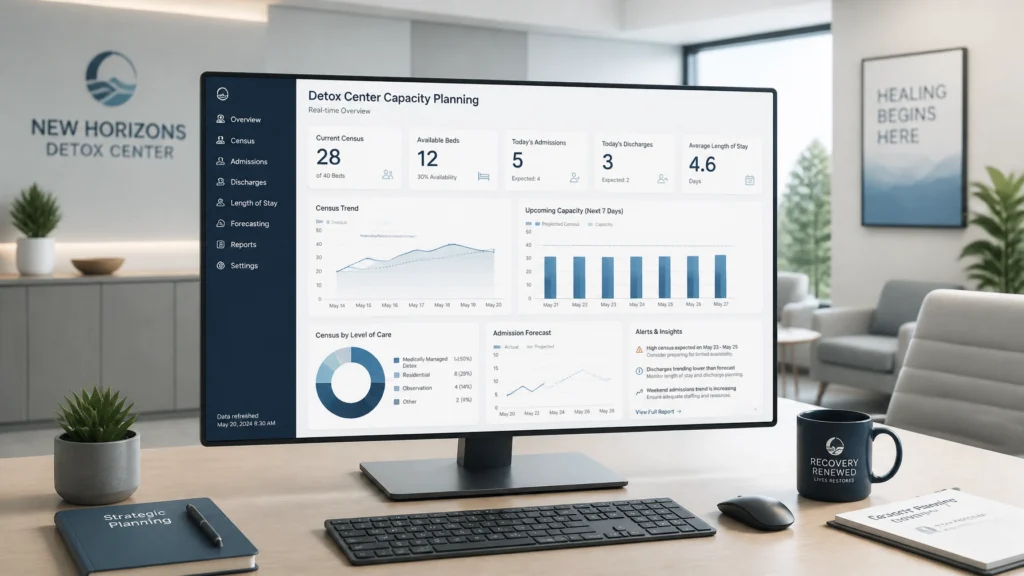
Running an addiction treatment facility is an extraordinary balancing act. On one hand, you carry the heavy financial responsibility of keeping your beds filled, covering rising operational overhead, and generating sustainable profitability. On the other hand, your clinical core is built on empathy, safety, and delivering life-changing care to individuals navigating their darkest hours. When your census dips, financial anxiety creeps in. When your census hits 100%, staff burnout skyrockets, clinical outcomes can fray, and regulatory risks multiply.
So how do facility owners find the sweet spot? Mastering detox center capacity planning is the operational linchpin that allows you to maximize your average daily census (ADC) without ever compromising patient safety or clinical integrity. If you have ever felt trapped between empty beds and an overextended nursing staff, this guide is built for you.
Table of Contents
- The Real Cost of Mismanaged Capacity in Withdrawal Management
- Translating Local Demand into Realistic Bed Counts
- Aligning Clinical Staffing Ratios with Patient Acuity
- Performance Impact: Unstructured vs. Data-Driven Capacity Planning
- Streamlining Patient Flow and Intake Bottlenecks
- Partnering for Sustainable Growth and ROI
The Real Cost of Mismanaged Capacity in Withdrawal Management
Every empty bed in your withdrawal management unit represents lost revenue that you can never recover. Conversely, chronic overcrowding leads to rushed intakes, delayed medical clearances, and critical oversights during acute withdrawal phases. According to guidance from the Substance Abuse and Mental Health Services Administration (SAMHSA), maintaining structural and clinical equilibrium is essential for preventing adverse clinical events.

When you approach capacity planning purely as a game of math: filling every physical square foot possible: you inevitably run into the utilization rate trap. As explored in our deep dive on why 100% occupancy might actually be hurting your revenue, operating at maximum capacity without buffer beds creates severe operational friction.
Ask yourself: When a high-acuity patient arrives during a weekend shift, does your team scramble, or do you have a predictable, structured intake protocol that absorbs fluctuations seamlessly?
Translating Local Demand into Realistic Bed Counts
Effective detox center capacity planning starts upstream with community needs and regional epidemiology. Before you expand your physical footprint or adjust your marketing spend, you need a clear-eyed assessment of your catchment area.
- Analyze Regional Overdose and Substance Trends: Review state health department reports and federal databases to understand local withdrawal management demand.
- Evaluate Length of Stay (LOS) Norms: Medical detox typically spans 5 to 7 days, but complex polysubstance or alcohol withdrawal may require extended stabilization before transitioning to residential care or our recommended SEO and PPC marketing strategies.
- Benchmark Against National Standards: Industry associations like the National Association of Addiction Treatment Providers (NAATP) emphasize that small-to-midsize stabilization units (ranging from 10 to 20 beds) often yield optimal nurse-to-patient oversight compared to sprawling, impersonal facilities.
By aligning your bed count with actual referral velocity rather than wishful thinking, you protect your margins and maintain the intimate, therapeutic environment families expect when they trust you with their loved ones.
Aligning Clinical Staffing Ratios with Patient Acuity
Beds do not treat patients: your clinical and nursing staff do. One of the most common pitfalls in facility management is sizing your staff strictly to your physical license capacity rather than your active patient acuity.
In an inpatient medical detox setting, best-practice nurse-to-patient ratios during acute withdrawal phases generally hover between 1:3 and 1:5. If your census spikes unexpectedly on a Friday night and your nursing ratio stretches to 1:7 or 1:8, vital vital-sign checks can be delayed, medication administration windows get tight, and staff burnout accelerates rapidly.
"When your staff feels overwhelmed by an unmanageable census, morale drops, turnover increases, and the quality of care: your facility's greatest asset: is directly compromised."
Implementing lean operations for treatment centers allows you to trim administrative overhead while fiercely protecting your bedside clinical ratios.
Performance Impact: Unstructured vs. Data-Driven Capacity Planning
To visualize how structured capacity planning transforms facility performance, let's examine the direct operational differences between reactive management and data-driven optimization:
| Operational Metric | Reactive / Unstructured Approach | Data-Driven Capacity Planning |
|---|---|---|
| Average Daily Census (ADC) | Volatile (swings between 60% and 100%) | Stable (consistent 80% to 88% optimal range) |
| Staff Overtime & Burnout | High (frequent emergency shift coverage) | Low (predictable scheduling aligned with acuity) |
| Admission Wait Times | Unpredictable bottlenecks during peak arrival | Streamlined (average intake under 4 hours) |
| Payer Verification (VOB) Delays | Frequent ghosting and lost bed days | Automated, fast-tracked verification pipelines |
| Net Profit Margin | Suppressed by high turnover and empty beds | Optimized through steady patient flow and low leakage |
As the comparison highlights, aiming for a consistent, sustainable operating census rather than chaotic peaks and valleys protects your bottom line and preserves staff well-being.
Streamlining Patient Flow and Intake Bottlenecks
Even with perfect bed counts and stellar staffing ratios, poor intake workflows will strangle your census. If prospective clients or referring hospitals experience frustrating delays during verification of benefits (VOB) or clinical pre-screening, they will immediately call your competitors.

To ensure smooth patient flow:
- Accelerate VOB Turnaround: Eliminate sluggish insurance verification bottlenecks that cause prospective admissions to slip away.
- Train Frontline Intake Teams: Equip your admissions staff with empathy-first scripts that build immediate trust while gathering essential clinical data. Explore our insights on how a 2-hour delay in VOB verification is costing you a bed a week.
- Integrate Digital Analytics: Partner with specialized digital marketing experts to monitor your acquisition funnel from initial click to final admission. Explore our specialized PPC management services to see how data-driven lead generation fuels predictable census planning.
Partnering for Sustainable Growth and ROI
Balancing census with clinical excellence is not a one-time project: it is an ongoing discipline that requires acute market awareness, robust operational frameworks, and targeted digital marketing. You do not have to navigate these complex operational puzzles alone.
Whether you need to refine your intake conversion funnels, revamp your website design for mobile-first accessibility, or stabilize your monthly admissions pipeline, Ads Up Marketing is here to help. We work exclusively with behavioral health facilities and addiction treatment centers, bringing decades of collective experience and data-driven insights to your leadership team.
Let's discuss how we can help you achieve sustainable, high-margin occupancy without sacrificing the compassionate care your clients deserve. Call us today at 305-539-7114 or visit our contact page to schedule your customized facility growth consultation.
