
INSIGHTS
Data-Driven Admissions: Building a Dashboard That Shows Your Real Marketing ROI
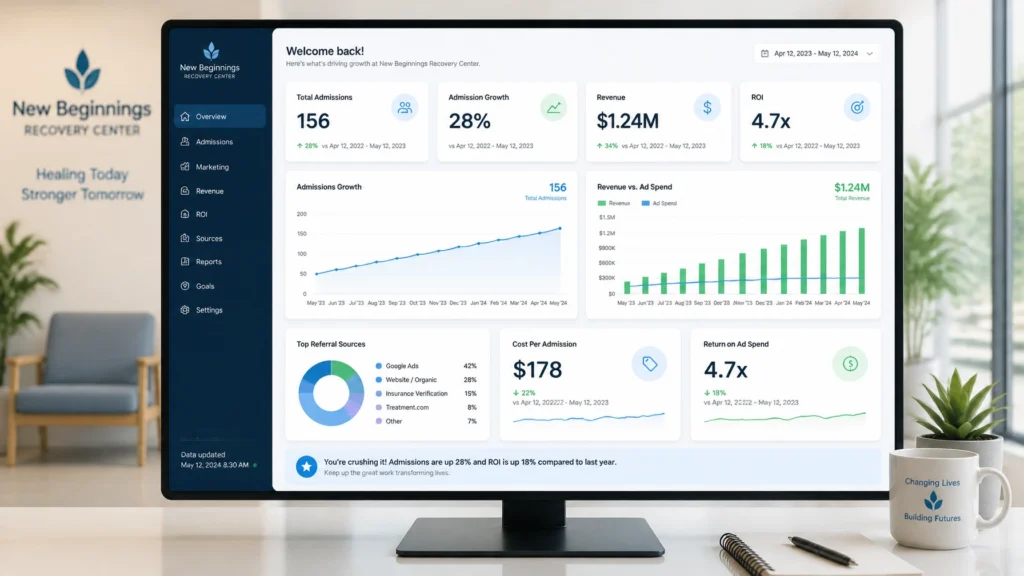
If you are running an addiction treatment center or behavioral health facility, you already know how fast monthly marketing budgets can disappear. Between competitive paid search auctions, directory listings, and content campaigns, it is easy to spend thousands of dollars every month while wondering: Is this actually filling beds, or are we just paying for website traffic?
I know you are struggling with attribution. When prospective patients call your facility in crisis, front-desk intake coordinators are often focused entirely on clinical screening, insurance verification, and immediate admission placement. Somewhere in that high-stress handoff, the exact digital source of the phone call gets lost. Suddenly, your monthly reports are full of vanity metrics: impressions, clicks, and general inquiries: that do not answer the one question keeping you up at night: What is our true return on investment?
Building a transparent, integrated analytics dashboard changes everything. Instead of guessing where your next admission came from, you can trace every single patient journey from the initial ad click to the final length of stay.
Table of Contents
- Why Vanity Metrics Fail Addiction Treatment Centers
- The Core Pillars of a Rehab Marketing ROI Dashboard
- Mapping the Patient Journey: From Click to Clinical Intake
- Performance Impact: Traditional Reporting vs. Data-Driven Attribution
- Integrating Your Tech Stack: Web, Call Tracking, and EMR
- How Ads Up Marketing Helps You Build Clarity
Why Vanity Metrics Fail Addiction Treatment Centers
For years, many treatment center owners have evaluated their digital marketing success based on metrics handed down by traditional agencies: total website sessions, keyword rankings, and cost-per-click (CPC).
So what's the connection between a spike in traffic and a signed admission? Frequently, very little.
According to data insights from the Substance Abuse and Mental Health Services Administration (SAMHSA), behavioral health consumer decisions are complex, sensitive, and deeply urgent. A prospective family member might visit your site three times across two weeks, look at your clinical accreditations, and finally pick up the phone at 2:00 AM. If your analytics platform only records a generic web visit or a dropped form, you have zero visibility into which campaign or keyword inspired that life-saving call.
This lack of visibility leads to misallocated budgets. You might cut high-performing campaigns because their cost-per-click looks high, while continuing to fund low-intent channels that look cheap on paper but never actually fill a bed.

The Core Pillars of a Rehab Marketing ROI Dashboard
To build an effective rehab marketing ROI dashboard, you need to shift your focus from top-of-funnel noise to bottom-line admissions data. A reliable command center brings together operational capacity and marketing spend into a single view.
Here are the non-negotiable metrics your dashboard must display:
- Cost per Lead (CPL): The exact marketing cost required to generate a phone call or form inquiry by channel (Paid Search, SEO, Social, Directories).
- Cost per Admission (CPA): The true advertising and agency cost required to successfully admit one patient into your facility.
- Lead-to-Admission Conversion Rate: The percentage of inquiries that successfully clear clinical screening and enter treatment, helping you diagnose whether a bottleneck is occurring in marketing reach or internal intake operations.
- Channel-Level Revenue Attribution: The total revenue generated by patients sourced from each specific marketing campaign, factoring in length of stay and payer mix.
As highlighted by the National Association of Addiction Treatment Providers (NAATP), ethical, data-driven growth requires transparency across both clinical outcomes and financial sustainability. When you can see your real numbers, you can scale confidently.
Mapping the Patient Journey: From Click to Clinical Intake
But this still doesn't drill down into how individual touchpoints connect. To make your dashboard truly actionable, you must map the complete patient acquisition funnel.
- Discovery: The user searches for specialized care (e.g., dual-diagnosis treatment or alcohol rehab) and clicks your ad or organic listing.
- Inquiry: The user calls your dedicated tracking number or fills out a secure contact form.
- Verification: Your intake team verifies insurance benefits and conducts clinical pre-screening.
- Admission: The patient arrives at your facility and begins treatment.
By integrating your call tracking software with your Electronic Medical Records (EMR) or CRM, every phone call is dynamically tagged with the original keyword, ad group, or referral partner.

If you are struggling to connect your ad spend to your intake calls, our team at Ads Up Marketing specializes in robust conversion tracking setups designed specifically for behavioral health providers. Give us a call today at 305-539-7114 to find out how we can help you uncover your true acquisition costs.
Performance Impact: Traditional Reporting vs. Data-Driven Attribution
To see why a custom dashboard transforms facility profitability, let's look at how traditional marketing reports compare to a fully integrated, data-driven approach.
| Metric / Dimension | Traditional Agency Reporting | Data-Driven Ads Up Dashboard |
|---|---|---|
| Primary Focus | Clicks, impressions, and keyword rankings | Cost per admission (CPA) and net revenue ROI |
| Call Attribution | General main-line call volume without source data | Dynamic number insertion tracking exact keyword and campaign |
| Funnel Visibility | Stops at the website form or phone ring | Connects initial click all the way to EMR admission status |
| Budget Decisions | Based on guesswork and superficial traffic spikes | Based on actual patient value, length of stay, and verified ROAS |
| Accountability | Vague monthly summaries with long-term lock-in contracts | Clear, transparent KPIs backed by month-to-month flexibility |
When you rely on vanity metrics, you are flying blind. Upgrading to a unified dashboard allows you to reallocate your Google Ads budget instantly toward the exact campaigns that bring families into your care.
Integrating Your Tech Stack: Web, Call Tracking, and EMR
Building this dashboard does not mean ripping out your existing software. Instead, it involves connecting the tools you already use into a unified pipeline:
- Web Analytics (Google Analytics / GA4): Measures user behavior, content engagement, and digital event triggers.
- Call & Form Tracking Systems: Captures unique phone numbers per channel and records every caller's digital footprint.
- EMR / CRM Platforms: Stores clinical admissions, patient length of stay, payer details, and revenue data.
- Business Intelligence (BI) Visualizers: Pulls data streams together into clean, executive-level dashboard tiles that your leadership team can review in minutes.
If your web presence needs a refresh to better support tracking and conversion optimization, explore our professional content creation and web design services. We build digital ecosystems that are both compassionate for families in crisis and structurally optimized for maximum admissions performance.

Let Ads Up Marketing Build Your Clarity
Navigating the competitive landscape of addiction treatment marketing requires more than just high ad spend: it requires absolute clarity on every dollar you invest. You deserve an agency partner that understands the unique regulatory and ethical standards of behavioral health, uses hard data instead of guesswork, and operates on flexible month-to-month agreements.
If you are ready to stop guessing and start tracking your real marketing ROI, we are here to help. Reach out to us today at 305-539-7114 or visit our contact page to schedule your custom marketing and analytics audit. Let's work together to fill your beds and help more people find the healing they deserve.