
INSIGHTS
Business Associate Agreements: The HIPAA Paperwork Behind Your Marketing Stack
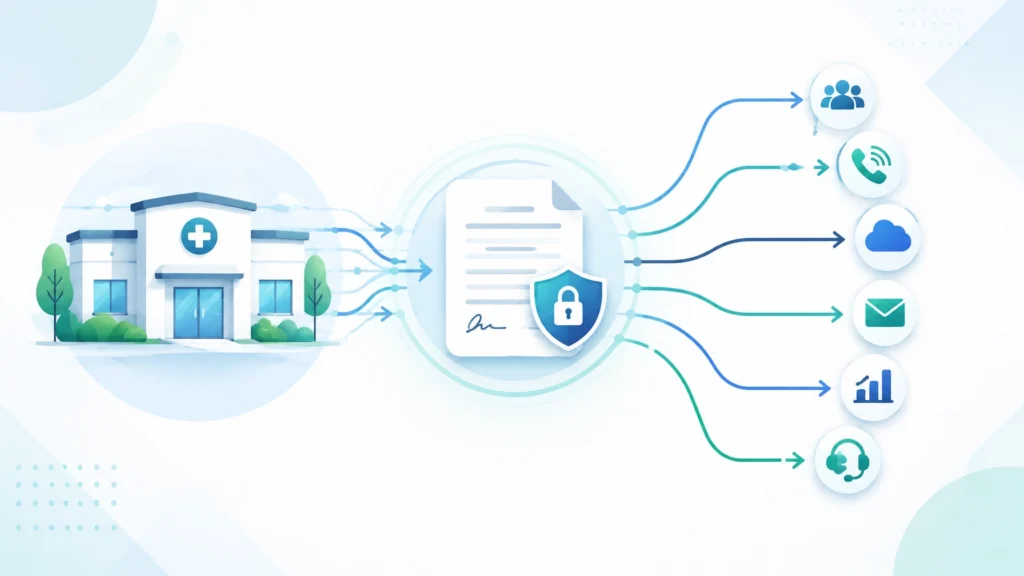
Your marketing stack may include a CRM, call tracking, email, website hosting, analytics, and an answering service. But do you know which of those vendors can access information about the people seeking care at your treatment center, and whether you have the right agreements in place?
A signed contract alone doesn’t make a vendor relationship HIPAA-compliant. And a vendor’s “HIPAA-ready” badge doesn’t answer the important question: What information does the vendor receive, and what does it do with it?
This guide explains how to think through business associate agreements (BAAs) across your marketing and communications tools. It’s educational information, not legal advice. Your specific obligations depend on your operations and data flows, so involve qualified legal or compliance counsel.
Table of Contents
- What is a business associate agreement?
- Which marketing vendors may need a BAA?
- What belongs in a BAA?
- Vendor red flags and subcontractors
- A practical vendor inventory routine
- Frequently asked questions
What is a business associate agreement?
A BAA is a written agreement between a HIPAA-covered entity, such as a treatment provider, and a business associate that handles protected health information (PHI) on the provider’s behalf.
Under HHS guidance, a vendor may be a business associate if it creates, receives, maintains, or transmits PHI to perform a service for a covered entity. That can include a vendor managing patient communications, storing ePHI, or operating systems that process it.
The vendor’s label doesn’t decide whether a BAA is needed. The service and the information involved do. A tool used for marketing isn’t automatically outside HIPAA, and not every company you hire is automatically a business associate.
For instance, a CRM used to manage prospective-patient inquiries may receive names, phone numbers, appointment details, or information about a person’s treatment interest. That deserves a different review than a tool used only for aggregate, non-identifiable website traffic.
A note about tracking technologies
Pixels, cookies, analytics tags, and similar tools need a careful, context-specific review. Ask what information they collect, where they are active, what gets sent to the vendor, and whether the information relates to an identifiable person’s care.
HHS has published guidance on online tracking technologies. A 2024 court decision narrowed one part of OCR’s position regarding IP addresses and visits to certain unauthenticated public webpages. That decision isn’t a blanket exemption for tracking tools. Don’t assume a tool is safe, or that a BAA alone makes its use permissible, without reviewing the actual data flow with counsel.
Which marketing vendors may need a BAA?
Use this table as a starting point, not a legal determination. Whether a BAA is needed depends on the vendor’s role and the data it handles.
| Vendor type | Is a BAA typically needed? | Risk if a required BAA is missing |
|---|---|---|
| CRM or lead-management platform | Often, if it receives identifiable inquiry or patient information on your behalf | PHI may be handled without required contractual safeguards |
| Call tracking or call recording | Often, if calls or transcripts contain PHI and the vendor stores or processes them | Sensitive conversations may be exposed without clear privacy, security, and response duties |
| Website hosting or cloud storage | Often, if the service maintains ePHI, such as form submissions or protected portal data | PHI may be stored without documented protections or vendor responsibilities |
| Email or messaging provider | Often, if it handles PHI in messages, contact records, or campaign workflows | Improper access, use, or disclosure may go unaddressed in the contract |
| Analytics or tag-management vendor | It depends; assess what data is collected, where the tool runs, and what is disclosed | Data may be sent to a vendor before you’ve assessed whether the disclosure is permitted |
| Answering service | Often, if staff take messages containing PHI on the center’s behalf | Access to caller information may lack written limits and safeguards |
| Marketing agency or other service provider | It depends on whether it handles PHI while performing services | Roles, permitted uses, security duties, and incident response may be unclear |
As a practical rule, review both the vendor and the configuration. A platform might be used for basic, aggregate reporting in one workflow and receive identifiable information in another. The name “analytics” doesn’t tell you what the tag sends.
Marketing has additional limits, too. HHS explains that using or disclosing PHI for marketing generally requires an individual’s authorization, subject to specific exceptions. A BAA does not, by itself, authorize every marketing use of PHI.

What belongs in a BAA?
HHS provides sample business associate agreement provisions. Your agreement should be reviewed and tailored by qualified counsel. In practical terms, check that it clearly addresses:
- Permitted uses and disclosures: What the vendor may do with PHI, and what it may not do.
- Safeguards: Appropriate protections for PHI, including applicable Security Rule obligations for ePHI.
- Incident and breach reporting: What the vendor must report, how quickly, and what information it must provide.
- Subcontractors: A requirement that subcontractors handling PHI accept applicable privacy and security restrictions in writing.
- Individual rights and cooperation: The vendor’s role, if any, in supporting access, amendment, accounting, or other covered-entity duties.
- HHS access and contract termination: Cooperation with HHS oversight, plus return or destruction of PHI at termination when feasible, or continued protections when it is not.
Don’t leave operational details to assumptions. For example, specify how you’ll be notified, who your vendor contact is, and how the vendor will support your investigation if an incident occurs.
Vendor red flags and subcontractors
Be cautious if a vendor:
- Refuses to sign a BAA even though it may handle PHI on your behalf.
- Says a “HIPAA-compliant” product makes an agreement unnecessary.
- Won’t explain which subcontractors can access or maintain your data.
- Uses broad terms that allow independent advertising, data sale, or audience-building with your information.
- Provides no clear breach-notification process, or treats the legal outside limit as its routine response window.
A business associate that uses a subcontractor to handle PHI generally needs a written agreement with that subcontractor as well. That makes it important to ask how your vendor manages downstream providers, including hosting and cloud services.
Under the HIPAA Breach Notification Rule, a business associate must notify the covered entity of a breach of unsecured PHI without unreasonable delay and no later than 60 days after discovery. That’s an outside regulatory limit, not necessarily a workable timeline for your organization. Ask counsel whether your contract should require faster notice so your team has time to assess the incident and meet its own responsibilities.

A practical vendor inventory routine
A spreadsheet is a useful place to start. Once a quarter, and whenever you add or change a tool, record:
- Vendor and business owner: Who uses the service, and who manages the relationship?
- Purpose: Is it used for calls, email, forms, advertising, analytics, or another function?
- Information involved: List the data collected, stored, viewed, or transmitted. Check whether it may include PHI or, where applicable, information covered by 42 CFR Part 2.
- Data flow and subcontractors: Note where information goes and which other providers may handle it.
- Agreement status: Record whether a BAA is required, signed, current, and consistent with the actual service.
- Exit plan: Identify how access will be ended and how data will be returned or destroyed where feasible.
Don’t forget the quiet integrations: website forms, call recordings, appointment tools, tag managers, CRM connections, and new staff logins. A vendor review is only useful if it reflects how the tools are actually configured.
For more context on compliant lead handling, see Ads Up Marketing’s article on compliant lead management. If you’re reviewing how digital activity is measured, our conversion tracking resource may also be useful, but tracking decisions involving sensitive data should be assessed with your compliance team.
Performance Impact
| Vendor review approach | What you learn | Practical value |
|---|---|---|
| Review only the vendor’s marketing claims | Whether the vendor says it supports HIPAA | Doesn’t establish what data is shared or what terms apply |
| Review the contract and vendor list | Which providers have agreements and named responsibilities | Helps identify missing or outdated paperwork |
| Map data flows and confirm configurations | Which tools receive which information, including through integrations | Gives counsel and your team a clearer basis for decisions |
A documented inventory won’t replace legal advice, but it can make the conversation with counsel more specific, and reveal integrations that might otherwise go unnoticed.
Frequently asked questions
Does every marketing vendor need a BAA?
No. A BAA is generally relevant when a vendor handles PHI on behalf of a covered entity as a business associate. A vendor that receives no PHI may not need one under HIPAA. Review the actual service, configuration, and information involved with counsel.
Does a BAA make a marketing use of PHI permissible?
Not by itself. The agreement governs the business associate relationship; it does not automatically provide authorization for a use or disclosure that HIPAA otherwise restricts.
If my vendor signs a BAA, do I still need to check its subcontractors?
Yes. Ask how the vendor identifies and contracts with subcontractors that handle PHI, and clarify how the vendor will notify you about changes or incidents.
Review the stack before adding another tool
If your vendor list has grown faster than your paperwork, you’re not alone. A practical next step is to inventory the tools, document what each one can access, and review the uncertain relationships with qualified legal or compliance counsel.
Ads Up Marketing works with addiction treatment and behavioral health organizations on digital marketing, lead management, and measurement. We can help you understand how your marketing workflows fit together, while your counsel advises on compliance decisions. Contact our team or call 305-539-7114 to start the conversation.