
INSIGHTS
Rehab Admission CRM Integration: Why Data Flow Dictates Admissions Success
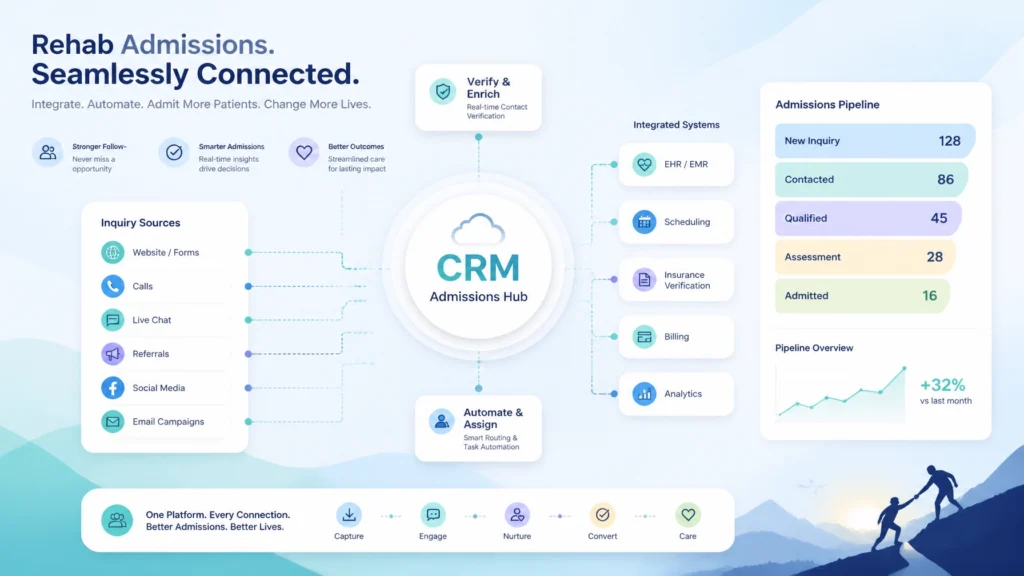
Picture this: It's Monday morning, and your admissions director walks into your office looking exhausted. Over the weekend, your digital campaigns generated twenty-five high-intent inquiries. But by the time your team manually sifted through voicemail logs, copied insurance details from web forms, and pasted them into your electronic health record (EHR) system, half of those prospective clients had already called a competing facility down the street.
If this scenario sounds painfully familiar, I know you’re struggling with a bottleneck that silently bleeds revenue from your addiction treatment center every single day. In an increasingly competitive landscape where major behavioral health groups spend millions on digital acquisition, the real differentiator isn't just how many leads you generate: it’s how seamlessly your data moves from the initial phone call to the clinical chart.
Without a robust rehab admission CRM integration, your facility is likely losing qualified admissions to slow handoffs and fragmented data silos. Let’s dive deep into why data flow dictates admissions success, how modern behavioral health tech stacks operate, and what actionable steps you can take today to fix your pipeline.
Table of Contents
- The Hidden Cost of Fragmented Intake Data
- What Is Rehab Admission CRM Integration?
- The Anatomy of a High-Velocity Admission Data Flow
- Performance Impact: Manual Entry vs. Integrated CRM Workflows
- Connecting Marketing Spend to Clinical Outcomes
- How Ads Up Marketing Helps Streamline Your Admissions Pipeline
- Conclusion & Next Steps
The Hidden Cost of Fragmented Intake Data
When a family is in crisis: searching desperately for alcohol or drug rehab options for a loved one: every minute counts. According to data highlighted by the Substance Abuse and Mental Health Services Administration (SAMHSA), speed to intervention is one of the single greatest predictors of whether a person successfully enters treatment.
Yet, many addiction treatment center owners operate with a profound disconnect between their front-of-house marketing and back-of-house clinical operations. You might be investing heavily in targeted Google Ads management to drive phone calls and form submissions, but if your intake coordinators are manually re-typing caller demographics into spreadsheets before entering them into your EHR (such as Kipu or Alleva), friction accumulates instantly.
So what's the consequence?
- Delayed Verification of Benefits (VOB): Insurance verification takes hours longer when details bounce between disconnected systems.
- Dropped Leads: Prospective clients experience cold transfers, missed call follow-ups, and unreturned texts.
- Blinded Marketing ROI: Your marketing team cannot attribute a closed admission back to the exact keyword or campaign that drove the call, making budget optimization a guessing game.
As noted by the National Association of Addiction Treatment Providers (NAATP), operational efficiency and ethical admissions practices go hand-in-hand. Facilities that streamline their administrative workflows protect both their financial sustainability and their ability to care for patients promptly.
What Is Rehab Admission CRM Integration?
To put it simply, a specialized rehab admission CRM integration bridges the gap between your front-end patient acquisition and your back-end clinical charting and billing systems.
Unlike generic customer relationship management tools, a behavioral-health-specific CRM (like Salesforce Health Cloud configured for addiction treatment, or industry-specific platforms) is built around the unique lifecycle of a rehab client. It tracks every touchpoint: from the first click on an ad or inbound phone call to the verification of benefits, pre-screen assessment, bed assignment, and final admission.
When properly configured, a true integration ensures that the moment your admissions coordinator clicks "Admitted" in your CRM, all essential demographic, insurance, and referral data automatically populates your EHR and billing systems. There is zero duplicate data entry, zero transcription errors, and zero wasted time.
The Anatomy of a High-Velocity Admission Data Flow
Let's break down how data should flow through a modern, high-performing treatment center tech stack:
1. Inbound Channels Feed the CRM Instantly
Every communication channel: whether it’s a phone call via dynamic number insertion, an AI intake chatbot, an SMS text message, or a website contact form: must feed directly into your CRM in real time. For instance, missed or abandoned calls should instantly trigger automated, HIPAA-compliant SMS recovery sequences while alerting your intake team.
2. Automated Pipeline Stages and SLAs
Once an inquiry hits the CRM, it enters a structured pipeline: Inquiry → Screening → eVOB → Prior Authorization → Scheduled → Admitted. Each stage has strict Service Level Agreements (SLAs) attached to it. If a lead sits in "eVOB Pending" for more than thirty minutes without movement, automated escalation rules notify your billing manager.
3. Bi-Directional EHR Sync
A one-way data push isn't enough. A robust integration requires bi-directional sync. When clinical milestones, level of care changes, or discharge dates are updated in the EHR, that data must flow back into the CRM. This allows your team to analyze long-term outcomes, measure length of stay by referral source, and power compliant alumni engagement campaigns.
Performance Impact: Manual Entry vs. Integrated CRM Workflows
To understand why facility owners are prioritizing technical infrastructure upgrades, review the performance comparison below. This data illustrates the operational and financial divergence between legacy manual workflows and fully integrated CRM environments.
| Metric | Manual Intake / Disconnected Systems | Integrated Rehab CRM Workflow |
|---|---|---|
| Speed to Lead Response | 45 minutes to 3 hours | Under 2 minutes (Automated + Instant Routing) |
| Data Transcription Accuracy | ~82% (High human error in VOB/Demographics) | 99.5% (Direct API transfer) |
| Admission Conversion Rate | 8% to 12% | 22% to 35% |
| Marketing Attribution Visibility | Low (Attribution stops at phone call) | Complete (First-click to revenue tracking) |
| Cost Per Acquisition (CPA) | High due to wasted ad spend and drop-offs | Optimized and significantly reduced |
When you look at these numbers, the business case becomes clear. Increasing your admission conversion rate from 10% to 25% without spending an extra dollar on advertising can completely transform your facility's bottom line. For more insights on financial optimization, explore our breakdown on how much rehab owners actually make.
Connecting Marketing Spend to Clinical Outcomes
If you are a facility owner or CFO, you need to know your exact return on ad spend (ROAS). But this still doesn't drill down into the deeper question: Which specific clinical cohorts and referral channels are driving sustainable long-term revenue?
According to research from the National Institute on Drug Abuse (NIDA), tailoring treatment approaches and understanding patient pathways significantly improves operational integrity and clinical success. By integrating your admission CRM with advanced conversion tracking, you stop guessing which marketing campaigns work.
You gain the ability to answer critical business questions instantly:
- Which insurance payers yield the cleanest authorization times and highest net collections?
- Which digital channels are bringing in clients who complete treatment vs. those who leave against medical advice (AMA)?
- How many minutes elapse between a prospective client's initial call and their bed placement?
Pinpointing these metrics allows you to eliminate wasted ad spend and scale the exact campaigns that bring right-fit clients through your doors.
How Ads Up Marketing Helps Streamline Your Admissions Pipeline
At Ads Up Marketing, we don't just build pretty landing pages or run generic ads. We specialize exclusively in digital marketing and growth infrastructure for addiction treatment centers and behavioral health facilities.
We know that driving traffic is only half the battle. If your intake team is bogged down by manual data entry and broken software handoffs, your marketing budget will leak profits. That is why our team works hand-in-hand with facility owners to audit, recommend, and optimize your entire acquisition ecosystem: from high-intent PPC management and custom web design to advanced conversion tracking and CRM workflows.
We combine decades of collective experience with over $100 million in PPC ad spend data to help independent and regional treatment centers compete and win against massive national conglomerates.
Conclusion & Next Steps
Your data flow is the lifeblood of your admissions department. When your phone systems, CRM, EHR, and marketing channels operate in harmony, your team can respond faster, verify benefits smoother, and admit clients with dignity and precision.
Are you tired of watching qualified inquiries slip through the cracks of a disconnected intake process? Let's fix your pipeline together. Call us today at 305-539-7114 or visit our contact page to schedule a confidential strategy session with our behavioral health marketing experts.