
INSIGHTS
Lifetime Value of Addiction Treatment Patients: Why Looking Beyond the First Bill Matters
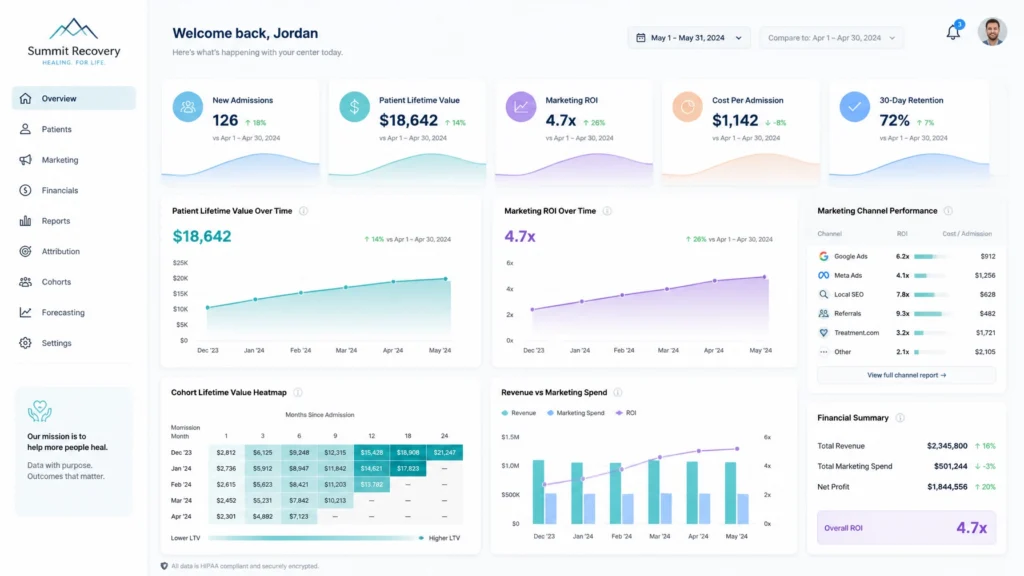
If you run an addiction treatment center or behavioral health facility, you already know the sinking feeling of looking at your monthly digital marketing invoice and wondering if every dollar spent on paid search is actually translating into full beds. You see a high cost per click, a fluctuating cost-per-admission, and you might be tempted to slash your ad budget because that first initial invoice or single detox episode doesn't instantly cover the heavy upfront acquisition costs.
I know you're struggling to balance rising operational overhead with competitive digital ad auctions dominated by national conglomerates. But stopping your marketing or evaluating success based solely on the first billing cycle is like judging a book by its prologue.
When you evaluate your facility through the lens of the lifetime value of addiction treatment patient, the entire financial equation shifts. Suddenly, high-cost clicks and competitive acquisition metrics start making profitable sense. Let’s break down why looking beyond the initial billing cycle is the single most important mindset shift for rehab owners and CFOs in 2026.
Table of Contents
- The Short-Sighted Trap of Episode-Only Marketing
- What Actually Makes Up the Lifetime Value of an Addiction Treatment Patient?
- Performance Impact: LTV vs. CPA Breakdown
- Connecting the Dots: Attribution and Continuing Care
- How to Maximize Patient LTV Without Compromising Ethical Standards
- Partnering with Experts to Scale Sustainable Growth
The Short-Sighted Trap of Episode-Only Marketing
Picture this scenario: Your facility acquires a client through a targeted paid search campaign. After factoring in management fees, ad spend, and intake overhead, your initial cost-per-admission sits around $7,500. The patient completes a 30-day residential detox and inpatient stay, generating a gross billing amount that leaves your net margin feeling a bit razor-thin for that month.
Panic sets in. You question your PPC management strategy and wonder if you should cut your budget.

So what’s the catch? Addiction and substance use disorders (SUD) are chronic conditions requiring a continuum of care, as emphasized by organizations like the Substance Abuse and Mental Health Services Administration (SAMHSA). When you measure success using only that first 30-day window, you completely ignore:
- Step-down Partial Hospitalization Programs (PHP) and Intensive Outpatient Programs (IOP)
- Ongoing outpatient therapy and psychiatric medication management (MAT)
- Alumni programming, family support groups, and sober living referrals
- Organic word-of-mouth referrals from recovering clients and their families
As highlighted by industry resources like the National Association of Addiction Treatment Providers (NAATP), facilities that view treatment as a multi-year healing journey rather than a one-off transaction unlock unprecedented financial and clinical stability.
What Actually Makes Up the Lifetime Value of an Addiction Treatment Patient?
To calculate the true lifetime value of addiction treatment patient, you must map out all subsequent episodes of care and ancillary revenue streams over a multi-year horizon: typically 2 to 3 years.
According to analyses by the National Institute on Drug Abuse (NIDA), long-term engagement in care drastically improves sustained recovery outcomes while simultaneously multiplying the economic utility of each admission.
Let's look at a realistic three-year revenue model for a single patient acquired through digital marketing:
- Initial Residential / Detox Stay: $20,000 gross revenue
- Step-Down PHP & IOP Services (3–6 months): $10,000 gross revenue
- Outpatient Therapy & Psychiatry (1–2 years): $5,000 gross revenue
- Alumni Events & Family Counseling: $3,000 gross revenue
- Peer & Family Referrals: Approximately $4,200 attributed value (based on a 15% referral rate)
Total gross revenue generated across three years reaches $42,200, compared to the initial single-episode revenue of just $20,000. When you factor in this comprehensive perspective, your marketing ROI looks entirely different.
Performance Impact: LTV vs. CPA Breakdown
To help executive leadership and facility owners visualize the contrast between traditional episode-based accounting and long-term lifetime value modeling, review the performance impact comparison table below:
| Metric Category | Traditional Episode-Only View | True Lifetime Value (LTV) View |
|---|---|---|
| Time Horizon Assessed | 30 Days (Initial Admission) | 2 to 3 Years (Continuum of Care) |
| Average Cost-Per-Admission (CPA) | $7,500 | $7,500 |
| Average Gross Revenue per Patient | $20,000 | $42,200 |
| Gross Margin After Care Costs | $10,000 | $21,100 |
| Calculated Marketing ROI | 33% | 181% to 503% |
| Strategic Decision-making | Restrict ad spend; fear of high CPL | Scale high-intent campaigns; invest in retention |
As you can see, when you rely solely on the first bill, your perceived ROI is severely understated. By understanding the true lifetime value of addiction treatment patient, you gain the financial confidence to bid competitively, optimize your SEO and content marketing, and capture high-intent search traffic before your competitors do.

Connecting the Dots: Attribution and Continuing Care
Of course, tracking LTV is impossible if your data is siloed. If your electronic health records (EHR) don't speak to your customer relationship management (CRM) platform, and your marketing team doesn't know which Google campaign originally drove an alumni member back for outpatient care six months later, you're flying blind.
This is why robust attribution mapping is critical. You need unified patient identifiers that track an individual through every phase of healing: from their very first phone call to your intake department all the way to alumni check-ins.
Furthermore, your admissions and intake teams play a monumental role in protecting this lifetime value. If your call center drops incoming inquiries or lacks empathetic follow-up protocols, you leak revenue before a patient even steps foot through your doors. Review our deep-dive on why your rehab call center might be your biggest revenue leak to ensure your front-end operations match the quality of your clinical care.
How to Maximize Patient LTV Without Compromising Ethical Standards
Maximizing lifetime value is never about pushing unnecessary services or exploiting vulnerable situations. In behavioral health, ethical integrity and financial sustainability go hand-in-hand. The best way to increase LTV is to provide exceptional, patient-centered clinical care that naturally encourages clients to complete their step-down continuum and stay connected to your alumni network.
When you build a brand anchored in trust, transparency, and compassionate web design: moving away from generic corporate templates: your prospective clients feel understood from the moment they land on your website. Pair this with a high-converting admissions process and you create a virtuous cycle: better clinical retention leads to higher lifetime value, which funds smarter marketing to help even more families in need.

Partnering with Experts to Scale Sustainable Growth
Navigating the complexities of digital acquisition, regulatory compliance, and multi-touch attribution in the addiction treatment sector requires specialized expertise. At Ads Up Marketing, we don't do cookie-cutter digital marketing. We work exclusively with addiction treatment centers and behavioral health facilities, leveraging decades of collective experience and over $100 million in managed PPC ad spend data to help you achieve predictable, sustainable growth.
If you're ready to stop guessing at your marketing ROI and start harnessing the true lifetime value of addiction treatment patient, let's talk. Call us today at 305-539-7114 or visit our contact page to schedule your custom revenue and LTV audit. Let's build a growth strategy that honors your mission and fills your beds for the long haul.