
INSIGHTS
Rehab Website Visual Trust Signals: What Families Look For First
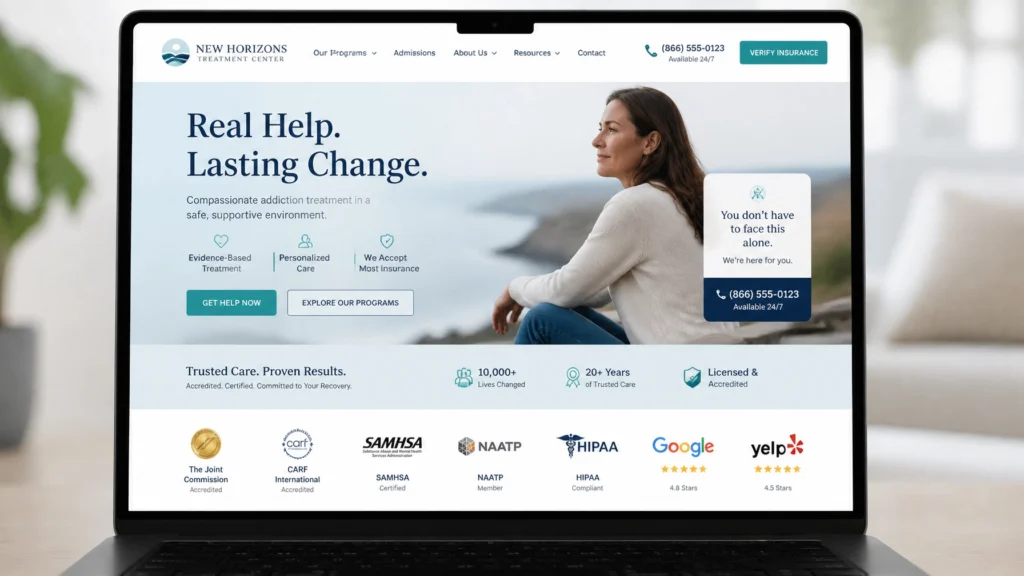
When a family is sitting at their kitchen table late at night, overwhelmed, exhausted, and desperately searching for an addiction treatment center for someone they love, every second counts. Within five to ten seconds of landing on your website, they are making a deeply emotional, high-stakes decision: Can I trust these people with my loved one's life?
If your website looks cluttered, outdated, or lacks immediate validation, that parent or spouse will click the back button and call your competitor instead. It's a brutal reality of modern behavioral health marketing.
So what actually stops that bounce? It isn't just a catchy headline or fancy copywriting. It comes down to rehab website visual trust signals: the instant visual cues that communicate safety, legitimacy, clinical competence, and deep empathy before a single word is read.
Let's walk through what families are looking for first, why these elements matter for your admissions pipeline, and how you can optimize your site to turn anxious visitors into confident callers.
Table of Contents
- The 6-Second Window: Why Visual Trust Makes or Breaks Admissions
- 1. Accreditation and Licensing Badges Above the Fold
- 2. Authentic Staff and Facility Photography (No Stock Photos)
- 3. Visible Clinical Leadership and Credentials
- 4. Security, Privacy, and HIPAA Assurance Near CTAs
- Performance Impact: Visual Trust vs. Bounce Rates
- How Ads Up Marketing Can Help Transform Your Digital Presence
The 6-Second Window: Why Visual Trust Makes or Breaks Admissions {#the-6-second-window}
I know you're struggling to keep your beds filled while competing against massive private equity-backed facilities with bottomless ad budgets. You’ve invested heavily in Google Ads and search engine optimization, getting qualified traffic to your domain. But traffic doesn't equal admissions if visitors bounce immediately.
When families arrive in crisis, their psychological defenses are running at maximum capacity. They have been burned by sketchy referral mills, predatory lead-gen sites, and facilities that overpromise and underdeliver.
"When a family looks at your website, they aren't just evaluating a business: they are looking for a lifeline. If the visual cues feel clinical, sterile, or fake, doubt creeps in instantly."
According to guidelines from authorities like SAMHSA and industry insights from the NAATP, establishing immediate transparency is non-negotiable in addiction treatment. When your visual layout answers unvoiced fears within seconds, your conversion rates climb dramatically.

1. Accreditation and Licensing Badges Above the Fold {#accreditation-and-licensing}
The very first thing a sophisticated family member scans for: often subconsciously: is proof that your facility is legitimate and regulated.
If your state licensing, Joint Commission (JCAHO), CARF, or LegitScript seals are buried on a footer page three clicks deep, you are missing an enormous opportunity. These badges must be visible above the fold on your homepage.
- Place recognizable seals right beside your primary phone number and main call-to-action button.
- Keep them crisp and clickable, allowing mobile users to tap and verify accreditation status instantly.
- Highlight specialized certifications (such as dual-diagnosis endorsement or medication-assisted treatment oversight) where relevant to your program offering.
When visitors see trusted industry standards right at the top of the screen, the friction of reaching out drops significantly.
2. Authentic Staff and Facility Photography (No Stock Photos) {#authentic-staff-and-facility}
Nothing screams "generic lead broker" faster than a smiling stock-photo model holding a coffee cup in front of a fake, sun-drenched mountain range.
Families can smell stock photography a mile away. When they see overly polished, manufactured images of people who clearly don't work at your facility, it triggers immediate skepticism.
- Show your real campus: High-definition, well-lit photos of your actual common areas, serene outdoor spaces, comfortable patient rooms, and clean dining facilities reassure families about physical safety.
- Introduce real team members: Feature candid, professional photos of your nurses, therapists, and techs interacting with clients in a supportive, dignified manner.
Investing in professional custom photography through a dedicated Website Design strategy pays for itself with the very first admission it secures.

3. Visible Clinical Leadership and Credentials {#clinical-leadership}
Who is actually going to be taking care of my son or daughter? That is the overriding question in every parent's mind.
If your "Our Team" page consists of first names and vague titles with no credentials, you leave too much room for doubt. Modern behavioral health consumers demand transparency regarding clinical oversight.
- Display medical and clinical director bios prominently, complete with full names, degrees (MD, PsyD, LCSW, LMFT), and years of specialized experience in addiction medicine.
- Link bios directly to treatment pages, showing families that evidence-based modalities are backed by certified professionals.
- Maintain human connection by pairing clinical credentials with warm, approachable headshots rather than intimidating, stern portraiture.
4. Security, Privacy, and HIPAA Assurance Near CTAs {#security-and-privacy}
Reaching out for help with substance use disorder is one of the most vulnerable moments in a person's life. Fear of exposure, legal worries, and privacy concerns frequently stop people from filling out contact forms.
This is why visual trust signals must extend directly to your conversion points.
- Add HTTPS/SSL indicators and padlock icons directly next to inquiry forms.
- Include explicit privacy microcopy such as "100% Confidential. HIPAA Compliant. We never sell your data." right beside the submit button.
- Use secure blue and green color palettes which psychological studies consistently link to feelings of safety, tranquility, and medical authority.

Performance Impact: Visual Trust vs. Bounce Rates
To understand how visual trust directly impacts your center's bottom line and admissions volume, let's look at how strategic design changes alter user behavior on addiction treatment websites:
| Website Element / Strategy | Without Visual Trust Signals | With Optimized Visual Trust Signals |
|---|---|---|
| Mobile Bounce Rate | 68% – 82% (High drop-off on first view) | 34% – 45% (Engaged, longer session duration) |
| Form Completion Rate | 1.8% – 2.5% | 5.2% – 8.1% (Higher confidence to submit) |
| Call-Through Rate from Hero | Low (Visitors hesitate to call) | High (Direct calls via prominent verified buttons) |
| Perceived Facility Legitimacy | Questioned due to stock photos & hidden licenses | Immediately validated by real staff & JCAHO seals |
As you can see, minor adjustments to your visual hierarchy yield major improvements in lead acquisition cost and overall facility profitability. For deeper insights into operational financial metrics, review our breakdown on how much rehab owners actually make.
How Ads Up Marketing Can Help Transform Your Digital Presence
At Ads Up Marketing, we don't build generic websites: we build specialized, high-converting digital ecosystems exclusively for addiction treatment centers and behavioral health facilities. We know the unique compliance hurdles, the competitive pressures, and what families desperately need to see when they land on your pages.
Whether you need a complete website redesign, targeted Drug Rehab Marketing campaigns, or an audit of your current conversion bottlenecks, our team of industry veterans is here to help you get noticed and fill your beds.
Ready to increase your admissions and elevate your online credibility? Let’s talk strategy today. Call us right now at 305-539-7114 or contact our team online. Let’s help more families find the healing they deserve.