
INSIGHTS
Attribution Mapping: Knowing Exactly Which Ad Spend Resulted in a Bed
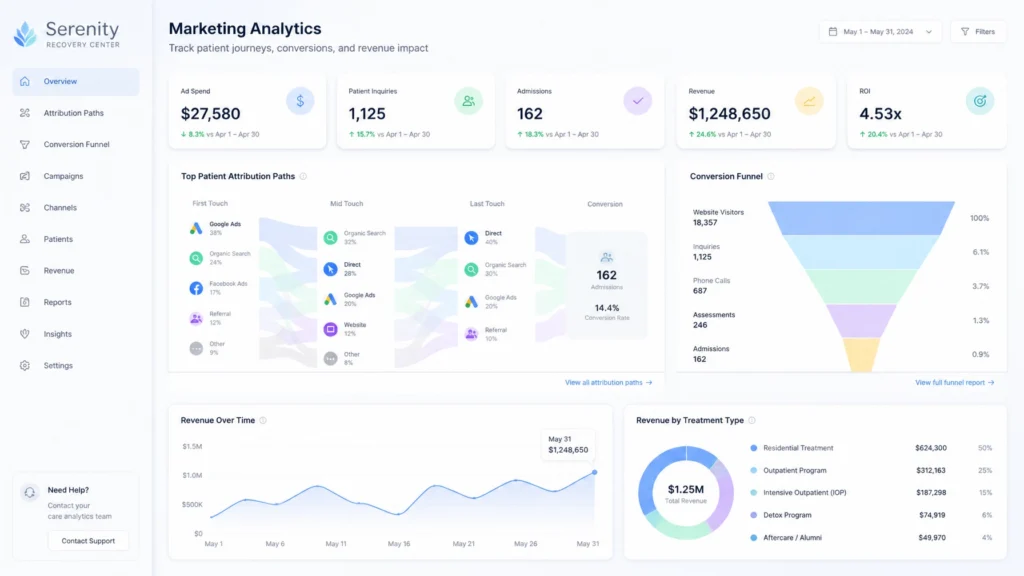
Let’s be honest for a moment. If you run an addiction treatment center or behavioral health facility, you’ve probably asked yourself this exact question at the end of every month: "We spent twenty thousand dollars on digital ads this month, but how many beds did those specific dollars actually fill?"
If your marketing report shows a comforting graph of "clicks," "impressions," and "form fills," but you still can’t draw a straight line from your ad spend to a verified admission sitting in a room, you are flying blind. In today's hyper-competitive rehab landscape, where large private-equity-backed facilities dominate search engines, guessing where your patient admissions come from is a luxury your budget simply cannot afford.
At Ads Up Marketing, we talk to facility owners every single week who are pouring money into PPC and SEO without knowing their true cost per acquisition. That’s why mastering attribution mapping for rehab centers is no longer just a technical exercise; it’s the ultimate survival strategy for your facility's profitability.
Table of Contents
- The Real Problem: Why Traditional Metrics Lie to Rehab Owners
- What Is Attribution Mapping and Why Does It Matter?
- Building Your Rehab Tracking Stack: From First Click to Completed Admit
- Performance Impact: Single-Touch vs. Multi-Touch Attribution
- How to Connect Marketing Data to Your Admissions CRM
- Frequently Asked Questions
The Real Problem: Why Traditional Metrics Lie to Rehab Owners
Picture this scenario: You look at your Google Ads dashboard. It tells you Campaign A generated 45 conversions last month. You pat yourself on the back, keep the budget steady, and move on. But when you check your actual census data, your residential beds are under capacity, and your finance director is sweating over the P&L statement.
Why does this disconnect happen? Because in behavioral health, a "conversion" online is rarely a completed patient admission. A family member in crisis might click a paid search ad, call your intake line from their mobile phone, speak with an admissions coordinator, check insurance eligibility (VOB), and finally admit three days later after visiting your website twice more via organic search.
If your analytics tool only credits the very last click, or worse, counts a phone ring as a confirmed patient, you will inevitably cut the exact campaigns that started those long, complex patient journeys. To understand how complex these pathways can be, take a look at our deep dive on tracking the patient journey and attribution models.
"When you optimize your marketing for phone calls and form fills instead of actual beds filled, you end up buying expensive traffic that looks great on paper but leaves your facility half-empty."
What Is Attribution Mapping and Why Does It Matter?

Attribution mapping is the practice of identifying every single touchpoint a prospective patient or their family encounters before making the decision to enter your facility. Instead of giving 100% of the credit to the last ad they clicked, attribution mapping distributes credit across the entire journey, from the initial educational search on SAMHSA or NIDA to the final brand search that preceded the admission call.
According to industry insights published by organizations like the National Association of Addiction Treatment Providers (NAATP), facilities that implement rigorous attribution analytics typically see a 20% to 35% reduction in wasted ad spend within the first ninety days.
When you know exactly which campaign, keyword, or content piece resulted in a bed, you can reallocate capital away from dead-end clicks and double down on what genuinely fills your rooms. For broader insights on setting realistic financial benchmarks, explore our guide on benchmarking your success and realistic ROI in 2026.
Building Your Rehab Tracking Stack: From First Click to Completed Admit
Because behavioral health decisions are deeply personal and urgent, often driven by phone calls rather than online checkout forms, your tracking infrastructure must be purpose-built for the addiction treatment industry.
Here is what a robust, HIPAA-compliant attribution stack looks like:
- Dynamic Number Insertion (DNI): Automatically changes the phone numbers displayed on your website based on how the visitor arrived (e.g., Google Ads vs. organic search vs. social media). Every phone call is instantly tagged to its exact source.
- UTM Parameter Discipline: Every single digital campaign, email, and social post must be tagged with precise UTM parameters so your web analytics tool never drops the referral source.
- Offline Conversion Import (OCI): Feeding your CRM admission statuses back into your ad platforms. When a lead turns into a verified admission, Google and Meta algorithms learn which specific user profiles actually get treatment, rather than just optimizing for cheap form fills.
- Granular Call Center Integration: Ensuring your admissions staff logs lead dispositions accurately. To understand how crucial call handling is to your bottom line, read our analysis on the hidden cost of missed calls.
Ready to audit your current tracking setup and find out where your marketing dollars are leaking? Let our experts help you build a bulletproof analytics framework. Call us today at 305-539-7114.
Performance Impact: Single-Touch vs. Multi-Touch Attribution
To see why attribution mapping changes everything, let's look at how different attribution models allocate credit and revenue for a typical residential treatment center spending $50,000 monthly on marketing.
| Attribution Model | Top Discovery Source Credit | Closing Source Credit | Resulting Strategy & Risk |
|---|---|---|---|
| Last-Click Attribution | 0% | 100% | Over-invests in branded search and remarketing; starves top-of-funnel SEO and educational PPC campaigns. |
| First-Click Attribution | 100% | 0% | Over-invests in broad awareness channels; ignores the crucial mid-funnel content that actually drives decisions. |
| U-Shaped Multi-Touch | 40% (First) + 40% (Last) | 20% (Middle touches) | Balanced view; honors both the initial discovery and the final conversion call. Highly recommended for rehab centers. |
| Data-Driven Attribution | Dynamic machine learning | Dynamic machine learning | The gold standard; assigns fractional credit based on historical admission data across all touchpoints. |
As the table shows, relying solely on last-click attribution can trick you into cutting your best awareness campaigns, while a multi-touch or data-driven approach gives you the clarity needed to maximize your PPC Management and SEO Services ROI.
How to Connect Marketing Data to Your Admissions CRM

Closing the loop requires bridging the gap between your marketing agency and your internal admissions team. Too often, marketing data lives in Google Analytics while admission data lives in a proprietary CRM or EMR.
When these systems are siloed, your marketing team is optimizing blindly. By integrating your admission CRM with your marketing pixel infrastructure, you unlock powerful capabilities:
- Cost Per Admission (CPA) Clarity: Knowing that your true CPA across all channels averages $2,500, but specific high-intent keyword groups bring it down to $1,400.
- Insurance VOB Filtering: Tracking which ad campaigns bring in inquiries with verified private insurance versus those that result in unfunded or unqualifiable calls.
- Pivoting in Real-Time: Using data-driven dashboards to shift budget mid-month when certain programs (like Detox vs. Outpatient) need immediate census boosts.
If your web presence needs a structural overhaul to support seamless CRM integration and patient conversion, our Web Design and Content Creation team specializes in building high-performing, compliant digital experiences for treatment centers.
Let’s stop guessing and start measuring what matters. If you want to know with absolute certainty which campaigns are filling your beds and driving sustainable revenue, we’re here to help. Reach out to Ads Up Marketing at 305-539-7114 to schedule your comprehensive attribution audit today.
Frequently Asked Questions
What is attribution mapping in addiction treatment marketing?
Attribution mapping is the process of tracking and assigning credit to every touchpoint (such as a Google search, social media ad, or phone call) that a patient or family member interacts with before completing an admission at your rehab facility.
Why is last-click attribution misleading for rehab centers?
Because seeking addiction treatment is a complex, multi-step journey often initiated by an educational search or social media ad and finalized days later via a phone call. Last-click attribution only gives credit to the very final interaction, ignoring the crucial top- and mid-funnel marketing efforts that started the relationship.
How does call tracking tie into attribution mapping?
Call tracking uses dynamic number insertion (DNI) to display unique phone numbers to visitors based on how they arrived at your website. This allows your facility to attribute incoming calls, and the resulting admissions, directly to specific PPC campaigns, SEO keywords, or referral sources.
Is patient attribution data HIPAA compliant?
Yes, provided your marketing agency and technology stack utilize HIPAA-compliant analytics tools, secure CRMs, and properly configured tracking mechanisms that do not capture or expose Protected Health Information (PHI) in public analytics platforms.